Putin’s economic lifeline is diminishing – and the shadow fleet is being hunted down
Strikes from across the border continue to bombard oil refineries, tankers and warehouses in Russia as Ukraine’s latest offensives continue to successfully hit targets beyond enemy lines.
Kyiv said two Russian oil refineries were hit on Friday night, with unverified videos showing one site ablaze.
The Ukrainian operation against the Russian shadow fleet also continued in the Black Sea and Sea of Azov and has taken out hundreds of tankers, including a dozen in the past week.
It comes as Vladimir Putin has tried to tighten his grip on public information after a wave of attacks on the country’s equivalent of Amazon.
Around 20 Wildberries warehouses, known as “Russia’s Amazon”, have been struck by Ukrainian drones in less than three weeks, killing at least 13 people.
Attacks on shadow fleet and oil refineries
A special Ukrainian drone squad says it has hit 12 Russian shadow fleet ships in the Black Sea over the past week.
The attacks occurred as part of Operation Molochka, in which Kyiv has tried to choke Moscow out of the Black Sea and neighbouring Sea of Azov.
In total, the Magyar’s Birds Brigade, one of the drone squads, said it had struck 218 shadow vessels since the beginning of the operation in July.
For years, the Sea of Azov was out of reach of Ukraine’s drones, allowing Russia to use Crimea as a launchpad for attacks on the country’s south and to export the fuel that props up its war machine.
Now, advances in Ukraine’s drone technology have opened up new possibilities.
Back in June, Unmanned Systems Forces commander Robert Brovdi – who uses the call sign Magyar – told Reuters “we will isolate Crimea in the near future”, as his forces look to sever Russian vessels from the region.
Videos also emerged on social media, though unverified, appearing to show flaming oil towers pumping out huge plumes of acrid grey smoke – reportedly the Syzran oil refinery in Samara, south-western Russia, 683 miles (1,100km) from the border with Ukraine.
In southern Russia, Kyiv said it had targeted the Ilsky oil refinery in Krasnodar Krai.
The Ukrainian armed forces’ Telegram account wrote “the facility is one of the key sites in the Samara region’s oil refining industry and supplies fuel, in particular, to meet the needs of the Russian armed forces”.
These join several recent attacks on major Russian oil refineries as Ukraine ramps up its efforts to take down key infrastructure, war production sites and choke out Russian ships in the Crimean peninsula.
In combination, the strikes have hit one of the Russian economy’s main lifelines and sparked fuel shortages across the country.
This is part of Ukraine’s strategy: crippling Russia’s energy supply to disrupt its military machine. They not only inconvenience Russian people and help turn them against the war, but strikes on oil refineries also reduce the profits the Kremlin can spend on the military.
Fears Putin will challenge Nato
This comes as US intelligence warned Russia could be plotting an attack on a Nato country to try and test the waters on the alliance’s commitment to Article 5, The Wall Street Journal reports.
Article 5 of the treaty states that an armed attack against one Nato member shall be considered an attack against them all.
US officials set out several possible scenarios, including escalating attacks in the Balkans or Poland, or cyber attacks, if Putin is looking to expand the war outside of Ukraine.
Kyiv’s newest MP, Mykola Davydiuk, told The i Paper he believes Putin may attack Nato forces in border regions of Sweden and Estonia as a form of provocation.
“It’s a war against Nato, the West and democratic systems. Russia is not a partner with whom you may trade gas and oil because it’s cheap. It’s the most expensive because you pay not only in money, but also with blood.”
Meanwhile, exiled Russian opposition leader Ilya Yashin agreed Putin will pose a threat to the continent as long as he remains in power.
Already, some have expressed suspicion that Russia could have been behind the German drone bomb which shut down a runway at Leipzig airport on Tuesday night.
The device was spotted and dispatched by a bomb-disposal robot before it could do any damage, but it was close to two Ukrainian cargo planes emblazoned with the yellow and blue national flag.
German authorities do not yet know who was behind the bomb, but Alexander Dobrindt, Germany’s interior minister, speculated the airport drone bomb “may involve foreign powers”.
Russia retaliates for long-range strike damage
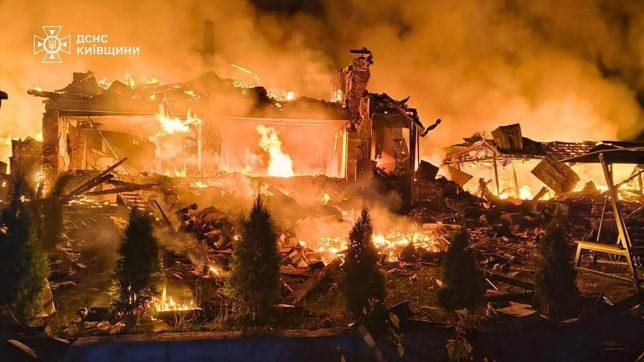
Moscow targeted Ukraine with yet another barrage of attacks on Friday night, launching six missiles and 151 drones, according to the Ukrainian government.
A total of 12 people were killed, including at least one child. Another 80 people were injured as Russia sought payback for Ukraine’s increasing capability to hit targets hundreds of missiles behind the Russian border.
This summer, the war has entered a new phase. Experts have pointed out that Ukraine has moved to a far more offensive tactic by bringing the war to Russian soil, often evading anti-missile capabilities and infuriating the Kremlin in the process.
Deadly attacks in Kyiv’s Brovary district targeted a major long-range missile and drone factory which is vital to Kyiv’s deep strike abilities.
This was a direct target to try and stymie the steady flow of Ukrainian projectiles into Russia.
The Fire Point factory which was reportedly hit is part of Ukraine’s leading arms company and one of the production sites for the Flamingo cruise missile.
The facility makes roughly 100 Flamingo missiles daily, each capable of carrying up to 1,150kg of explosives.
They were used in the Ukrainian attack on a Russian military factory in Cheboksary in June – and this latest assault by Moscow may have been a direct rebuke for that damage.