Norway’s King Harald dies, the country’s most popular monarch and a symbol of welfare and freedom
The sovereign has consistently enjoyed the support of around 85% of his fellow citizens since ascending to the throne in 1991. Only the recent scandals involving Mette-Marit and her son Marius have seriously damaged the institution’s image.
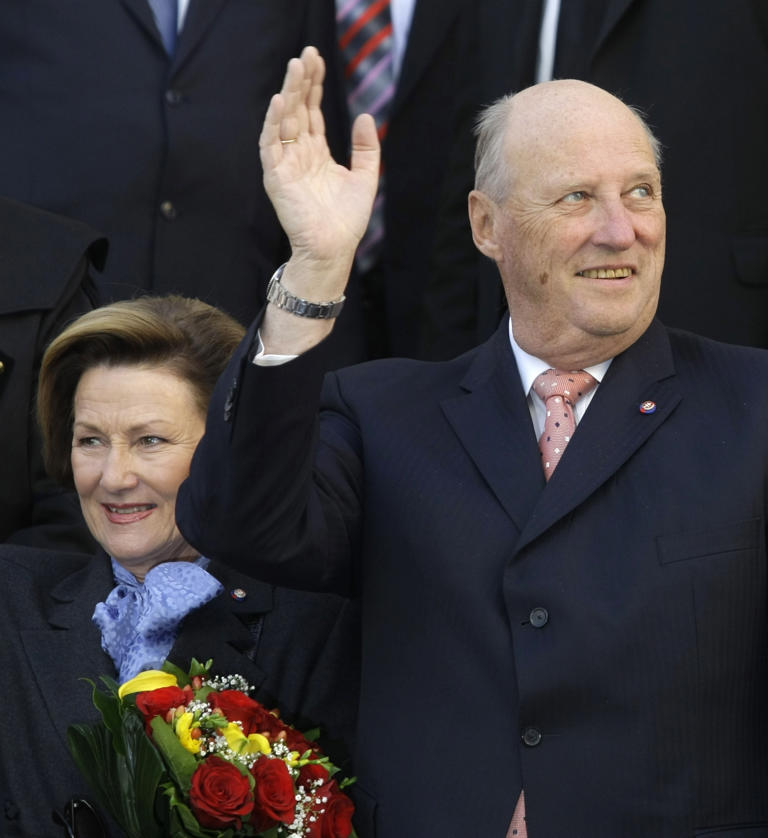
King Harald V of Norway, until now the dean of European monarchs, passed away on Friday at the age of 89, as announced by the Royal Palace.
“With deep sadness, we announce that His Majesty King Harald left us today. King Harald passed away peacefully at the national hospital (Rikshospitalet) on Friday, August 28, at 6:35 a.m.,” the Palace wrote in a statement.
Harald’s intense life, as the third monarch in the modern history of the Scandinavian country since its independence in 1905, was marked by a heartbreaking historical event of which he likely had no memory. Because when on April 9, 1940, the German troops of the Third Reich invaded Norway, Harald was just three years old – born in Asker, a current suburb of Oslo, on February 21, 1937. And yet, that day would determine the future of the dynasty and undoubtedly his reign several decades later.
At that time, his grandfather Haakon VII occupied the Norwegian throne, having been proclaimed sovereign by popular choice with the newly formed country after the peaceful dissolution of the Kingdom of Sweden and Norway. Haakon VII did not hesitate for a moment in the face of the Nazi boots’ advance. He risked his life by opposing the invasion head-on and flatly rejected Berlin’s plans, as he refused to recognize the collaborator Vidkun Quisling as prime minister, the puppet politician who served as minister-president supported by the occupying forces during the so-called National Government. Haakon VII had the support of the democratic government and the main forces of the Parliament, and hastily improvised an evacuation plan to prevent the royal family from falling into the hands of the Nazi army.
The monarch and his Heir, the future Olav V, managed to escape to London, where they remained until the capitulation of Hitler’s regime, leading the resistance government in exile. On the other hand, Harald’s mother, the then Crown Princess Marta, managed to escape on the same night of April 9, 1940, to neighbouring Sweden, her home country, taking her three young children with her: the princesses Ragnhild and Astrid, and Prince Harald, for whom at his young age, all of that must have been little more than an adventure. Later, the four settled in the United States, as a safer refuge, invited by President Franklin D. Roosevelt, where they spent the rest of the Second World War.
Harald, as a young man, with his father and his grandfather, King Haakon VII.Getty
When, on May 8, 1945, the entire royal family disembarked at the Honnørbrygga, the Honour Quay of the port of Oslo, a crowd of citizens welcomed them enthusiastically, happy about Hitler’s defeat, and acknowledging the heroism of their dynasty and above all of their firm commitment to democracy and freedoms, unlike what happened with some other royal families who fraternized with Nazism.
From there, a communion was established between the Norwegian people and the Monarchy, as a symbol of pluralism, national sovereignty, and individual rights, which continues to this day. Harald grew up inspired by these principles deeply ingrained in the Norwegian Crown. And when it was his turn to assume the throne, he did not hesitate to demonstrate his strong democratic convictions and the importance in our times for European kings to be both faithful guarantors of the Constitution and national unity, as well as antidotes against all forms of extremist populism.
Harald V has fulfilled his duties as the parliamentary monarch of Norway so well that throughout his reign, he has maintained almost unchanged popularity ratings close to 85%, making him not only the king with the most support from his fellow citizens across the continent but also probably one of the most backed heads of state globally.
Harald, as mentioned, was the only son of the then Crown Prince Olav and Marta. Although his two sisters had already been born when he came into the world, the Fundamental Law stipulated that only males could ascend to the throne, so he received the education befitting someone destined to reign one day. Until the Nazi invasion, the young prince’s early years unfolded within the peaceful walls and gardens of Skaugum, the official residence of the Heirs at that time, as it would later be for Haakon and Mette-Marit.
Upon returning from the American exile, once the embers of the terrible Second World War had cooled, Harald, who was already eight years old, began his education at Smestad School in Oslo. His parents refused to have him educated by tutors at the Palace and, conversely, wanted the prince to have an education similar to boys his age. Another choice that naturally shaped his personality and helped him empathize with the average Norwegian over time. Subsequently, he entered the Norwegian Cavalry Officer Candidate School and completed his military training at the Military Academy in 1959. After completing his mandatory military service, he moved to Oxford to study from 1960 to 1962, focusing on social sciences, history, and economics.
Harald and Sonja, at the religious ceremony for their coronation, at the cathedral of Trondheim, in June 1991.Getty
His university years came as the Crown Prince. Because his grandfather Haakon VII passed away in the autumn of 1957, automatically placing his father, Olav V, on the throne. This meant that the future king had to suddenly assume an intense institutional agenda, with milestones such as his first official visit abroad in 1960 to the United States, which had welcomed him so well as a child, on this occasion to mark the 50th anniversary of the American-Scandinavian Foundation.
Throughout the three decades he spent as the Heir, one of Harald’s main functions in service to the Crown and the nation was to serve as a high commercial delegate, facilitating the access of the Norwegian industry to the international market on numerous foreign trips.
Sports and Nature Enthusiast
Sports and nature were two of his passions during his youth. He participated in three Olympic Games, in 1964, 1968, and 1972, in the sailing discipline. Over time, he would preside over the Norwegian Sailing Association and become a member of the International Yacht Racing Union. He took part in national and international regattas until announcing his retirement from competitive sailing in 2022, at the age of 85. He was also one of the promoters of the Norwegian branch of WWF (World Wide Fund for Nature). Environmental preservation has been one of the pillars of his reign, at a time when he has witnessed how climate change is affecting the landscape of his country.
At the end of the 1960s, Norway, which had been a modest nation whose main resources came from the sea, discovered its first giant oil and gas fields in the North Sea. The State established the National Oil Fund. By the 1990s, the Norwegian Government Pension Fund Global was created to save the income from gas and oil. We are talking about the largest sovereign wealth fund in the world, exceeding two trillion dollars, which supports the national economy’s health and invests in multinational projects. Considered one of the top 10 wealthiest countries per capita, Norway boasts an enviable social model where its royal family leads in what many analysts define as the “Welfare Monarchy,” a modern stage of the institution that prioritizes inclusion initiatives, social work, and extending rights of the new generation. In the political realm, the Crown in the 10 parliamentary monarchies in Europe is characterized by acting as a neutral moderating power above partisan struggles, aiming to be perceived as useful by addressing social concerns as its main raison d’être, as expressed by historian Frank Prochaska. Harald has been a particularly committed king in this regard, explaining the high popularity he has enjoyed as mentioned before.
Courtship and Marriage with Sonia
There were alleged relationships and a list of European princesses who were reportedly attempted to be matched with the young Harald, including Irene of Greece, Tatiana Radziwill, or Benedicta of Denmark. Let’s not forget that the Heir with Viking features apparently was the first love of Queen Sofia, who eventually married Juan Carlos of Bourbon and became the Spanish Consort.
However, Harald was part of a sentimental story that also left its mark on the institution. In the summer of 1959, at the age of 22, he met Sonja Haraldsen, and what both described as “love at first sight” blossomed. They met at a social event thanks to a mutual friend. From there, their closest circle helped them keep their courtship secret for years. The relationship, which was not well-received at the Palace because she was a commoner, was tested while he studied in Oxford and she was conveniently sent away to Switzerland. But even so, neither of them was willing to give up on their feelings. In 1964, British and Norwegian media published a photo of Sonja, uncovering the romance. This caused a social earthquake and a serious crisis within the institution. Neither the then King Olav nor the State Council accepted it. “I had very conflicting feelings, I loved Sonja Haraldsen, but I also felt guilty towards my father and towards Norway,” explained King Harald over time.
The Heir needed Parliament’s consent to marry. It has always been said that Harald even threatened his father with renouncing his dynastic rights if he couldn’t marry the woman he loved and even with remaining single forever, which would have also brought succession problems. Media outlets like Presse-Norg warned that a morganatic marriage would be the end of the Monarchy. “There are more important things at stake than the heart,” harsh editorials pointed out.
But Harald and Sonja were patient, convinced that time would play in their favor. After eight years of courtship, in 1967, King Olav began discussing the matter with the Government led by Prime Minister Per Borten and agreed to meet the young woman. Finally, Parliament and the Executive chose to let the decision rest solely with the monarch, and he eventually gave in. The wedding took place in August 1968 at Oslo Cathedral. Harald became the first Crown Prince of one of the major European Monarchies to have a morganatic marriage, paving the way for many others to come, such as his own son Haakon, Felipe of Spain, Frederik of Denmark, and many more, turning that once anomalous exception into the rule.
In 1971, the royal couple’s first daughter, Princess Märtha Louise, was born, followed by Haakon two years later. The succession was thus secured.
In June 1990, King Olav’s delicate health condition led to Harald being appointed regent. A few months later, in January, the elderly monarch passed away. His son swore to the Constitution before Parliament on January 21, 1991, being proclaimed the new sovereign of Norway in that act.
Modernization of the Crown
In his early years of reign, Harald undertook profound modernization and rationalization reforms in a Monarchy with customs and traditions already much more modest than others like the Swedish or British. The institution enjoyed notable stability and managed to navigate scandals well until the controversial announcement in 2001 of the engagement of Crown Prince Haakon to Mette-Marit Tjessem Høiby, a young woman of modest origin and single mother of a four-year-old, Marius. The press described the future princess as a woman with a “turbulent past,” which she herself described as “wild” and of which she confessed to being “regretful.” Also, the other daughter of the kings, Princess Märtha Louise, caused some issues for the Crown, first with her marriage to the eccentric writer Ari Behn, and especially later with her private business ventures alongside her new partner, the shaman Durek Verrett, incompatible with what the dynasty represents, leading Harald to remove his daughter from the Monarchy’s representation duties.
All these matters, however, pale in comparison to the more recent scandals that have plunged the institution into its most significant crisis since Norwegian independence. On one hand, the arrest and recent conviction of the princess consort’s illegitimate son, Marius, found guilty of serious crimes such as rape, abuse of a former girlfriend, severe bodily harm, and threats. On the other hand, the case that completely shattered the image of Mette-Marit herself, her deep friendship with the pedophile businessman Jeffrey Epstein, an issue that in the eyes of most Norwegians makes her unsuitable to become queen.
“I stick to what I have always said, I have sworn an oath to Parliament, and it lasts a lifetime,” declared Harald in 2024 to make it clear that he would never abdicate, addressing the debate sparked by other abdications like the one carried out by Queen Margrethe II of Denmark. There have always been experts attributing the king’s firm decision to the abyss that would represent for the Crown if he had stepped aside during the most delicate reputational moment. In fact, Norwegians have continued to fully support the elderly monarch, regardless of his health problems in recent years hindering him from assuming his responsibilities with full vigor.
“A great man” with auctoritas
Surely what must have caused him the most pride is that, beyond always being supported as a king, among Norwegians there is a widespread and even more important conviction that he was “a great man.” He quickly earned that crucial aspect for any parliamentary monarch, which is auctoritas. One of his most memorable speeches, from 2016, served to demonstrate to what extent the Monarchy maintains the ability to stand as a glue and national symbol. After bitter debates and xenophobic events in the Nordic country, he delivered the most applauded speech of his reign, a hymn to tolerance that once again placed the Crown at the forefront of protecting minorities and promoting racial, religious, and sexual respect: “Norwegians are people from the north, center, and south of the country. But Norwegians are also those who have immigrated here from Afghanistan, Pakistan, and Poland, from Sweden, Somalia, and Syria. Norwegians believe in God, in Allah, in everything and in nothing. There are Norwegians who like football and Norwegians who like handball. But many prefer to stay on the couch. Norway is boys who love boys, girls who love girls and boys and girls who love each other. In other words, Norway is you. Norway is us. Despite all differences, we are one people.”
Harald, in tandem with an exceptional queen like Sonia, has been the true keystone of a Monarchy forced to change its skin. Therefore, his death not only leaves a void in the country that identifies him with the best period in Norwegian history but also places the Crown in a too uncertain scenario.