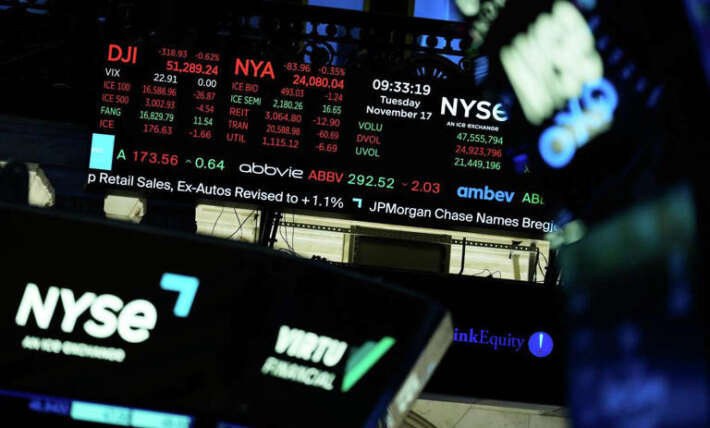
Trump warned of a ‘1929-style depression’ if Democrats won. The Dow soared 1,570 points, then gave back the gains. What it means for your 401(k)
Before Americans headed to the polls for the midterms, President Donald Trump had a dire warning about what would happen to their money if Democrats won.
“If the Democrats win, you will have an economic depression much like 1929,” he said in an October Truth Social video promising $5,000 payments to adult U.S. citizens (1) if Republicans kept control of Congress.

Must Read
- Jeff Bezos backs a platform that lets anyone invest in rental homes for as little as $100 — 5 ways to build wealth like a landlord without actually being one
- A record 45% of central banks plan to grow gold reserves — and many investors are following suit. Get your free gold IRA guide from Goldco
- Dave Ramsey warns nearly 50% of Americans are making 1 big Social Security mistake. Here’s what it is and 3 simple steps to fix it ASAP
Democrats swept anyway.
And on Nov. 4, the day after the election, the Dow Jones Industrial Average catapulted 1,570 points (2), gaining 3%. The S&P 500 climbed 1.5%, while the Nasdaq rose 1.4%.
The celebration didn’t last long, though.
The Dow plunged more than 1,800 points the following day, wiping out its election-day gains. By midday Nov. 16, it was trading around 51,945 (3), roughly 1,400 points below its Nov. 4 close.
Oil prices fell, too. U.S. crude futures dropped 8.3% to $88.12 a barrel, per Reuters (4), as traders anticipated that Democratic control of Congress could increase pressure to end the war in Iran.
For retirees and savers, those wild swings present something of a dilemma.
A $200,000 portfolio tracking the S&P 500 would have gained roughly $3,200 on Nov. 4, before fees. But anyone who rushed to buy stocks after watching the Dow soar would have faced another sell-off almost immediately.
And those who sold before the election? They may have had another chance to buy at lower prices, depending on what they owned and when they sold.
Timing those moves is difficult even for professional investors. You have to decide when to sell, when to buy back in and what to do if the market moves against you in the meantime.
Fortunately, you can build a retirement strategy that doesn’t require getting every one of those decisions right.
Give your contributions a schedule
Imagine selling your investments ahead of the election, watching stocks soar and then seeing the market tumble again the very next day.
You might have avoided some losses, but you’d still have to decide when to get back in. Buy too soon, and prices could fall further. Wait too long and you risk missing the next rally.
It’s a lot of guesswork, especially when you’re investing money you won’t need for another 20 or 30 years.
One way to take some of that pressure off is to invest a fixed amount on a regular schedule. You can keep contributing through your workplace retirement plan and put any additional money you can afford into a separate investment account.
You can start building a diversified portfolio with Acorns, an app that helps automate the habit by investing your spare change.
Link your debit or credit cards, and Acorns rounds eligible purchases up to the nearest dollar.
A $3.25 morning coffee sets aside 75 cents toward your investments. Once those round-ups reach $5, the money transfers into your investment account.
Your money goes into a diversified portfolio of ETFs matched to your investing profile. You can also set up recurring investments to keep contributing beyond your everyday purchases.
And when you sign up through the offer and complete your first qualifying recurring investment of at least $5, Acorns will add a $20 bonus to help you get started.
Even an extra $25 a week would put $1,300 into your investments over a year, before any gains or losses. You’d still experience the market’s ups and downs, but you wouldn’t have to guess which week was the right one to invest.
Read More: Millionaires under 45 hold only 32% of their wealth in stocks. Here’s where their money is actually going
Look at how much you have riding on stocks
The Dow’s sharp reversal also gives you a reason to look at how much of your retirement savings you have tied up in stocks.
If a few bad trading days could seriously disrupt your retirement plans, you may be taking on more risk than you’re comfortable with.
You don’t necessarily need to sell everything to reduce that exposure. Some investors choose to hold gold alongside stocks and bonds, although gold has its own price swings and won’t necessarily rise when stocks fall.
One way to invest in gold that offers significant tax advantages is to open a gold IRA, such as the one from Priority Gold.
Gold IRAs allow investors to hold physical gold or gold-related investments within a retirement account, combining the tax advantages of an IRA with the protective benefits of investing in gold, making it an attractive option for those looking to hedge their retirement funds against economic uncertainty.
To learn more, you can get a free information guide that includes details on how to get up to $10,000 in free silver on qualifying purchases.
Can your retirement budget survive a market drop?
A bad week on Wall Street looks different when you’re 35 than when you’re about to retire.
If you’re still working, you may have years to recover from a downturn. Once you’re relying on your investments to pay the bills, a big loss can force you to withdraw money from an already diminished portfolio.
If you’ve saved $750,000, and you plan to withdraw $30,000 in your first year of retirement, that’s a 4% draw of your funds.
Now suppose your investments lose 20% before you retire, leaving you with $600,000. That same $30,000 withdrawal would consume 5% of what’s left.
In a pinch, you don’t have many options. You still need the money to cover your expenses, but you’re taking a way bigger bite out of your savings at precisely the time you’d prefer to leave more invested for a recovery.
That doesn’t automatically mean you have to delay retirement.
You might be able to reduce withdrawals temporarily, adjust your spending or draw on other income. The important question is whether your plan can absorb a loss without forcing you to make decisions you can’t afford.
If you’re worried about how a market downturn could affect your retirement, it may be worth speaking with a qualified financial advisor.
Envestnet found (5) that working with a financial advisor can add around 3% in annual value through financial planning, asset allocation, investment selection, regular rebalancing and tax management.
That’s particularly useful when stocks are swinging hundreds of points a day, and you’re tempted to make a big change to your investments.
Finding the right advisor is simple with Advisor.com. Their platform connects you with licensed financial professionals in your area who can provide personalized guidance.
A professional advisor can also help you determine how many years you have left to invest before retirement and assess your comfort level with market fluctuations — two key factors in building the right asset mix for your portfolio.
Through Advisor.com, you can schedule a free, no-obligation consultation to discuss your retirement goals and long-term financial plan.