Inside Ukraine’s fortress cities – and the ex-convicts fighting Putin
Even as Ukraine and Russia intensify mass aerial attacks against each other, the unrelenting slaughter on the battlefields below continues, particularly in Ukraine’s Donetsk region, which Vladimir Putin has been obsessed with seizing since he launched his invasion.
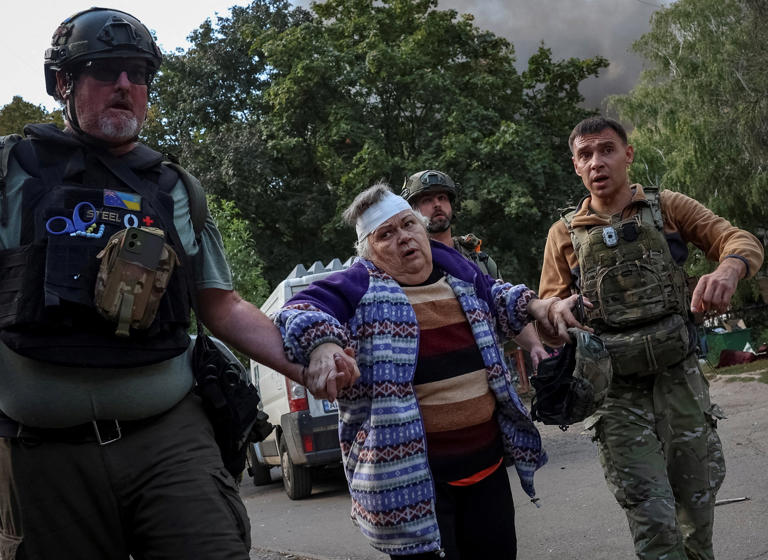
Two large cities, Slovyansk and Kramatorsk, and a number of smaller towns in the region remain in Ukrainian hands and have become known as the “fortress belt”. The area is key to Ukraine’s overall security.
Putin has vowed every year since 2022 to take the Donetsk region in its entirety. And each year that has not happened, Putin has felt more humiliated and again ordered his commanders to capture the region that year. Despite marginal advances with suicidal frontal attacks – at tremendous cost in Russian lives – Moscow has failed in its mission.
Defending this area are troops who in times of peace would make for the unlikeliest of allies – prisoners and police officers, whom The Independent met on visits to the frontlines.
Between two visits to the fortress belt in July and August, the extent of the Russian efforts to capture the area was starkly visible. In July the Ukrainian military had told me that Russian soldiers had been spotted probing some five miles from the eastern side of the road.
By my second trip to the area, a few weeks later, in August, large coils of razor wire lined the left, eastern, side along the 13-mile stretch of road south between Slovyansk and Kramatorsk with more defences of entrenchments and wire entanglements further east and south.
By August 21, Slovyansk and Kramatorsk had been designated a war zone and by the second trip many inhabitants had left or been evacuated and the streets were mostly empty of pedestrians and vehicles. Many buildings that had been standing in July, including residential ones and petrol stations, were charred ruins.
The sound of Ukrainian anti-aircraft defences and explosions of Russian drones, rockets, glide bombs and artillery provided a soundtrack whose intervals of silence became briefer each day.
Like other Ukrainian military units, the 10th Brigade started allowing convicts to serve in their ranks in 2024 to relieve a manpower shortage. Unlike in Russia, the convicts allowed to serve in return for a pardon have not been convicted of serious crimes like premeditated murder, rape, or child abuse.
The Independent spoke to two of them, who both joined in 2024 and are now in important positions as sergeants in the “Shkval” (Squall) battalion, the name given to all Ukrainian units composed of ex-cons. The two gave their full names but preferred their war nicknames, “Malyuk” and “Rameses”, be used in this article.
Their non-convict commander told the two to speak freely and left the room during the interview. Before going, he said: “These ex-convicts have become some of our best and bravest soldiers. They are highly motivated and often better-disciplined than the ordinary soldiers. Some of the brigade’s boys have deserted – but not the Shkval lads.”
Malyuk, aged 27, said he was convicted of manslaughter in 2019 after killing a man in a fight and had served nearly five years of his sentence by the time he joined the military. He said he was single but intended to marry his girlfriend.
Rameses, 30, joined the army in 2022 but was then (unfairly, he implied) convicted of a relatively minor offence, which he was reluctant to specify, and again joined up as soon as he could. He is divorced but tries to keep in close contact with his two infant children.
Both men had seen a lot of action, including intense fighting during Ukraine’s invasion of Russia’s Kursk region in 2024. They said that out of the original 120 in their group, only 20 had escaped death or serious injury.
Malyuk said: “From the start of the war we were writing and asking to be allowed to join the military, but because of bureaucracy we had to wait until the spring of 2024.
“You don’t have the right to be sitting on your ass in prison when your country is fighting for its life. Whatever we had done to put us in prison, this is still our home and we needed to go to war and defend our country.”
Rameses said recruiters from different military units talked to prisoners who wanted to serve, extolling the virtues of their outfits. “The first thing we tried to find out about was which units suffered the biggest losses so as to avoid them. The 10th Mountain Assault Brigade had low losses and a high rating for treating its people decently.”
Malyuk said that in Kursk they fought as frontline assault troops, always at the riskiest, sharp end of attacks. After they returned from Kursk in late 2024, the war had changed, with drones playing a far more prominent part.
Malyuk said: “So it’s a different type of war. We aren’t needed as assault troops at the moment, and we are in an ordinary infantry role. From the beginning of this year I was made the chief sergeant of the company. From time to time, I go out to frontline positions to collect dead or wounded. But in general now I am engaged in training of people.”
Both know that the Russians are determined to take the fortress belt and they anticipate heavy fighting not far in the future.
Rameses said: “The Russians are using drones, rockets, glide bombs with one-ton or more payloads. They have ballistic missiles that we cannot intercept any more. They are hitting everywhere like shops, supermarkets, petrol stations where people gather. They want to level Slovyansk and Kramatorsk like they did Bakhmut (which was made uninhabitable).”
Rameses thinks that it is probably easier for someone who has experienced prison to acclimatise to life in the military than an ordinary recruit.
“You endure a lot in prison. I wouldn’t say that prison is worse than war. War is clearly worse. But you have to develop a self-discipline in prison that fits in with army service.”
Malyuk said: “Yes. In prison you need psychological strength and the ex-convicts have strong motivation. Unlike those who are conscripted into the army unwillingly and want to escape, we are all here because we want to be. And we intend to fight until the end of the war.”
Both men know that a brigade composed mainly of police, called the Lyut (Fury) Brigade, is fighting less than 20 miles south of their positions at a town called Kostyantynivka, where Ukrainian forces have been hard-pressed for more than a year.
The Russians have several times falsely claimed to have captured the town, much of which is in ruins, but they have infiltrated parts of it and Ukrainian forces may eventually have to fall back, opening the prospect that cops and the ex-criminals will have to fight side by side.
Malyuk said: “Actually, we’ve already done that as we operated close to cops from the Lyut Brigade in Kursk.” Both men said that, away from the frontlines during rest periods or mealtimes, some pointed jokes and unpleasant conversations were exchanged. “But on the battlefield,” said Malyuk, “Everything was OK, no problems between us. And they fought very well, I have to say.”
The Lyut Brigade has indeed gained a reputation for courageous and tenacious fighting in many of the toughest battles of the war. It was formed in January 2023 by police who wanted to serve at the front lines.
Serhii Kurylenko is the commander of the brigade’s “Safari” Regiment, known for its expertise in repelling Russian forces from built-up areas Moscow attacks and then aggressively pursuing them.
Kurylenko said that Lyut’s high standards for selection, training, respect for brigade members and formidable battlefield prowess has attracted many non-police recruits.
He said Ukraine’s police are exempt from conscription and could have remained in relatively safe policing jobs close to their homes, but instead thousands volunteer to face the perils of frontline warfare.
Kurylenko is a powerfully built man and his nom de guerre, “Strong”, reflects the fact that he was known on Ukraine’s weightlifting competition circuit. He was appointed commander in February this year when two Lyut units were combined into the present Safari unit.
He said that because he started as an ordinary soldier and rose to be a commander:
“That means I understand every level of a fighter’s duties. I understand how things should work. For me, a soldier is not just a statistic, an impersonal fighting unit. They are all my brothers and it is an honour to be their commander during a time of war and I care for and support each one of them any way I can.”
He takes pride in the fact that when he moved to his new role, everyone in his previous command came with him.
“I would describe the Safari regiment in three words: brotherhood, experience and motivation. When I select people for my team, I look for dedication and initiative. We need motivated people who know why they are joining. We will teach them everything else here.”
Lyut has been at the heart of the fierce fighting to defend Kostyantynivka for more than a year. One of Safari’s deputy commanders, a lieutenant with the call sign “Jackson” commanding 100 men, said the defence of Kostyantynivka is probably the Brigade’s toughest and most important battle.
The single 28-year-old was a policeman in the Donetsk region port city of Mariupol when it was besieged by Russian forces at the start of the full-scale war. He joined the city’s epic and heroic but ultimately unsuccessful defence, which caught the world’s attention for its early display by the Russians of the atrocities against civilians they committed everywhere they occupied Ukrainian territory.
Thousands, perhaps tens of thousands, of Ukrainian military and civilians were killed as the vastly larger and better-equipped Russian forces reduced much of Mariupol to ruins – notoriously including hospitals and clearly marked shelters for children.
Jackson was taken prisoner and held in brutal conditions where he was tortured by his Russian captors but was fortunate to be released in a prisoner swap after only six weeks, while some of his comrades are still in Russian prisons or perished in captivity.
“All that I had in my life that was valuable, important – it’s all gone. I have nothing more to lose. I realised that I had to go and fight the Russians until the end, whether that’s death or victory.”
“The Russians infiltrate in small groups. They aim to reinforce these and establish them into permanent core positions that can be expanded. Our surveillance drones locate them and hit them with drones and missiles. Then we move in to clear out any remaining Russians.
“It’s intense close-quarter combat on streets or, frequently, every floor and room of an apartment building until they surrender or we kill them.” Jackson and his comrades know Kostyantynivka is critical for the defence of the entire fortress belt because if it falls, the road to the remaining strongholds will be open.
He said: “So we know we have to remain here as long as possible and fighting amidst ruins and rubble favours us, the defenders. The Russians massively outnumber us and their commanders don’t care how many of them die. They may eventually take Kostyantynivka – but not anytime soon.”
The Lyut brigade, like all police, comes under the auspices of Ukraine’s interior ministry rather than the defence ministry and its members receive police powers. That means anyone with a criminal record is prohibited from joining. But Kurylenko said he has no qualms about fighting alongside members of the Squall unit: “They could have stayed in prison, where it’s safer, but they volunteered to fight, which shows they have motivation. They are our fellow soldiers and we are fighting the same enemy. And we know that they fight very well.”
The Independent is the world’s most free-thinking news brand, providing global news, commentary and analysis for the independently-minded. We have grown a huge, global readership of independently minded individuals, who value our trusted voice and commitment to positive change. Our mission, making change happen, has never been as important as it is today.