Iran warns Middle East will collapse if government falls amid US threats
As President Donald Trump threatens potential military action against Iran in the wake of the deadliest wave of protests and unrest in the history of the Islamic Republic, a senior Iranian official has shared with Newsweek a warning that the downfall of the Iranian government would bring about dire and far-reaching consequences that have even Washington’s Middle East partners worrying.
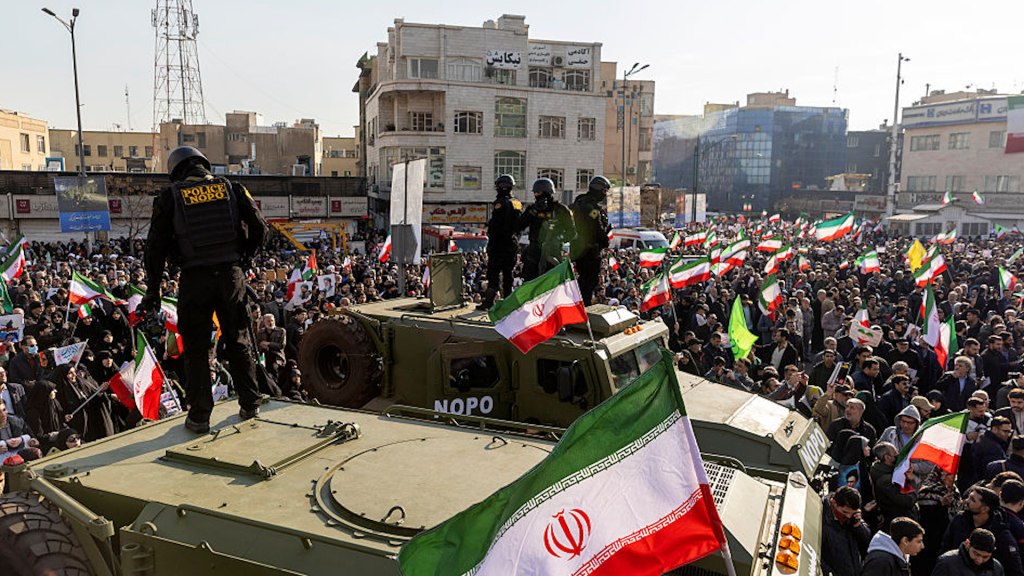
The latest death toll provided by Iranian officials of the demonstrations that began December 28 and devolved into nationwide clashes by January 8 stands at a minimum of 3,117 people, more than 500 of whom were said to be members of the security forces. Human rights groups based outside the country place the total casualty count even higher, with the U.S.-based Human Rights Activist News Agency (HRANA) estimating at least 5,137 deaths and nearly 13,000 cases under review.
While the Iranian government asserts the return of a sense of normalcy and ongoing probes into alleged foreign-backed infiltration, new threats have emerged from Washington in the form of Trump’s declaration Friday that an “armada” of U.S. Navy assets, namely the USS Abraham Lincoln Carrier Strike Group, was headed toward Iran. He said he would “rather not see anything happen, but we’re watching them very closely,” the most serious answer yet to his January 13 message to protesters that “help is on the way” as the U.S. accused Iran of allowing security forces to kill civilians.
With tensions high and speculation of potentially imminent strikes in the absence of diplomatic progress, the senior Iranian official argued that Israel, Iran’s archfoe and America’s top ally in the region, was fueling the calls for intervention that may substantially boost the nation’s geopolitical position.
“A state collapse, which will directly result in regional collapse, is something the Israelis would like to see, and this is not merely about toppling the ruling system in Iran,” the senior Iranian official said in comments shared with Newsweek. “Regional collapse is in no one’s interests. The only party that would benefit from such a regional collapse is Israel.”
“And the Israeli regime is very much pursuing this, because they believe this is an opportunity for them to gain an edge over other countries for decades to come—Türkiye, Saudi Arabia, Kuwait, Oman,” the senior Iranian official said. “This is why everyone except Israel opposed any military confrontation between the United States and Iran. Diplomacy is the best option we have; the alternatives are so unattractive.”
‘All Options Are on the Table’
Reached for comment, a Trump administration official reiterated the president’s earlier remarks, adding that Trump had previously shown a willingness to act on ultimatums when he conducted an unprecedented bombing of three Iranian nuclear sites during the 12-Day War between Iran and Israel in June, as well as when he oversaw the brazen U.S. Delta Force raid that seized Venezuelan President Nicolás Maduro and his wife out of their home in Caracas early this month.
“President Trump has stated he hopes that no action will be necessary, but the President has been clear about the consequences for the Iranian regime murdering protestors,” the administration official told Newsweek. “The President has demonstrated with Operation Midnight Hammer and Operation Absolute Resolve that he means what he says.”
“As the President stated, he is watching the situation in Iran very seriously and all options are on the table if the regime executes protestors,” the administration official added.
Throughout his comments Friday, Trump also alleged that he had prevented the hanging of 837 people in Iran, where execution is practiced out at a rate second only to China despite having only a fraction of the population of the People’s Republic. Trump’s claim was soon rejected by Iran’s top prosecutor.
“This claim is completely false; no such number exists, nor has the judiciary made any such decision,” Iranian Prosecutor-General Mohammad Movahedi said Friday in a statement published by the Iranian Justice Ministry’s Mizan News Agency.
Meanwhile, Iranian Foreign Minister Abbas Araghchi issued his own warning amid the ongoing tensions, declaring in a Wall Street Journal op-ed published Tuesday that, “unlike the restraint Iran showed in June 2025, our powerful armed forces have no qualms about firing back with everything we have if we come under renewed attack.”
Such “an all-out confrontation,” he argued, “will certainly be ferocious and drag on far, far longer than the fantasy timelines that Israel and its proxies are trying to peddle to the White House,” adding that “it will certainly engulf the wider region and have an impact on ordinary people around the globe.”
‘Changing the Face of the Middle East’
The 12-Day War was sparked by a massive Israeli air campaign that targeted Iranian nuclear and defense sites and assassinated top military commanders and nuclear scientists. Iran responded by launching hundreds of missiles and drones against Israel and fired one salvo against the Pentagon’s Al-Udeid Air Base in Qatar in retaliation for the U.S. intervention, before Trump declared he reached a ceasefire with both sides the following day.
The confrontation marked one of the single most dramatic clashes surrounding the war in Gaza, sparked by an October 2023 surprise attack led by the Palestinian Hamas movement that drew a fierce Israeli response and the intervention of Iran and its allies of the Axis of Resistance coalition across the region.
A number of personnel at Al-Udeid Air Base, the largest U.S. military installation in the Middle East, were once again advised to evacuate last week as signs, also including the movement of refueling aircraft and other equipment, mounted of looming U.S. military action. The USS Abraham Lincoln Carrier Strike Group, previously operating in the South China Sea, has recently made its way to the Indian Ocean on its journey toward waters closer to Iranian territory.
With Iranian personnel preparing for a possible showdown, Israeli Prime Minister Benjamin Netanyahu took credit for his role in a war that has already reshaped the region, with major setbacks for Tehran and the Axis of Resistance. He stated that Israel was prepared for any new strikes from the Islamic Republic.
“We are changing the face of the Middle East. We are courageously contending with the barbarians that seek to destroy us, and are simultaneously working to fulfill opportunities for peace,” Netanyahu said during a parliamentary debate on Monday, according to a Knesset readout. “We are closely following what is happening in Iran. We are all looking with a sense of wonder at the heroic struggle of Iran’s citizens to achieve liberty, welfare and justice. We see the atrocities of the massacre ordered by the rulers of Iran.”
“If Iran makes the mistake of attacking us, we will act with might that Iran has not seen before,” Netanyahu added. “No one can predict what tomorrow will bring in Iran, but one thing is clear; no matter what happens—Iran will not return to being what it was.”
Newsweek has reached out to the Israeli Prime Minister’s Office for comment.
The comments have received some backlash from the region, including from Turkey, a NATO ally of the U.S. that has repeatedly criticized Israel over its campaigns in Gaza, Lebanon and Syria throughout the conflict.
“I hope they find a different path, but the reality is that Israel, in particular, is looking for an opportunity to strike Iran,” Turkish Foreign Minister Hakan Fidan told Turkish broadcaster NTV on Friday.
‘Individuals Who Infiltrated Iran’
From the Iranian government’s perspective, both the recent unrest and looming threats of renewed U.S. and potentially Israeli military intervention mark a continuation of the 12-Day War, which also saw numerous reports of operations conducted by individuals within the Islamic Republic.
The accounts add to a long list of actions attributed to Israeli intelligence assets within Iran, including the assassinations of nuclear scientists in past years as well as the killing of Hamas Political Bureau chief Ismail Haniya during an attack in Tehran in June 2024.
But while Netanyahu has long called for the overthrow of the Iranian government, he publicly urged such an action to be carried out by the Iranian people and has never confirmed any direct role of the Mossad or any other Israeli agency. Still, the Iranian government has continued to accuse Israeli spies of deliberately stirring unrest.
The Iranian Intelligence Ministry announced last week that authorities had arrested up to 3,000 members of alleged “terrorist groups” amid the protests, including at least one suspected Mossad agent who was later executed.
Iran does host a number of militant groups, including the Islamic State (ISIS), which was behind bloody operations in Iran, including the deadliest attack in the nation’s history during a memorial for Islamic Revolutionary Guard Corps Quds Force commander Major General Qassem Soleimani in January 2024. A number of other groups have roots in ethnic minority movements, including groups comprised primarily of Arabs, Azeris, Balochi and Kurds.
Kurdish factions have traditionally been the most organized of these dissident groups. At least one Kurdish group, the Kurdistan Freedom Party (PAK), has assumed responsibility for armed attacks during the demonstrations, framing them as being conducted in defense of protesters, while others, like the Democratic Party of Iranian Kurdistan (PDKI), have ramped up operations across the Iran-Iraq border.
Once Iran’s closest ally in the Middle East, Syrian President Bashar al-Assad’s downfall at the hands of former Islamist militant chief-turned-interim leader, President Ahmad al-Sharaa, has served as a major setback to Iran’s Axis of Resistance network. Porous borders with Taliban-led Afghanistan and Pakistan also complicate Iran’s efforts to secure its immediate front lines.
Still, many opposition groups attest to Iranian security forces being primarily responsible for the steep death toll, with a number of videos appearing to show uniformed Iranian personnel opening fire on crowds. Both Iranian officials and activists have released footage they assert backs their opposing views of the events.
In the comments shared with Newsweek, the senior Iranian official alleged a concerted effort to hijack peaceful demonstrations that began with merchants expressing grievances over the nation’s ailing economic situation through the insertion of militants trained in territory formerly held by ISIS, which once controlled vast swathes of land in Iraq and Syria.
“There were individuals who infiltrated Iran after being recruited and trained in ISIS-controlled areas,” the Iranian official said, “in some cases receiving their training there before being transferred into the country.”