US ally declares national emergency due to oil crisis from Iran war
The Philippines declared a national energy emergency on Tuesday, with President Ferdinand Marcos Jr. warning the country’s fuel supply was in “imminent danger.”
Marcos issued Executive Order 110 a day after a presidential office spokesperson said the country was facing a “price disruption,” not a full-blown crisis, according to local media.
The move comes as the war involving Iran disrupts traffic through the Strait of Hormuz, a 21-mile-wide chokepoint that carries roughly a quarter of the world’s seaborne oil.
Asia is the region most exposed to the oil shock. But while China, Japan and South Korea hold strategic reserves that can cover months of demand, many Southeast Asian economies operate with far thinner buffers.
The Philippines is in particularly dire straits, with the Middle East accounting for roughly 95-98 percent of its oil imports. The U.S. treaty ally’s fuel supply will dry up in just two months if the government doesn’t secure enough backup supplies, Department of Energy Secretary Sharon Garin said during a Tuesday panel, per the Philippine Inquirer.
“The worst-case scenario is we run dry, this country runs dry,” she said.
“A state of national energy emergency is hereby declared in light of the ongoing conflict in the Middle East and the resulting imminent danger posed upon the availability and stability of the country’s energy supply,” the executive order said.
The emergency will remain in force for up to a year unless extended or lifted by the president.
Newsweek reached out by email to the Philippine Presidential Communications Office for comment outside of regular office hours.
Manila has already begun taking steps to cushion the impact of the shortage, including a temporary four‑day work week across government offices and plans to secure emergency fuel supplies. State‑run PNOC Exploration Corp. is moving to source up to 2 million barrels of oil to boost the country’s buffer stock, the country’s finance department said.
Some sectors are already being hit hard by rising fuel prices—particularly transportation.
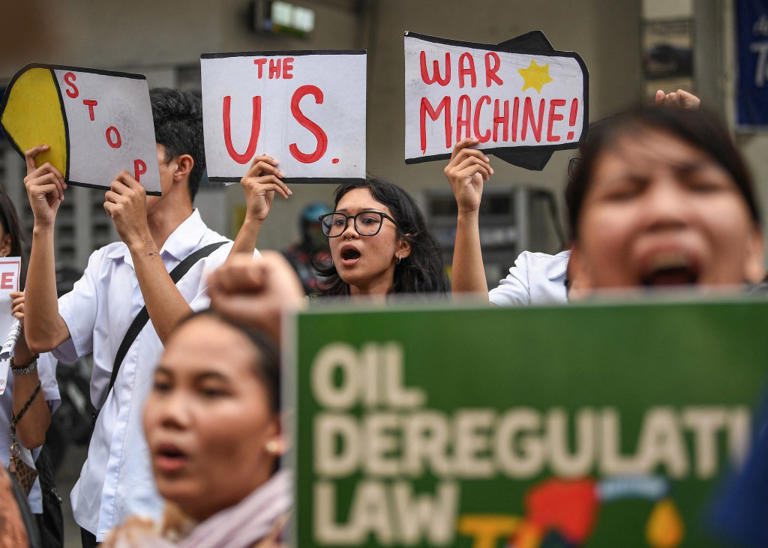
More than 20 transport groups, representing drivers of buses, jeepneys, and other public utility vehicles, are planning a second nationwide strike on Thursday and Friday, demanding government action to lower fuel prices, suspend the fuel excise tax, and approve fare increases.
“We don’t want commuters to sacrifice or be inconvenienced. But you’re not listening to our grievances,” said Mar Valbuena, chairman of strike co‑organizer and transport group Manibela, during a press conference on Monday, according to the Philippine Star.