Two US deportations overturned by courts over fears of torture
Two federal appeals court panels overturned government deportation orders in separate cases Friday – one to El Salvador, the other to Angola – and said U.S. immigration officials discounted or ignored evidence that the immigrants were likely to be tortured if returned to their homeland.
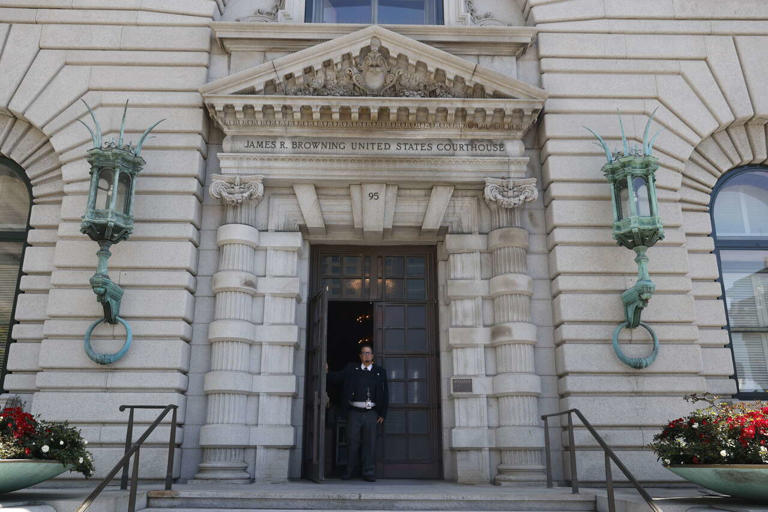
In one case, a panel of the 9th U.S. Circuit Court of Appeals in San Francisco halted the deportation of Joao Mbueno-Vita, who fled Angola and entered the United States in 2022 with his wife and two children and applied for political asylum.
Mbueno-Vita was an active member of the National Union for the Total Independence of Angola, which opposes the current governing party, the People’s Movement for the Liberation of Angola.
According to his testimony, he was beaten by police while returning from an anti-government rally in 2019. Then after another rally in 2021, he said, soldiers stopped a bus carrying the protesters, tear-gassed and arrested him and others, then took him to a “black site” and tortured him for two days, beating and stomping on him until he had difficulty breathing. He said they killed one of the protesters and warned the others that they would also be killed if they spoke out.
The U.S. Board of Immigration Appeals, which reviews immigration cases for the Justice Department, said his testimony was not credible and contained differing accounts of his injuries. But the appeals court said any inconsistencies were “trivial” and reflected Mbueno-Vita’s continuing trauma and difficulty in understanding questions in English.
A U.S. State Department report in 2022 found that “the Angolan government has targeted and arbitrarily arrested, detained, tortured, and killed members of the opposing political parties,” Judge Richard Paez said in Friday’s 3-0 ruling.
He said the immigration board had also found that the family had lived safely in Angola for four months before leaving for the United States, but had failed to mention that “Mbueno-Vita and his family were living in hiding.” The board must reconsider his case, “accepting his testimony as credible,” and determine whether he has a reasonable fear of torture in Angola, the court said.
Paez, appointed by President Bill Clinton, was joined by another Clinton appointee, Judge William Fletcher, and by Judge Roopalo Desai, appointed by President Joe Biden.
The court did not decide whether Mbueno-Vita should be granted asylum in the U.S., but ordered the immigration board to reconsider his case under proper legal standards.
In the second case, a different 9th Circuit panel told the immigration board to reconsider the case of Alfredo Parada, an immigrant from El Salvador entered the U.S. as a teenager and then spent nearly 35 years in prisons for a murder committed at age 16 in Los Angeles.
In a 2-1 ruling, the court said the board had wrongly required Parada to show that half or more of all deportees to the Central American country were tortured.
“Statistical evidence is not required” and would be particularly difficult to obtain from “repressive regimes like El Salvador,” Judge Kim Wardlaw wrote in the majority opinion. She said an expert witness had concluded that Parada, a former gang member whose body is heavily tattooed, “would be severely injured or killed if he were forced to return to El Salvador.”
Wardlaw also cited a filing with the court by dozens of former federal immigration judges who said the United Nations Convention Against Torture, which took effect in 1987 and was ratified by the United States in 1994, requires the immigration board to consider “all evidence relevant to the possibility of future torture,” and not just statistics from one country.
Wardlaw, appointed by Clinton, was joined by Judge Gabriel Sanchez, a Biden appointee. In dissent, Judge Carlos Bea, appointed by President George W. Bush, said there was little evidence “to compel a finding that anywhere close to half of the detainees in El Salvador are tortured with government consent or acquiescence,” and that Parada therefore could not show he was likely to be tortured.
“Harsh conditions of confinement” and “even extensive beatings by police officers do not compel a finding of torture,” Bea wrote. He added that “El Salvador has taken steps to improve prison conditions.”
Lawyers for the immigrants and the government did not immediately respond to requests for comment. The Justice Department could ask the full 9th Circuit court for a rehearing before a larger panel in each case, and then appeal to the Supreme Court.