Oil producers don’t want to ‘drill baby drill.’ There’s a problem in Texas.
The Trump administration wants U.S. oil companies to drill more, so they can boost output and lower prices as the Iran War decimates global supplies. But there is little sign of that happening so far.
One big reason they aren’t ramping up production has to do with a quirk in the commodities market, analysts say. Natural gas, a byproduct of oil drilling, is selling for negative prices in the Permian Basin of Texas and New Mexico, severely depressing how much money producers can make from each barrel of oil they sell.
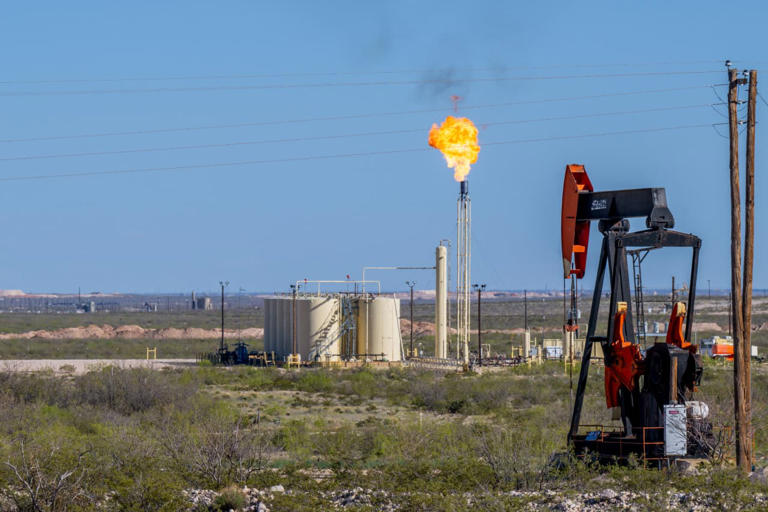
“The natural gas situation in the Permian Basin is an absolute disaster,” Tim Rezvan, an analyst at KeyBanc Capital Markets, told Barron’s. The Permian Basin, which accounts for around half of U.S. production and holds billions more barrels underground, would be the logical place for oil companies to drill mores. But the natural gas problem is limiting their appetite to do so. It’s one reason why few producers have committed to boosting output, even as oil prices have risen more than 70% since the start of the year.
Natural gas is normally a valuable commodity that’s used for home-heating and to generate electricity. Consumers in Europe and Asia are desperate for natural gas today. Those regions don’t produce enough of their own, and can’t get their usual supplies from the Middle East because Iran has blocked the Strait of Hormuz.
But in Texas, the largest state by far for oil production, there’s too much natural gas being produced today and not enough pipelines to take it away. That’s driven natural gas prices well below zero, meaning that producers have to pay buyers to take it away. “They are losing money by paying to offtake that gas,” said Kojo Orgle, oil and gas analyst at energy analytics firm ICIS.
Over the past month, prices at the main hub for natural gas in Texas have fallen as low as negative $9.56 per million British Thermal Units, the standard measurement. On Tuesday, the price was negative $4.50. Pipelines are being built to transport more gas and lift those prices, but they won’t be finished for a couple of years.
Quantifying just how much money the oil companies lose from their natural gas production depends on the mix of gas and oil in the wells they are drilling. In the Permian Basin, wells tend to produce about 40% gas and 60% oil, according to one government analysis. But older wells tend to become “gassier,” producing an even higher percentage of natural gas.
Orgle estimates that for each barrel of West Texas oil that a producer can sell for $107 today, they will lose around $20 paying someone to take the natural gas off their hands. Oil companies could simply “flare” that gas, allowing it to escape into the air, but that’s harmful to the environment and limited by regulators in most areas. Most major oil companies have said they don’t regularly do that anymore.
Most oil producers haven’t reported their first-quarter earnings yet, so it isn’t clear if they will eventually change their minds about ramping up their output. Among the biggest names to watch is Diamondback Energy, one of the top Permian producers. The company reports earnings May 5.
