Americans told to prepare for nationwide emergency alert test
Americans have been put on notice ahead of a nationwide emergency alert test that will interrupt television and radio programming across the country.
Federal officials announced the drill will begin at approximately 2.20pm ET on November 17, with December 3 as the backup date. Officials are giving advance notice so Americans can prepare now and avoid being alarmed when the test begins.
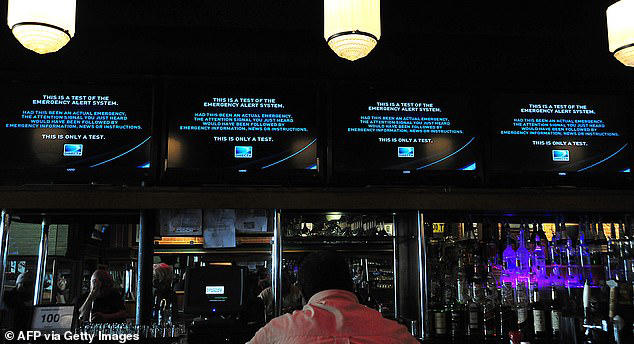
The Emergency Alert System (EAS) connects thousands of television and radio stations, cable systems and satellite providers to deliver potentially lifesaving warnings during emergencies. It also allows the president to address the nation during a major crisis.
During the test, television viewers may see a full-screen message or a scrolling banner, accompanied by loud alert tones and a spoken announcement.
The message will clearly identify the broadcast as a test, and normal programming will resume afterward.
The drill will check whether broadcasters can receive and relay a national emergency message, helping officials identify failures before the system is needed in a real disaster.
The scheduled test comes amid a string of disruptions to essential services, including a global Microsoft outage and Friday’s nationwide grounding of flights.
Customers at several major US banks also reported problems accessing online services on Monday, adding to a turbulent few days for the country’s critical systems.
The upcoming test will be conducted by the Federal Emergency Management Agency (FEMA), in coordination with the Federal Communications Commission (FCC).
In a briefing, FEMA said: ‘At approximately 2:20 p.m. ET on November 17, 2026, radio and television broadcasters, cable systems, satellite radio and television providers, and wireline video providers nationwide will interrupt normal programming to relay a test message.’
The message will state: ‘This is a nationwide test of the Emergency Alert System, issued by the Federal Emergency Management Agency, covering the United States from 2:20 to 2:50 hours ET.’
News of the test quickly spread online, where the public raised concerns, as it was planned during a time of turmoil.
One X user questioned the timing, saying they received a news notification about banking disruptions followed by what they described as a FEMA alert.
They cited Microsoft, FAA and Workday problems, expressing alarm at the succession of events and asking, ‘Seriously, what’s happening?’
Another X user posted: FEMA just scheduled a nationwide emergency alert test for tomorrow while cyber systems are dropping, banks are offline, Iran is threatening, and Ukraine is heating up.
‘Coincidence, or are they stress-testing the system before they need it for real?’
The concerns come as several major banks, including Chase, Bank of America and Wells Fargo, are experiencing outages, leaving customers locked out of accounts.
On Friday, the country came to a standstill after the Federal Aviation Administration (FAA) announced a rare nationwide ground stop at 3.45pm ET on Friday, citing extraordinary circumstances and safety concerns.
It was only the second nationwide ground stop since the September 11 attacks and was lifted just after 8pm.
The aviation shutdown came on the heels of another communications crisis, with governments, businesses and ordinary users worldwide already grappling with a Microsoft outage that began Thursday afternoon.
That failure cut access to Outlook and essential services used by banks and court systems.
The test and disruptions come just weeks after governments overseas are urging households to stockpile basic supplies so they can cope with emergencies without immediate help.
The UK has advised citizens to keep three days’ worth of essentials, including food and water, while former FBI deputy director Dan Bongino recently told Americans to take similar preparedness warnings seriously.
In late October, governments in the UK, Sweden, Germany, Ireland, the Netherlands and France encouraged households to keep food, water, medicines and other essentials available for emergencies.
The UK’s updated guidance recommends enough supplies for three days, helping families cope if severe weather, cyberattacks or other disruptions interrupt essential services.
In Sweden, the country’s civil defense guidance is warning households to be able to manage on their own for at least one week ‘in case of crisis or war.’
Bongino, who left the bureau in January, commented on the recent warnings, urging Americans to do the same.
‘Have yourself an emergency radio, have yourself some batteries, get yourself some emergency food, get yourself a rain collection and water filtration, some filtration tablets,’ he said on Monday.
‘Get your stuff today. Please. Do it for your family,’ Bongino added.
He said preparing in advance could reduce anxiety and prevent families from finding themselves without essentials when a crisis strikes.
‘There’s nothing wrong with being prepared. It’s not panicking or anything like that,’ he added.