Argentina issues Falklands threat to Britain and accuses UK of ‘illegally plundering’ oil reserves
Argentina’s president has threatened legal action against Britain over an offshore oil project in the Falklands.
Javier Milei has set a two-week deadline for work to stop at Sea Lion, a field being developed by firms from the UK and Israel.
If drilling does not stop Argentina will ask the International Tribunal for the Law of the Sea, a Hamburg-based maritime court, to order a temporary halt to the project.
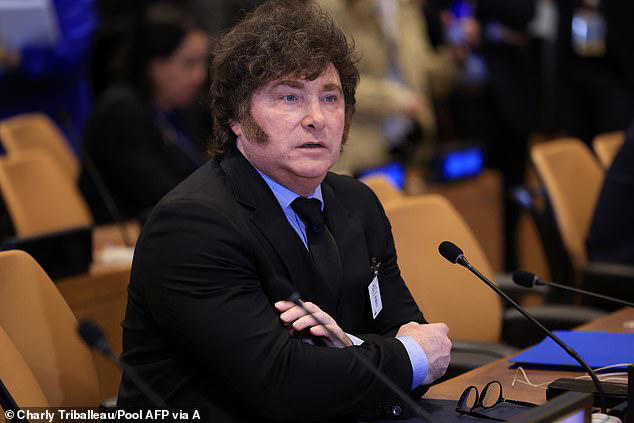
Mr Milei’s threats represent a major escalation in a clash over resources that could transform the economy of the sparsely populated South Atlantic archipelago.
He has made repeated statements claiming ownership of the Falklands for his country, which calls the islands ‘Las Malvinas’.
A presidential statement said that Argentina would not ‘stand idly by’ while Britain caused ‘irreversible and irreparable’ harm with the oil field.
Sea Lion, which is being developed by Israel’s Navitas Petroleum and Britain’s Rockhopper Exploration, is expected to start pumping oil in 2028.
Corporation tax revenues and royalties generated by the oil field are expected to transform the Falklands’ economy.
The islands’ government has also pledged to contribute to its own security costs from the windfall, thereby reducing the £500million Britain spends each year to protect the Overseas Territory.
The territory’s gross domestic product is predicted to triple, hundreds of jobs will be created, and it will become energy self-sufficient.
The tribunal, an independent court established under the 1982 UN Convention on the Law of the Sea, can issue legally binding emergency orders.
But even if it ordered the UK to halt drilling at the site, which is six times larger than the Rosebank field west of the Shetland Islands, it has no means of forcing the government to comply.
The UK rejects Argentina’s sovereignty claim over the archipelago, arguing that the islanders have the right to determine their own future and develop their natural resources.
Falklands residents voted overwhelmingly to remain a British Overseas Territory in a 2013 referendum but Argentina says the islands were populated illegally.
Foreign minister Pablo Quirno praised Mr Milei’s move as ‘a historic and unprecedented step’ in Argentina’s nearly two-century campaign to secure sovereignty over the Falklands.
‘Whoever explores or exploits our natural resources in the Malvinas without Argentine authorisation must face the consequences,’ he said.
But critics have accused Mr Milei of using the sovereignty claim – one of the few causes in Argentina that cuts across the country’s stark political lines – to bolster flagging public support ahead of next year’s election as the economy falters.
The president, a self-described ‘anarcho-capitalist,’ initially drew scorn from his nationalist opponents for his conciliatory stance toward Britain and professed admiration for Margaret Thatcher, who ordered British troops to recapture the islands following an Argentine invasion in 1982.
The brief but bloody war killed 649 Argentine troops, 255 British service members and three islanders.
Mr Milei has taken an increasingly confrontational stance over Sea Lion in recent weeks and last week dedicated much of his UN General Assembly speech to the Falklands, accusing the international body of neglecting the dispute over the islands and denouncing the oil project as an illegal exploitation of Argentine resources.
US President Donald Trump has also said he is reassessing Washington’s stance over the sovereignty of the territory and has previously said he would not back Britain if Argentina invaded again.
Mr Milei has sent the Argentine congress a bill proposing prison terms of up to 20 years for extracting resources around the islands without authorisation and extending penalties to fishing, the bedrock of the islands’ economy.
Authorities in Buenos Aires are investigating at least 60 companies and executives for possible violations.
An Argentine judge this month also ordered a halt to work on Sea Lion pending an environmental review.