Experts’ chilling warning Australia is at greater risk of nuclear attack under security agreement
Australia is at greater risk of a nuclear attack because of the AUKUS defence pact, military experts have warned.
They also warn the chance of being dragged into a destructive conflict with China has increased as a result of the agreement.
Australia, the United Kingdom and the United States, agreed in 2021 to strengthen the three countries’ military capabilities and security co-operation in the Indo-Pacific, where China’s growing military power is a major concern for the US and its allies.
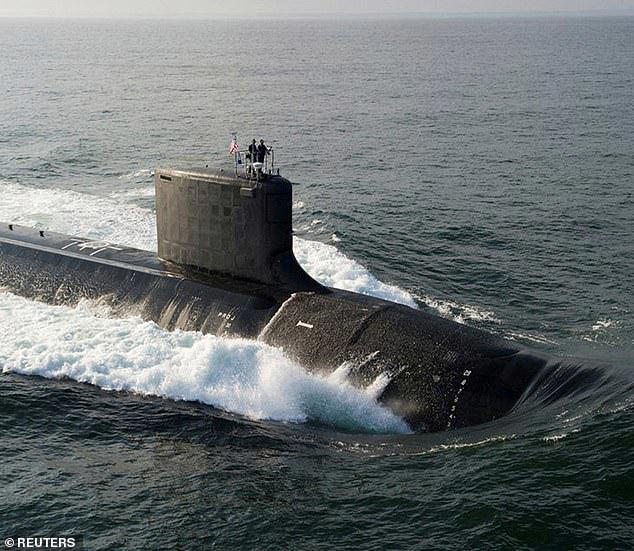
The agreement will also see Australia acquire nuclear-powered submarines intended to significantly boost long-range undersea warfare capabilities.
A public inquiry into AUKUS heard on Thursday, however, that Australia’s sovereignty and defence strategy has effectively been tied to the United States.
Former Department of the Prime Minister and Cabinet secretary Michael Keating and former military public servant Jon Stanford warned that Australia could become more exposed if tensions between the US and China escalate, especially over Taiwan.
‘We are now in a situation where, because of the AUKUS strategy of integrated deterrence in defence of US regional primacy, Australia is more likely to be attacked, potentially with nuclear weapons,’ they told the crowd-funded inquiry.
The pair called on the government to rethink defence strategy and abandon AUKUS submarines; to instead explore alternatives such as low-enriched uranium-powered vessels from France or South Korea.
Mr Keating and Mr Standford argued that policies of ‘integrated deterrence’ and ‘pooled sovereignty’ give the US greater access to Australian military facilities without giving Australia equivalent control.
They warn that developing US military infrastructure in Australia, including facilities for US nuclear-powered submarines at the HMAS Stirling base in Western Australia, could also make the country a prime military target.
Around 1,000 US Navy personnel are expected to be stationed at HMAS Stirling from next year to support submarines operating from the Western Australian naval base.
‘If there is a war between the US and China, Australia will inevitably be involved … even if we do not provide military support,’ their submission states.
They also point out that Australia does not have a formal US guarantee that America would come to its defence if it were attacked, unlike allies such as Japan, the Philippines and South Korea.
They point to warnings made by former French foreign minister Jean-Yves Le Drian, who criticised Australia’s decision in 2021 to scrap a $90billion deal for French-built non-nuclear submarines in favour of AUKUS.
The French deal would have seen Australia acquire 12 conventionally powered subs for a fraction of the cost, and its scrapping sparked a minor diplomatic row.
Mr Le Drian accused Australia of sacrificing its sovereignty by choosing military technology it would not control.
The crowd-funded independent public inquiry into AUKUS got underway in June and is headed by former politician and Midnight Oil front man Peter Garrett, with backing from think-tank the Australia Peace and Security Forum.
Former home affairs secretary Mike Pezzullo was among those who appeared before the inquiry’s Canberra hearings on Wednesday.
Pezzullo argued that Australia should deepen its military integration with the US but also retain the ability to make its own decisions about entering a conflict.
‘Alliances are political documents first and foremost,’ he said, and warned Australia should not be dragged into every US conflict.
He also issued a warning similar to that made by Mr Keating and Mr Stanford, saying Australian military bases used by US forces could be targets in a war with China, even if it did not directly involve Australia.
‘If I was a Chinese war planner,’ Mr Pezzullo said, ‘I would flatten every single potential facility that might be used overnight by Americans flying in.’
But Pezzullo also argued the nuclear-powered submarines acquired under AUKUS would significantly expand Australia’s ability to operate at sea and could support the development of advanced autonomous underwater technology.
He said the ability to operate beneath the surface would be crucial in a theoretical future conflict, including for tracking enemy submarines and gathering intelligence.
Mr Pezzullo said Australia had two options: stay out of a potential US-China conflict and risk the consequences of a US defeat, or strengthen its alliance with Washington in the hope that a combined military force would deter China from going to war.
‘I prefer that latter approach,’ he said. ‘The war machine is the thing that prevents the war.’
Also on Thursday, Australian Defence Minister Richard Marles met US counterpart, Secretary of Defense Pete Hegseth, in Washington DC and discussed an expansion of the US presence on Australian military bases.
Around 1,000 US Navy personnel are expected to be stationed at HMAS Stirling from next year to support American nuclear-powered submarines.
The Pentagon has also flagged greater military-industrial co-operation between the two countries.
Hegseth has previously pressed Australia to increase its defence spending and ensure its military capabilities ‘match’ those of the US.
‘We now have defence spending at 2.8 per cent of GDP by the NATO measure, which puts us ahead of most NATO countries,’ Marles told reporters on Thursday.
‘This is the biggest peacetime increase in defence spending that we’ve done … we understand the American position, but I think that is a story which is well received here.’
Mr Marles also confirmed he remained confident Australia would receive its first Virginia-class submarine in 2032.
However, under an AUKUS clause, only assets that the US does not require would be provided and a future US president would have to approve any final sale.