Haiti deportation flight landed Thursday; gang massacred 47 in Kenscoff three days later
Three days after the US sent more than 160 Haitian deportees to Cap-Haïtien on August 20 — the largest deportation flight since the Trump administration terminated Temporary Protected Status for some 350,000 Haitians — the Viv Ansanm gang coalition descended on Kenscoff, a hillside farming community above Port-au-Prince that Haitians had long regarded as one of the few places in the capital’s orbit where gang violence had not yet reached. Armed men raided Kenscoff late Sunday night, setting fire to 25 homes and vehicles, attacking a church where displaced families had taken shelter, and executing residents in the streets. By Tuesday, August 26, the United Nations had confirmed 47 dead including five children — and more than 50 others kidnapped. Gang leader Izo 2 threatened hostages in a posted video, saying he would execute the captives if Haitian police continued their response operations.
The administration’s core justification for the deportation program — that conditions in Haiti have improved sufficiently to support returns — had no more precise an answer than this massacre. The same week the DHS “Home Sweet Haiti” press release arrived, the community his agency sent deportees toward lost 47 of its residents to a terrorist-designated gang coalition in a single night.
“Haiti is a tragedy, and what we’re doing is compounding it by trying to send these people back,” Archbishop Thomas Wenski of Miami said after the massacre. He noted that the US government was urging American citizens not to travel to Haiti while simultaneously deporting Haitians there, and called on the Trump administration to “rethink” the program.
What the Administration Said, and What Happened Three Days Later
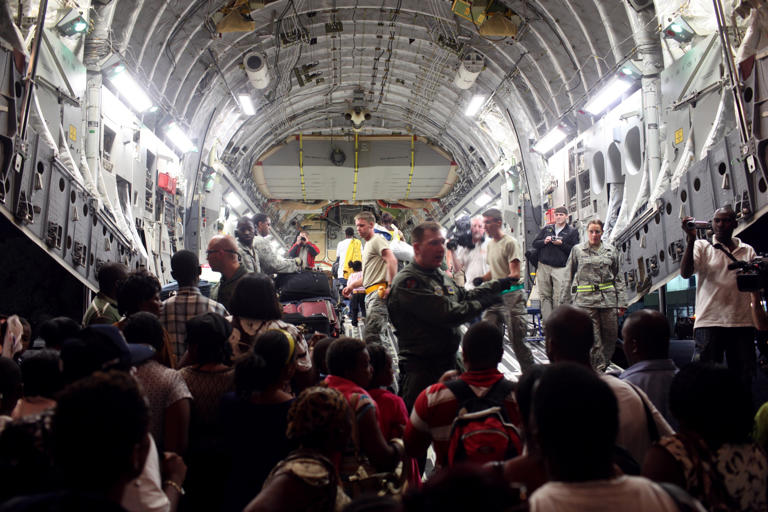
The Department of Homeland Security conducted its largest post-TPS deportation flight on August 20, sending 162 Haitians to Cap-Haïtien — Port-au-Prince’s airport has been closed to US flights because of gang violence. That flight came after the administration informed Haitian officials that deportation flights were expected to increase to at least two per week following the expiration of TPS protections, a rate that would amount to roughly 1,000 deportees per month. The first expanded flight July 16 had already arrived, carrying 111 people.
The DHS press release accompanying the August 20 flight, titled “Home Sweet Haiti,” listed criminal histories of some of those removed, including convictions for sexual offenses, burglary, cocaine trafficking, weapons charges, and alleged gang affiliations with groups like Zoe Pound. Secretary Mullin wrote that “the T in TPS stands for TEMPORARY” and that “previous administrations have used it as a de facto amnesty program for decades.”
Three days after the flight, Viv Ansanm — the gang coalition the State Department designated a foreign terrorist organization last year — attacked Kenscoff. Mayor Massillon called it “a night of terror” as armed men opened fire on residents, torched the neighborhood, and took more than 50 people hostage. Farmer Mathurin Pierre told AP he lost 14 relatives, with others still missing. Resident Marc Paul said his 16-year-old niece was kidnapped and sexually assaulted before managing to escape. “I had to run over bodies,” Paul said.
Romain Le Cour told reporters the attack was “a major political and security test, for the government, for the police and for the international mission.” The attack also specifically contradicted the administration’s progress narrative: according to the Armed Conflict Location and Event Data Project, security in Kenscoff had improved 66% from January through August 2026 compared with the same period in 2025 — and then the massacre happened.
Who Is Viv Ansanm, and What Does It Now Control
The Kenscoff attack was carried out by Viv Ansanm — a Haitian Creole phrase meaning “living together” — a coalition of previously rival gang factions, including the G9 Family and Allies and the Kraze Barye group, that began coordinating operations in 2023 and has since conducted a systematic expansion across the country. The coalition’s Viv Ansanm gang coalition history stretches back to that coordination, and it controls most of Port-au-Prince — an estimated 70 to 90% of the capital. Its ability to strike Kenscoff — a cooler, hillside neighborhood that residents had treated as a last refuge — signaled that the coalition was actively pushing into communities that had so far been spared.
Armed gangs control 90% of Port-au-Prince and are expanding into rural areas. Gang violence has displaced 1.5 million people across Haiti, with more than 3,100 people killed and 796 raped between January and June 2026 alone, according to UN statistics. Between April and June, at least 81 kidnapped April-June — with the UN noting that the actual number of kidnappings is likely significantly higher, because many families negotiate directly with gangs rather than report incidents to authorities.
Haiti’s 2026 humanitarian response appeal required $880 million humanitarian appeal; as of mid-June, only 25% of that amount had been received, limiting life-saving operations at a moment when 6.4 million need humanitarian assistance — more than half of Haiti’s total population.
“Everybody’s Scared”: Communities Already in Limbo Face Escalating Removals
The 350,000 Haitians who lost TPS protection were not criminals. To receive TPS in the first place, individuals had to apply through US Citizenship and Immigration Services — undergoing TPS application and background checks, paying filing fees of more than $500, and submitting documentation. The termination of that status erased their legal protection, not their records.
The Haitian Bridge Alliance estimates that approximately 50,000 US citizen children were born in the US to Haitian parents with TPS, and the loss of those protections has created a large new population of mixed-status families vulnerable to separation. An analysis by FWD.us and partner organizations found that Haitian TPS holders generate an estimated $5.9 billion in annual US contributions and pay more than $1.5 billion in combined federal, state, and local taxes, with approximately 200,000 in the active US workforce. Healthcare faces particular exposure: roughly a fifth of Haitian TPS holders work in healthcare and home health care sectors whose patients depend on them directly.
Father Reginald Jean-Mary, pastor of Notre Dame D’Haiti Catholic Mission in Miami’s Little Haiti neighborhood, said uncertainty has spread throughout his congregation, with many Haitian families afraid to leave their homes and church attendance dropping sharply. He questioned the logic of forcing people to return to a country the State Department itself considers too dangerous for American citizens to visit.
The State Department “Do Not Travel” advisory for Haiti — the highest level, meaning “do not travel” — has been continuously in effect throughout the TPS termination process, citing gang-related crime, terrorism, unrest, and limited healthcare services, as well as an ongoing national state of emergency that began in 2024.
Deportees returning to Haiti face dangers beyond the general security environment. Those deported for criminal matters in particular have long been viewed by Haitian authorities and communities as outsiders blamed for bringing crime, and have reported being targeted by police, imprisoned without charge, surveilled, and harassed. Armed neighborhood watch groups have opposed their presence in communities, and gangs have attempted both to kidnap deportees for ransom and to forcibly recruit them.
“These deportations are adding fuel to an already devastating humanitarian catastrophe,” said Haitian Bridge Alliance Executive Director Guerline Jozef. “The United States is knowingly returning people to a country overwhelmed by violence, mass displacement, and institutional collapse.”
What the DHS Says — and What the Legal Record Shows
The DHS has maintained that TPS was always intended as a temporary program and that the Multinational Gang Suppression Force, which began deploying initial contingents in April 2026, has improved conditions enough to support returns. Critics note that the force remains far below its authorized strength and has had limited impact on gang territorial control.
The Supreme Court’s 6-3 ruling in Mullin v. Doe on June 25, 2026 settled the legal question definitively: federal courts may no longer review the Homeland Security Secretary’s decisions to terminate TPS, or any of the predicate steps in that process. Federal judge Ana C. Reyes confirmed the stay was lifted on August 5, formally ending the last judicial protection for Haitian TPS holders. A racial discrimination claim — Miot v. Trump racial discrimination — continues in district court, with Judge Reyes denying the government’s request to halt discovery, but Mullin v. Doe removed the procedural review that had delayed enforcement for months.
The DHS has encouraged voluntary departure through the CBP Home app, which allows Haitian TPS holders to arrange their own flights home. Those who self-deport receive a free flight, an exit bonus of $2,100, and a waiver of civil fines for failing to depart on schedule. Immigration attorneys warn that most TPS holders do not qualify for other forms of relief, and that the window for legal consultation is rapidly closing.
The Haitian Bridge Alliance has called on Congress to pass S. 4814 Senate bill text, which would require the Secretary of Homeland Security to designate Haiti for TPS for three years. Passage in the Senate faces a 60-vote threshold that advocates concede is difficult under current conditions.
Who Else Is Watching: Salvadorans, and 1.3 Million More
Haiti’s legal ordeal carries direct implications beyond the Haitian community. The Mullin v. Doe ruling removed federal courts’ ability to review TPS termination decisions for all 17 designated countries, covering approximately 1.3 million TPS holders across those nations. Under that ruling, the Homeland Security Secretary can now terminate any TPS designation with no procedural review in federal court — making the Haiti experience the template for what comes next.
The Trump administration is expected to make a decision on the fate of approximately 170,000 Salvadorans with Salvadoran TPS September 9 expiration. The same Supreme Court ruling that cleared the deportation path for Haitians would govern any challenge to a Salvadoran termination.
Meanwhile, Haiti is attempting to press ahead with long-delayed elections scheduled for December 13 — the country’s first in more than a decade — while the 2026 humanitarian appeal remains critically underfunded and the gang coalition that just conducted the Kenscoff massacre holds an expanding portion of the country.
What Is Happening to People Sent Back
Haiti’s Group Supporting Refugees and Returnees has warned that “Haiti is not ready to receive this number of migrants,” noting that more than 140,000 Haitians had already been deported from neighboring countries, primarily the Dominican Republic, in the first half of 2026. The country’s absorption capacity is under strain before the US deportation program reaches its planned scale.
For individual deportees, the legal and physical risks are immediate. Removal proceedings are ongoing; those without other lawful immigration status have been ordered deported and face arrest. Employers are required to reverify workers who previously held TPS. Immigration attorneys recommend immediate legal consultation for any affected individual, as some TPS holders may qualify for asylum, family-sponsored petitions, or other forms of humanitarian relief — but options are narrow and time-limited.
The Kenscoff hostage situation remained unresolved as of August 26, with gang leader Izo 2 threatening in a posted video to execute the more than 50 remaining captives if security forces continued their offensive.
Frequently Asked Questions
Is Haiti actually safe for the people being deported there?
The Level 4 “Do Not Travel” advisory for Haiti — the highest possible rating — has been in continuous effect throughout the deportation program, citing gang-related crime, terrorism, kidnapping, limited healthcare, and an ongoing national state of emergency. The same federal government carrying out deportations to Haiti advises American citizens not to travel there. The Kenscoff massacre three days after the largest post-TPS deportation flight — in which Viv Ansanm killed 47 people and kidnapped more than 50 in a community previously considered one of the country’s last safe neighborhoods — directly illustrated the conditions awaiting deportees.
What happened in Kenscoff, and why does it matter for deportation policy?
The Viv Ansanm FTO designation confirmed gang coalition attacked the hillside community of Kenscoff on the night of August 23-24, 2026, killing at least 47 people (including five children), kidnapping more than 50, and setting fire to 25 homes and vehicles, including a church sheltering displaced families. The attack struck what had been regarded as one of the few safe communities near Port-au-Prince and occurred three days after the US sent 162 deportees to Haiti. The UN confirmed the toll on August 26. The attack directly contradicted the administration’s argument that conditions in Haiti have improved enough to support returns.
How many Haitians face deportation, and what happens to the US citizen children of TPS parents?
Approximately 350,000 Haitians lost TPS protection following the Supreme Court ruling in Mullin v. Doe on June 25, 2026, which invalidated their employment authorization documents when its mandate issued on July 27. An estimated 50,000 US citizen children at risk were born in the US to Haitian TPS parents; the loss of parental TPS creates mixed-status families in which children who are American citizens face either family separation or accompanying their deported parents to a country facing an active humanitarian crisis. An analysis by FWD.us estimated that 25,000 of these children would be pushed into poverty by their parents’ removal.
What can Haitians facing deportation do right now?
USCIS has directed those without TPS to its USCIS “Explore My Options” page, but immigration attorneys warn that most Haitian TPS holders do not qualify for other forms of relief. Pathways that do exist include asylum claims, family-sponsored petitions, and other humanitarian relief — each narrow and requiring immediate action. The DHS’s CBP Home app allows individuals to arrange voluntary departure and receive a $2,100 exit bonus and civil fine waiver; attorneys note that voluntary departure may preserve some future immigration options that a forced removal would not. Anyone affected should consult an immigration attorney immediately, as enforcement pressure is intensifying and the window for legal action is closing.