I died for several minutes — I met Jesus who sent me back with a message
On the morning of April 1, 2008, Chase Skylar DeMayo didn’t show up for work at Langley Air Force Base, where he was posted as a survival evasion resistance and escape instructor.
His supervisor used a key to access his dorm room and found him unconscious, so the then 19-year-old was rushed to hospital for x-rays and blood tests.
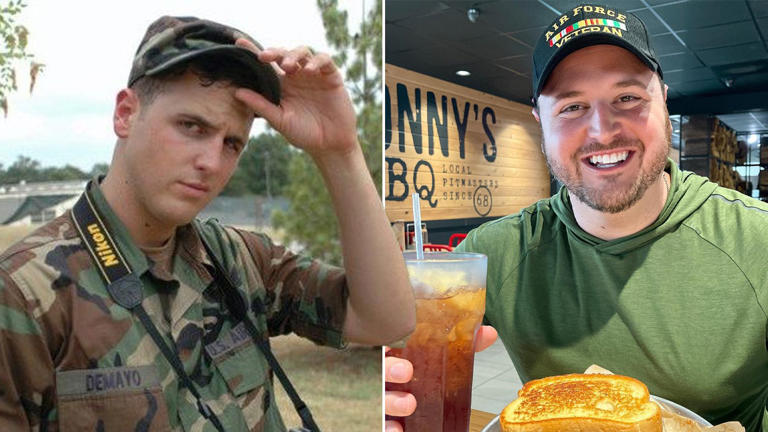
Doctors couldn’t find anything wrong, but it was there, he died for several minutes, after watching his heart monitor flatline, and got a glimpse of what happens when you die.
Lying on his hospital bed, Chase’s vision suddenly blurred and everything went hazy.
‘The last thing I heard was alarms going off,’ Chase, 38, explains. ‘A calming voice told me that it would be OK, and I felt no fear at all – only peace.’
An air embolism had entered his IV drip at the hospital, causing his cardiac arrest.
‘The pain that came up my arm felt like something five, ten times too large in that vein, it was so painful you could almost feel every centimetre of it travelling up,’ he told Coming Home, a YouTube channel that covers near-death experiences.
Once his heart stopped, he recalls floating in mid-air as he was greeted by a familiar face and voice; Jesus. It makes sense, since growing up in Orlando, Florida, he was adopted by his grandparents and experienced a religious upbringing.
‘I watched my body from above as I spun upward like a tornado, surrounded by lights, angels, laughter and music like bells,’ the married dad-of-one says.
‘I ended up in a vibrant garden with colours brighter than anything here on Earth. There, I saw Jesus.’
He explains he didn’t look how Jesus was typically depicted, instead wearing a warm smile with curly brown hair and green eyes.
‘He was playing with a child who was my younger, happier self,’ Chase adds. ‘We connected without words. He told me to go back and spread love, laughter, light and joy.
‘And reminded me of my true purpose on Earth beyond everyday struggles. No matter my past, I had light to chase and share.’
He had had a few difficult months prior to this, having suffered an injury in both knees, which left him in the process of being medically retired from the military, and which meant he lost his sense of purpose.
But, as he died, Jesus was there, in heaven telling him his time hadn’t yet come.
‘I was always a happy kid but I think I’d forgotten that by the time I was 19, I was taking life so seriously and I was so worried about my career and the military, I’d forgotten about being that happy little kid, so it was a beautiful reminder of how I should be,’ he added on Coming Home.
Chase still can’t comprehend that he remembers everything from his near death experience. ‘I was fully aware, and the initial pain I felt turned into calm,’ he says.
‘There was an element of surprise, though no fear about dying. It was peaceful and beautiful, like cool ice leaving my chest.
‘I didn’t want to leave the garden at first, but I understood my purpose wasn’t done.’
When he woke up, he was in a different hospital in Hampton, Virginia, and he was unhooked from medical machines. Miraculously, his heart functioned as if nothing had happened.
‘I was discharged quickly, with tests showing no damage,’ Chase says.
But, in July, 2008, he was medically retired from the army and had to find a new career. He’s just completed his doctorate in holistic counselling, with the aim of guiding people toward their life’s purpose.
‘It’s changed everything for me,’ he explains. ‘I chase forgotten joys.
‘And I live with a reminder each day to live with purpose, chasing light even in dark times. I feel grateful and transformed.’
He didn’t tell his story for years, with fears of being ‘labelled’ a certain way, but he now believes his near-death experience was a ‘gift that reshaped [his] path’.
‘I’m no longer fearful of death and embrace how fragile life is instead,’ Chase explains.
‘I still communicate with Jesus, angels and find peace in the unknown.’
People who have a Near Death Experience (NDE) often report similar things.
A lot of the time their experience is positive and life changing.
NDEs are defined as someone having been considered clinically dead before coming back to life, or the experiences of someone thought to be near death.
Studies show that people who experience them regularly report out of body sensations or seeing a tunnel of light. Some people enter meditative states and feel as though they are in a dream.
And that was the case for Adam Tapp, a paramedic in Canada who was considered clinically dead for more than 11 minutes. So, what did he see?
Speaking on the YouTube Channel Beyond the Veil, Adam claimed to recall being in a ‘state of absolute tranquility’ after ‘dying’ for 11 and a half minutes in February 2018.
While he was working on a woodshop project, a wood-etching tool known as a Lichtenberg device pierced his hand and electrocuted him.
His friend who was with him at the time disconnected the tool and called for Adam’s wife, who is a cardiac nurse.
Adam said: ‘I was moving the electrodes one-by-one and it just arcs into my hands. And it was just this snap from reality. And it was almost overwhelming.
‘It was like this intense, intense level of absolute pain, like every single cell in my body was being pulled into pieces.’
And it was then when Adam says was taken on his NDE journey and he felt like he was ‘falling’ before he saw himself as a single point of awareness in an inky black void he described as something like deep space.
While he was clinically dead, Adam says he was ‘perfect’. He continued: ‘It was this perfect inky blackness. I wasn’t Adam. I wasn’t dead. I wasn’t anything. I was just perfect, like absolute contentment.
‘Then I felt sort of this frequency started washing over me, and it was, it was like this fractal patterns. And it was like gasoline on water, this rainbow effect that was iridescent to some extent and it was just this juxtaposition of thoughts and feelings and emotions.’
Adam explains that he felt like he was being pulled into pieces and becoming part of everything. He said: ‘It was like basically becoming [the] fabric of the universe. And it was absolutely perfect. Like there was no fear and it was nothing.
‘This was just the natural progression of what every single one of us is going to do, which is go back to the source, go back to this infinite consciousness or infinite complexity.’
But during his experience, he says he then felt like he was being electrocuted again. The paramedics were trying to revive him in an attempt to bring him back to life.
He said: ‘At the time, I didn’t understand what was happening. But in hindsight, it was me being defibrillated. I was defibrillated twice.
‘I was in a ventricle fibrillation arrhythmia, which is basically the heart spasming.’
He says this caused him to become aware of what was happening and he contemplated his place in the universe.
He said: ‘Now I’m aware that I’m Adam, that I’m dead, that I just got electrocuted,’ adding that he was then in a ‘void of being’ for a ‘really long time.’
When he awoke from his eight-hour coma, he was surprised to find out it had only been that long. He said: ‘If someone had told me it had been five years or a decade, I would have been completely on point with that.’
After leaving the hospital, Adam says he started to become hyperaware of himself, such as his natural ‘pheromonal smell’ and ‘the texture of my skin.’
Over time, he says he accepted being in his body but was left with an ‘overwhelming sense that this is just the stage, it’s simply an evolution of consciousness.’
He added: ‘This is simply transient, where we exist right now, and there wasn’t any anthropomorphic figures or people in robes, it was just going back to the source of everything which is the infinite consciousness that permeates everything.’
Death happens to us all, so it’s only natural to want to know what you experience the moment your heart stops beating.
Will you see a bright light or dead loved ones? Will you be confronted with everything you wish you’d done differently? Is peaceful or scary?
There’s a saying that your life flashes before your eyes, it’s a phenomena dubbed ‘life recall’.
You’ll often hear people who’ve had a brush with death say their whole life replayed in their mind — and it turns out, scientists have proved something like this could very well happen when you die.
Neuroscientists have actually recorded the brain activity of someone as they died, and found that their brain waves at the time of death were similar to those that happen when we dream, recall memories and meditate.
Is it just us, or is that oddly comforting? If we’ve peaked your morbid curiosity, then read on to learn more about what happens when you die.
How does life recall work?
The study, published in the Frontiers in Aging Neuroscience in 2023, found that our brain could remain active and coordinated during and even after the ‘transition to death’, responding to the change with a ‘programmed’ ending.
This finding came after an 87-year-old patient developed epilepsy and an EEG was being used to detect the seizures so they could treat the patient.
While they were recording the brain activity, the patient had a heart attack and died, meaning the activity of a dying brain was recorded for the first time ever.
Dr Ajmal Zemmar, a neurosurgeon at the University of Louisville, US, who led the study, explained to Frontiers they investigated the 30 seconds before and after the heart stopped beating and saw neurological differences.
‘We saw changes in a specific band of neural oscillations, so-called gamma oscillations, but also in others such as delta, theta, alpha, and beta oscillations,’ he said.
Oscillations is a fancy term for brain waves and all the aforementioned types of brain waves, bar delta, are associated with dreaming, memories and information processing – which amount to flashbacks.
Delta brain waves are associated with deep sleep are certain states of consciousness.
‘The brain may be playing a last recall of important life events just before we die, similar to the ones reported in near-death experiences,’ Dr Zemmar speculated.
‘These findings challenge our understanding of when exactly life ends and generate important subsequent questions, such as those related to the timing of organ donation.’
It’s important to remember though, that this study only had a single patient who had also suffered seizures and swelling but Zemmar is hopeful that this knowledge comforts those who have lost or are losing loved ones.
‘Although our loved ones have their eyes closed and are ready to leave us to rest, their brains may be replaying some of the nicest moments they experienced in their lives,’ he said.
Visioning
But it’s not just at the point of death that we see things, we also experience visioning as part of the dying process.
It’s one of the six deathbed phenomena described by hospice nurse Julie McFadden, 41, who’s based in LA and spends her time administering palliative care.
‘Visioning is wild,’ Julie says. It’s not about hallucinations and psychosis, or seeing things due to mental illness. ‘It happens to many people, it’s always comforting and the person is almost always alert and oriented,’ she explains.
‘People always say “oh it’s the medication or the lack of oxygen” or “they’re just confused”, but… most people who have visioning are none of those things.
‘It usually happens a few weeks before death, they can be up and having a normal conversation with their family and saying they’re seeing their dead father in the corner who is smiling and telling them he’s coming to get them soon and not to worry.’
The best thing to do as a family member witnessing your loved one experiencing visioning is to ‘just go with it’, according to the nurse.
She says that people typically experience visioning about a month away from death.
The death reach
Sometimes visioning goes hand-in-hand with what is called ‘the death reach’.
‘This is when a person is lying in bed and they reach up in the air, almost like they’re seeing someone or reaching for someone to hug them or to shake their hand,’ Julie explains.
This can be for a prolonged period of time too. Again healthcare professionals don’t necessarily know why this is happening but it’s normal.
While nothing is fully understood yet, it’s clear that our brains work in mysterious ways when our time comes to pass on. At least now, you have a little bit of an idea as to what you can expect.
What happens to your body after you die, according to an embalmer
Lianna Champ, 59, the UK’s first female undertaker and embalmer, has made dead bodies her life ever since seeing her first one at the age of 15. We enlisted her to walk us through everything that happens, between the time of death and the funeral.
‘Once the heart stops beating the energy of the body stops,’ she tells Metro. ‘It’s our energy and blood flow that keeps us warm, so the body will start to cool and it’ll go through a period of processes and changes, which is what we know as decomposition.
‘Rigor mortis sets in a few hours after death. It’s a chemical reaction that is caused by a lack of oxygen and biochemical changes in the body after someone has died. This causes the muscles to stiffen and contract.’
Lianna says that people mistakenly believe that if you attempt to move limbs or fingers during rigor mortis you will break the bones, but this is not true.
She says: ‘If somebody’s hand went stiff and you were to gently bend their fingers you would be breaking down the rigor mortis because it doesn’t last, it breaks down itself naturally after about 48 hours.’