Iranians feel the pain as their economy descends into a death spiral
War has imposed a heavy cost on Iran’s economy: more than a million people out of work, soaring food prices and a prolonged internet shutdown that has slammed online businesses.
The question is how much more pain Iran’s leaders are willing to tolerate as they try to negotiate a favorable end to the war.
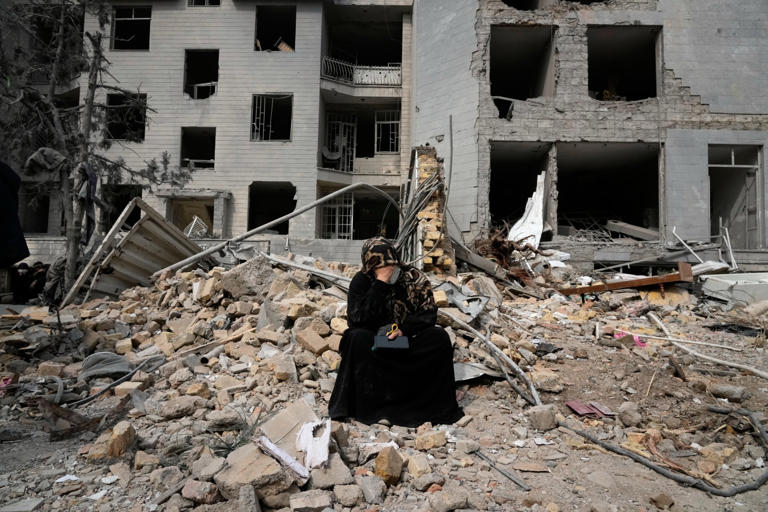
Talks between the U.S. and Iran have stalled. American officials are betting that Iran will soon crack because of the deepening economic crisis. Iran is betting the U.S. will crack first and end its blockade of Iranian ports to calm global markets and bring down American gasoline prices.
To contain the economic fallout, the Iranian government has raised wages, subsidized basic goods and handed out cash to the poor. But authorities are confronting a level of hardship not seen in decades, according to residents.
“It is an authoritarian regime, and it can claim that resisting economic pressure is a question of national pride,” said Alex Vatanka, a senior fellow and Iran expert at the Middle East Institute. At the same time, “As the money dries up because of the blockade, we may find that more and more folks have no choice but to mobilize politically,” he said.
At the center of the fight is the continued closure of the Strait of Hormuz, the conduit for roughly a fifth of the world’s oil and liquefied natural gas.
Iran closed the strait early on in the conflict, effectively using the waterway to hold the world economy hostage. The U.S. responded with a naval blockade of its own, dealing a devastating blow to Iran’s already-battered economy.
Daily struggles
Government revenue has dried up just as the needs of its population are rising.
The war has thrown around one million people out of work directly and another million indirectly, according to early estimates cited by Gholamhossein Mohammadi, an official at Iran’s Labor and Social-Affairs ministry. That is a significant portion of the roughly 25 million people who are normally employed in Iran.
The cost of living has soared, with the annual inflation rate reaching 67% in the month through mid-April from the same period a year earlier, according to Iran’s central bank. The subsidized price of red meat, which was mostly imported through sea routes, has gone up to the equivalent of around $3.60 a pound, beyond the reach of most in a country where the minimum wage is around $130 a month.
Iran’s national currency on Wednesday hit a record low of 1.8 million rial to the dollar.
“Living is not affordable anymore,” said Mahdi Ghodsi of the Vienna Institute for International Economic Studies. “Iran is at its weakest point.”
Businesses across the country—from manufacturers to retailers—are closing, residents said. The lack of steel and other raw materials is hampering production in various industries. Electronic goods, which are mostly imported, are in short supply and expensive.
War damage
Iran’s economic meltdown predates the war, crippled by years of U.S. and international sanctions. The collapse in the value of the local currency and fast-rising prices triggered mass antigovernment protests at the turn of the year. The regime crushed the protests with lethal force. The economic woes that underpinned the protests have worsened since the start of the war, raising the possibility that the unrest could flare up again.
The bombing campaign by Israel and the U.S. caused extensive physical damage to roads, ports and residential buildings. It also hit vital industries, including the country’s main steelmaking and petrochemical factories. Iranian state media estimates that postwar reconstruction could cost around $270 billion, a crippling sum for a country with an annual gross domestic product last year of $341 billion.
Before the blockade, most of Iran’s oil exports and most of its imports—from food to pharmaceuticals to raw materials—transited through the Strait of Hormuz.
Now, Iran is struggling to ship oil and other commodities that generated most of its revenue, shipping records show. As recently as March, Iran exported 1.85 million barrels of crude oil a day, worth $191 million at international prices. There is no evidence any Iranian oil cargo has breached the U.S. blockade and reached Chinese customers or other buyers, said Homayoun Falakshahi, a senior oil analyst at the commodities-data company Kpler.
Iran is pushing for a quick reopening of the Strait of Hormuz, an indication of how vital it is to its economy. Tehran has presented regional mediators with an offer to stop its attacks in the strait in exchange for a full end to the war and a lifting of the U.S. blockade of Iranian ports, The Wall Street Journal has reported. Tehran wants to postpone discussions about Iran’s nuclear program.
“The government sees the end of the war as the beginning of a new problem: having to cope with a disillusioned, impoverished citizenry,” said Djavad Salehi-Isfahani, a professor of economics who studies Iran at Virginia Tech. “If crude exports resume, they have some cushion. Iran can project an upward path to recovery, and people can say: these are terrible times, but we will recover.”
Coping mechanisms
The Iranian government has taken steps to contain the economic fallout. It has increased the minimum wage and raised the salary of government employees and continued to subsidize the price of bread, fuel and other essential goods. It is giving cash handouts to the poor and issuing coupons for the purchase of rice, chicken, cooking oil and other goods. It drew from strategic reserves of household staples to soften the economic blow for regular people.
The government has appealed to Iranians to do their part by limiting their consumption of water, electricity and gas. Tehran residents were encouraged to drive less and use public transportation instead.
Iran has taken some protectionist measures, banning the export of steel products. Rasoul Khalifeh Soltani, secretary of Iran’s Steel Producers Association, called on companies to ration their use of steel sheets for the next two months, according to Iranian state media.
Iran is trying to bypass the U.S. blockade by relying on alternative trade routes. It is using rail and road connections with Turkey, Armenia and Azerbaijan as well as the Caspian Sea to the north to import goods, Ebrahim Najafi, an Iranian lawmaker, said recently in the country’s Parliament.
At least 11 vessels loaded with grain, corn and sunflower oil have arrived in Iran’s Caspian ports since the U.S. blockade started, according to Kpler. They had departed from Russia, Kazakhstan and Turkmenistan.
Over the weekend Pakistan announced that it has designated six corridors—both ports and land borders—through which Iranian goods could transit without restriction. Those routes will also be used to import rice and meat.
“Iranians will suffer hardship,” said Mohamed Amersi, an Iran expert and member of the Global Advisory Council of the Wilson Center, a Washington think tank. “But their pain tolerance threshold is higher.”