Iran’s plan to strike back in second round of war
Iran is preparing for the restart of war – and its neighbours across the Gulf are in the line of fire.
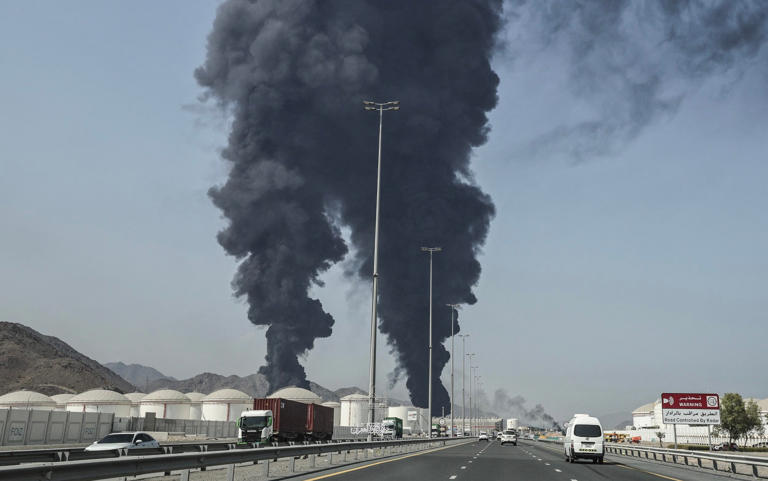
Recent United States intelligence leaks showed that Saudi Arabia and the United Arab Emirates carried out secret strikes on Iran during the war earlier this year.
The revelation has transformed Iran’s military preparations.
Targeting pipelines and oil wells in Saudi Arabia and other Gulf states, closing the Bab el-Mandeb Strait and deploying Iran’s most powerful missiles are all on the table for leaders in Tehran.
The shift in Iran’s approach became evident this week when Donald Trump delayed a planned strike on Tuesday after requests from leaders of Qatar, United Arab Emirates and Saudi Arabia, who argued a deal could be reached within days.
Analysts attribute the postponement to Arab officials’ fear that their forces would be targeted directly rather than only through American bases on their land.
Iran’s military mobilisation not only involves its armed forces but also its civilians.
The typically bellicose state television has shown newsreaders firing AK-47s during live broadcasts and teaching viewers weapon handling, demonstrating how to load magazines, chamber rounds and maintain a proper firing stance.
Public gun kiosks have appeared in Tehran squares, while mosques across multiple cities host combat training sessions for citizens, including children.
Mohsen Barmehani, deputy head of state broadcasting, defended the programmes as necessary adaptations to “war conditions”.
Credit: @Tasnimnews_Fa/ X
“Familiarity with weapons isn’t just a symbol of war and readiness for battle but has educational, cultural and training aspects,” Mr Barmehani said.
Yadollah Javani, deputy political commander of the Islamic Revolutionary Guard Corps (IRGC), said a renewed US attack would produce “much heavier losses than before” and that “exiting the war won’t be as easy as the previous period”.
He claimed that the 40-day war fundamentally strengthened Iran’s strategic position by mobilising Iran’s population and handing it effective control of the Strait of Hormuz, “far exceeding nuclear weapons” in strategic impact.
In the field, Tehran has restored operational access to 30 of its 33 missile sites along and around the strait, classified US intelligence assessments reveal.
Despite US claims of widespread destruction, assessments show Iran retained approximately 70 per cent of its pre-war missile stockpile and mobile launchers.
Credit: @Tasnimnews_Fa/ X
Iran’s air defence architecture relies on vast underground tunnel networks built over decades specifically to survive the kind of sustained aerial bombardment the US and Israel conducted.
These facilities allow Iranian forces to move equipment between hardened positions, present decoy systems to confuse American targeting, and restore damaged sites within hours of strikes.
Tehran has constructed a defensive system based on multiple interlocking layers, each designed to address different threats at different ranges and altitudes.
About 90 per cent of underground missile storage and launch facilities are now considered “partially or fully operational”.
The stockpile includes Khorramshahr-4 ballistic missiles with estimated ranges exceeding 2,000km and capable of targeting regional US bases and allied facilities.
Iran also maintains supplies of Sejjil medium-range ballistic missiles alongside shorter-range cruise missiles designed for operations against naval vessels.
Credit: Reuters
Before US aircraft even arrived, mobile launchers relocated munitions away from anticipated strike zones.
China reportedly sent Iran anti-ship missiles before the war started. One former Trump administration official told The Telegraph that these could now be crucial to the success or failure of a renewed assault by American forces.
Iran has also developed an extensive network of indigenous radars that form the backbone of its air defence and remain functional despite the strikes.
The Sepehr radar is one of Iran’s most advanced long-range systems, capable of detecting aerial targets at distances of up to 3,000km. The Ghadir radar can detect and track aerial targets up to 1,100km away.
The outermost defensive ring consists of long-range air defence systems designed to detect and destroy threats at different distances and altitudes.
Iran also produces a range of man-portable air defence systems, including the Misagh and Shahab Saqeb, lightweight shoulder-fired missiles effective against helicopters and low-altitude aircraft, deployable by individual soldiers.
The Tor-M1 system, bought from Russia and entering operational service in 2007, provides point defence for sensitive installations. It has an operational range of 12km to 20km and can engage targets at altitudes between 10 metres and 6,000 metres.
Iran’s actions suggest forces preparing for imminent combat rather than extended peace.
The IRGC’s Mohammad Rasoul Allah unit – the primary formation responsible for security in the Tehran region – conducted exercises this week designed to “confront any movement of the enemy”.
Credit: @FarsNews_Agency/ X
The drills practised dual scenarios that include battling American-Israeli forces while simultaneously suppressing domestic unrest.
In a separate five-day Basij militia exercise in the capital, paramilitary forces trained to execute “any operation at any point at any time”.
The exercises simulated urban warfare scenarios specifically against “American-Israeli enemy” forces.
Iranian military forces also scheduled drills at Mahshahr Port, located around 100km from Kuwait’s Bubiyan Island.
Rear Adm Shahram Irani, commander of Iran’s navy, announced this week that light submarines equipped with long-range torpedoes have deployed to the waters of the Strait of Hormuz in combat-ready posture.
The vessels possess “seafloor sitting” capability, allowing them to rest on the seabed for extended periods while scanning for enemy ships.
Mr Irani described the submarines as “dolphins of the Gulf” capable of conducting manoeuvres then returning to depths to continue their hunting mission, adding that forces were standing with “finger on trigger” awaiting orders.
Iran has also expanded its definition of the Strait of Hormuz zone, according to Fars News, citing IRGC officials.
Tehran now claims control over waters stretching from Jask on the eastern coast to Siri Island in the west.
The comprehensive preparations – from civilian weapons training to submarine deployments to strategic missile preservation – suggest Tehran is preparing for every possible scenario.
Others interpret the militarisation as strategic messaging: demonstrating resolve while betting Mr Trump lacks appetite for a lengthy war.
For Iranian families watching state television presenters fire rifles and military commanders position submarines for combat, the question has shifted from whether war will resume to when it will happen.