NATO has been using fighter jets to stop drones. One ally says a new Ukraine-inspired anti-drone wall will handle them first.
- Fighter jets have been NATO’s costly answer to incoming drones.
- Latvia is building an automated anti-drone border defense to stop them with cheaper weapons.
- Its defense minister told Business Insider that jets will be the “secondary means” of stopping drones.
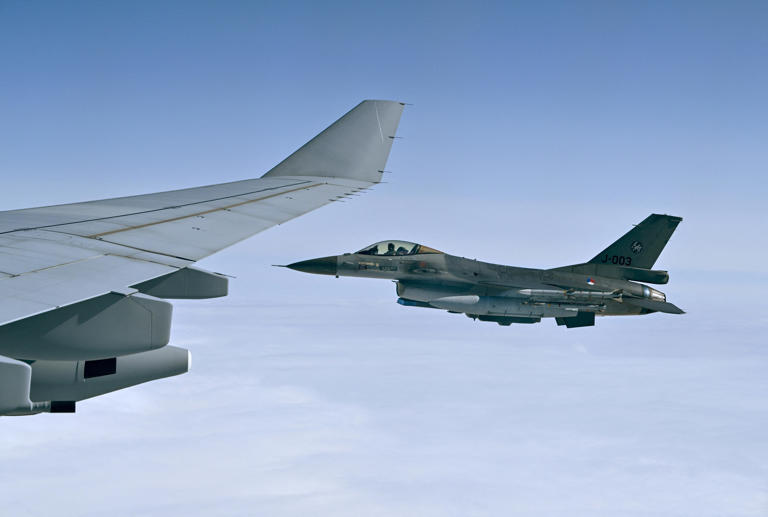
Fighter jets armed with expensive air-to-air missiles have led the way in the fight to take down the cheap drones that breach NATO airspace, a costly dynamic officials say needs to change.
NATO ally Latvia is building a Ukraine-inspired automated anti-drone wall along its entire eastern border with Russia. It is designed to make fighter jets a last line of defense, not the first, Latvian Defense Minister Raivis Melnis told Business Insider. The system is expected to be completed by the end of September.
The system, Melnis said, aims to detect and neutralize “any drone which flies in.” Fighter jets will work instead as “the secondary means” of stopping drones, he said. If a drone penetrates the wall, NATO jets will then be used to intercept it.
Latvia’s approach is aimed at addressing a problem facing NATO more broadly: relying on fighter jets such as F-35s, F-16s, and Rafales to shoot down cheap drones with air-to-air missiles can prove expensive. Surface-to-air missiles can be even more costly, putting defenders in an unsustainable situation.
NATO Secretary General Mark Rutte said in June that “long-term we cannot continue by shooting down drones with very costly interceptors, so we have to find interception techniques which are of the same costs as the drones.”
It’s a problem the US has worried about in its war with Iran, where some Iranian drones were stopped by very expensive interceptor missiles.
Melnis said it’s important that drones are stopped by a “cheap but reliable system.” He described interceptor drones, which the Ukrainians have pioneered as a cost-effective defense, as “a cheap technology in comparison with a missile.”
A border that stops drones
Melnis said that the new anti-drone border is key because ultimately, the “border is not a Russian-Latvian border. It is a Russia-NATO, Russia-Europe border.”
He said that while this segment of Russia’s border is shared specifically with Latvia, “we are NATO, and we are a European Union country.” Any drone that crosses the border, he said, “that’s the drone coming into NATO airspace. That’s the drone coming into Europe.”
The defensive plan was inspired by Ukraine, which has developed a host of cheap interceptor drones to stop Russian attack drones without using expensive air defense missiles. That development has been a wake-up call across Europe.
Latvia still values NATO’s air-policing missions, which bring aircraft and pilots from across the alliance to defend its airspace. Those missions have expanded at Latvia’s request in response to recent drone incursions.
But Russia’s war against Ukraine has demonstrated the limitations of relying on expensive defenses against cheap drones, which can be launched in large numbers and overwhelm air defenses.
Melnis said that the goal is for soldiers to make only “the final decision to neutralize” a drone. “Otherwise, detection, tracking, and launching, that’s autonomous,” he said, allowing Latvia to rely on technology to reduce the number of soldiers needed to operate the system.
Learning from Ukraine’s counter-drone warfare
NATO allies are turning to cheaper air defenses, such as interceptor drones, and learning lessons from Ukraine; however, most are still far from fielding new solutions at scale. Latvia is moving especially quickly.
Melnis said that Latvia’s defense planning was driven by observations and lessons from the war in Ukraine, where interceptor drones are proving to have a “really high reliability and kill ratio” against the threat of Russian drones.
Latvia is keenly focused on preparing for Russian aggression. It has been facing what it calls hybrid attacks, including cyber attacks, arson, espionage, and disinformation campaigns. Moscow has also threatened military action against the country.
Melnis said Latvia is not seeing any Russian direct military aggression or conventional threat against Latvia or any other NATO member, but Russia is attempting to “break our cohesion, unity, break our will to support Ukraine.”
He said supporting Ukraine, which Latvia has strongly backed, helps protect Latvia and the rest of NATO by keeping Russia from advancing and rebuilding its forces. Latvia is closely studying Ukraine’s battlefield experience and working with Ukrainian defense companies to apply those lessons at home.
Latvia, he said, should “look at those lessons and then decide what’s the best practice for us to take,” rather than simply copying Ukraine. He said Ukraine can help NATO “build an understanding of how to fight such a war like they are fighting and to build our capabilities to be ready for a war,” though a conflict involving Latvia, as a NATO ally, could look very different from Ukraine’s war.