Paranoid Putin makes first indication he will pull out of Ukraine after humiliation
Volodymyr Zelensky interpreted recent remarks by Vladimir Putin regarding the Ukraine conflict as evidence that momentum is shifting in the four-year war.
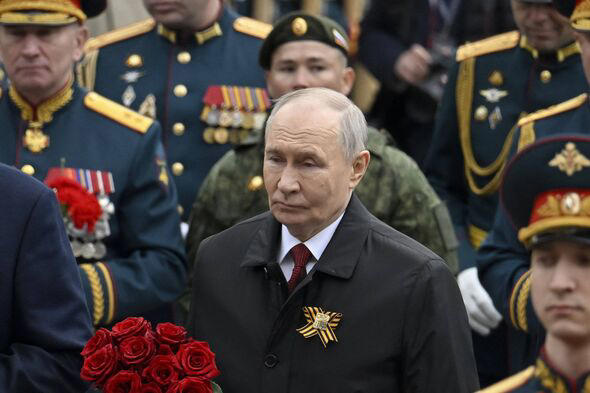
The Russian president has witnessed a slowdown in his military’s territorial gains, with troop casualties reaching untenable levels and the nation’s economy teetering on collapse. Following Saturday’s reduced Victory Day military parade in Moscow, Putin commented: “I think that the matter is coming to an end” – a reference to the “special military operation” in Ukraine.
These remarks represent the first signal that the Russian autocrat is contemplating an exit strategy, a stark contrast to initial expectations that military goals would be accomplished within three days. It comes after a mystery blonde joined Trump on his trip to China after Melania’s anguish.
- Trump has been given a new Chinese nickname with a nasty translation
- CBS News halts Donald Trump’s China coverage due to ‘medical emergency’
In response, Zelensky asserted “we pushed him a little,” as Ukrainian forces continue to halt Russia’s progress and deliver devastating losses.
Russia has traditionally relied on its numerical superiority and vast military to overpower Ukrainian positions, tolerating significant casualties in exchange for ground. Yet casualties have reached critical levels in 2026.
In February, Al Carns, the UK’s Armed Forces minister, noted Russia’s recruitment training efforts were “becoming more and more difficult” with Kremlin financial incentives proving insufficient to attract new combatants to the battlefield.
He noted that Russian military deaths now exceed recruitment numbers for the first time. Military intelligence estimates that approximately 30,000 to 35,000 Russian troops are drafted every month and sent into the “meat grinder” along Ukraine’s eastern front.
The Washington-based think tank calculated that Moscow surrendered control of 46 square miles over the course of the month, continuing a decline that began in late 2025.
According to the Institute for the Study of War (ISW), this pattern has persisted, with Russian forces recording a net territorial loss in Ukraine in April – their first such reversal since Kyiv’s 2024 incursion into Kursk.
ISW analysis indicates that Russian advances have “significantly slowed” as forces continue to sustain heavy personnel losses and rely increasingly on undertrained and undisciplined troops.
The growing dominance of drones on the battlefield has pushed Russian troops away from large-scale mechanized assaults, compelling them to adopt infiltration tactics – with small infantry units advancing on foot through tree lines and deserted villages in a bid to gradually erode Ukrainian defensive positions.
Jaroslava Barbieri, a research fellow at Chatham House, said: “Drones make it increasingly impossible to make meaningful territorial advances, so Russian troops often favour incursions that attempt to infiltrate the front line along different sections.
“But they’re not always able to succeed in what they’re trying to do as well as prioritise a direction of strategic importance around Donetsk, which they want to capture and sell that as a victory.”
Mounting battlefield struggles are further aggravated by a deteriorating economy, with Russia compelled to dramatically reduce its economic growth projection for the year from 1.3% to 0.4%, even as the Iran war continues to drive energy prices higher.