Putin critic found dead in Portugal
Prosecutors in Portugal have opened an inquiry into the death of a Ukrainian activist who was a vocal Vladimir Putin critic.
Pavlo Sadokha, 56, was found dead on Sunday in Quarteira, near the tourist resort of Vilamoura, while on a work trip.
Police called to the scene did not detect any evidence of a crime, and it was later found that he had a history of heart issues.
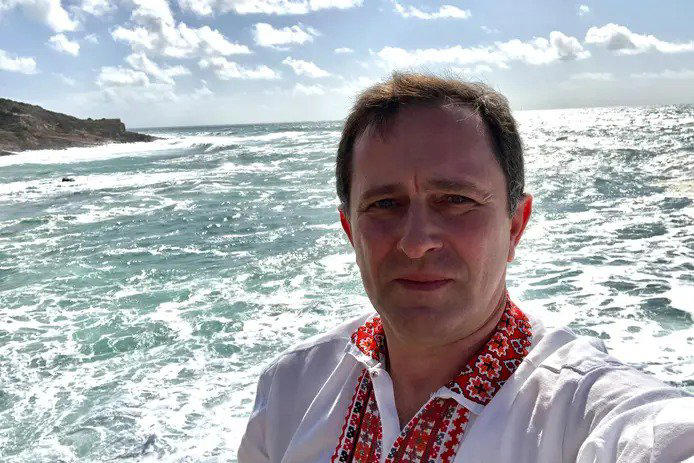
But overnight, it emerged that Portugal’s Public Prosecution Service opened a probe to rule out the involvement of third parties in Sadokha’s death.
Friends and relatives told respected Portuguese daily Correio da Manha that his health was ‘perfectly under control’, and he had undergone recent tests.
Mykola Shymonyak, Vice-President of the association Sadokha presided over at the time of his death, told the newspaper they had pressed for a full autopsy ‘to examine all the possibilities’.
‘Everyone wants to do everything possible to make sure doubts are clarified,’ he said. ‘Our objective is that all the possible hypotheses are fully investigated. It’s a duty we have towards our compatriot.’
The initial autopsy has already taken place, but it will be around three or four weeks before the results of toxicology tests due to be carried out on his blood and tissue samples at a specialist lab will be known.
Sadokha had lived in Portugal for more than two decades. The Ukrainian World Congress issued a statement, mourning his passing.
‘Pavlo dedicated decades of his life to Ukraine and to serving the Ukrainian community in Portugal,’ they said.
‘He was a key member of the UWC leadership team and was instrumental in establishing the Ukrainian Youth Association (CYM) in Portugal. For many years, he was one of the strongest voices for Ukrainians in Portugal.
‘He helped organise Euromaidan solidarity actions in Portugal in 2013-2014 and, following Russia’s aggression against Ukraine, organised rallies, appeals to Portuguese government officials and support for Ukraine’s defenders.’
UWC President Paul Grod added: ‘Pavlo was a highly regarded Ukrainian community leader in Portugal and on the world stage. He was a close friend and someone I could always count on.
‘He cared deeply and dedicated his life to serving Ukraine and its people around the world. This is a massive loss, and he will be missed deeply. May his memory be eternal.’
In June last year, Sadokha accused the Kremlin of militarising children in Tenerife through Russian-backed organisations he said were running Soviet-style military-patriotic games.
He led protests against Brazil president Lula da Silva in 2023 during his five-day official visit to Portugal after the political leader angered many in the West for suggesting both Ukraine and Russia were to blame for the conflict that began when Moscow attacked its neighbour in February 2022.
Protestors held up signs outside the Brazilian embassy saying: ‘Russia is a terrorist state’ and ‘Stop killing our children.’
Pablo Sadokha said at the time: ‘People die in Ukraine every day and we need international support.’
We’ll lose to Russia without more drones and warships, navy chief warns
Britain must become a naval superpower once again or risk defeat at sea against Vladimir Putin’s fleet, the head of the Navy has warned.
General Sir Gwyn Jenkins said Russia is ‘probing Britain for weakness’ and may seek to use the UK’s own war tactics against it by targeting vital underwater cables on day one of any future conflict.
In a private speech yesterday, the First Sea Lord said we must ‘strengthen our warfighting readiness’ by urgently building more warships and drones to guard the Atlantic.
Sir Gwyn said: ‘The greatest threat to our security today is Russia.
‘Russia retains advanced submarines that are increasingly difficult to track, long-range precision weapons, and specialist systems designed to operate deep underwater.’
The Navy is having to deploy two warships a week to track Moscow’s vessels, which he said are ‘probing, testing and mapping’ the sea floor for weaknesses.
Sir Gwyn said: ‘Critical undersea infrastructure is now part of the strategic landscape. On the day that the UK declared war on Germany, the allies severed its transatlantic telegraph cables.
‘I pray it does not happen, but were we to go to war again, we know our enemies will try to use the same playbook against us.’
He added: ‘Sea power not only sustained us during the war. It arguably saved us. Lose the war at sea and you lose the war. That was the warning of Admiral Pound, the First Sea Lord of the day, and it remains true now.
‘If we are to prevail in the Atlantic again, we must strengthen our warfighting readiness and rediscover what it means to be a maritime nation.’
Sir Gwyn’s warning came on the day Prime Minister Andy Burnham met with Nato chief Mark Rutte for the first time in person.
The Prime Minister faces political pressure to show how the UK will meet its Nato commitment of allocating 3.5% of gross domestic product – a measure of the size of the economy – for core defence spending by 2035.
Chancellor John Healey quit as defence secretary in Sir Keir Starmer’s administration in a row over funding, arguing that it was necessary to reach 3% by 2030.
Mr Rutte used a speech later on Wednesday to praise the UK for being ‘serious about security’.
‘It is leading, along with Nato allies, the push back against Russia’s dangerous and reckless campaign against us,’ Mr Rutte said.
He added: ‘Collectively we will continue to strengthen our ability to deter and defend all allies, against any threat.
‘Nato will not be intimidated by Russia’s campaign of hostile actions. Russia wants to stop us helping Ukraine – but their actions will only lead us to do more for Ukraine. Russia’s actions are a sign of weakness, and a symptom of Putin’s failure in Ukraine.’
Nato allies have agreed to hike spending on security to 5% of economic output by 2035 including the 3.5% target on core defence spending, amid burgeoning threats from Russia and China and demands from Donald Trump’s America that European member states invest more in their own security.
Mr Rutte praised British efforts already under way to hike defence spending, which is expected to rise to around 2.7% of GDP by 2027.