Russia ‘planning drone attacks on southern Europe’, CIA warns
Russia is planning to launch seaborne drone attacks against Italy, Spain and France, according to the CIA.
Moscow intends to expand its focus from Eastern Europe and the Baltics to the Mediterranean and Western Europe.
Vladimir Putin’s regime intends to launch drones from container ships out at sea, hitting ports, airports and other infrastructure, according to El Mundo, the Spanish newspaper.
Drones launched from merchant ships could reach the entire eastern half of Spain, including Madrid and the holiday destinations of Andalucia, practically all of Italy aside from the country’s north-east, and most of southern France, including Toulouse and Marseille.
The CIA reportedly tipped off Paris, Madrid and Rome about the possible escalation of probing attacks against Nato countries on Europe’s southern flank.
“They will use drones launched from the sea, concealed in shipping containers; it is not difficult at all,” an unnamed source close to the Lithuanian ministry of defence told El Mundo.
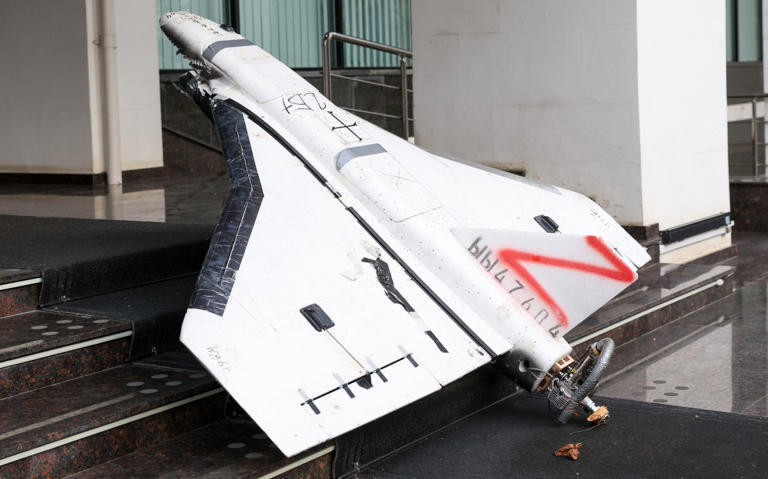
Lithuanian authorities have reportedly been informed that the type of drone that Russia is planning to use would be a Gerbera, a relatively small aircraft that could be concealed inside merchant shipping containers and launched via a catapult.
The Gerbera is about 2m long and has a wingspan of 2.5m.
It can reach speeds of around 99 mph (160 km/h) and has a maximum range of around 373 miles (600km).
A merchant ship could carry several such drones, and they are easier to launch than Geran or Shahed drones.
The Gerbera’s small payload is insufficient to destroy a large facility, but it could cause considerable damage, temporarily shutting down a port or airport.
Vilnius and other European capitals have been aware of the warning about new drone attacks since shortly after CIA director John Ratcliffe’s mysterious trip to Moscow on Aug 25.
Media reports have suggested that Mr Ratcliffe went to warn Russia against any attack or provocation targeting Nato.
The Danish defence intelligence service said there was a growing risk of Russian military action against Nato countries and that while an outright invasion was “highly unlikely”, it could not be ruled out.
Russia’s objective in launching drone attacks on France, Spain or Italy would be to sow division and exploit domestic political differences over support for Ukraine.
All three countries will be holding elections next year.
In Italy, there are parties within the governing conservative coalition and the centre-Left opposition that are trenchantly opposed to sending more military and economic aid to Kyiv, believing that the support simply fuels the conflict.
Jean-Luc Mélenchon, a Left-wing leader in France, has blamed the intensification of Moscow’s threat in Europe on Ukraine’s “long-range attacks” on Russia.
Keir Giles, a British analyst specialising in Russian military strategy, said Spain’s distance from the Russian border offered no guarantee of safety.
“It is not necessarily the front-line countries that will be targeted. The target will be wherever Europe’s weakest point lies,” he told El Mundo.
Mr Giles said Spain, like the UK, was especially vulnerable because it had “not invested in integrated air and missile defence systems adequate to the Russian threat. Russia looks for where any given action will have the greatest impact based on a lack of resilience, civil defence and political fragility”.
The choice of target is driven by “a constantly changing equation”, said Mr Giles. Moscow calculates where it can achieve the greatest result relative to the risks and resources it is willing to commit.
Four Russian drones entered Moldova’s airspace on Thursday morning, highlighting Moscow’s escalating campaign of provocation.
“Russia’s massive attack on Ukraine reached Moldova again this morning. Four Russian drones violated our airspace, and at least one exploded in the north,” Maia Sandu, the president of Moldova, wrote on X. “Russia’s war endangers all of Europe.”
The report by El Mundo caused alarm in Italy. “The news of a possible attack by Russian drones against Italy requires an immediate clarification from the government,” said Lia Quartapelle, an MP from the main opposition force, the Democratic Party.
“Is it correct? And what is the government doing, along with other European countries, to protect us from these risks?”
Emmanuel Macron convened the French defence council on Sept 16 and summoned the leaders of all political parties and candidates for the 2027 presidential election to the Élysée Palace two days later.
He said: “The nature of Russian aggression and threats in Europe is changing. No one is safe.”
The Kremlin’s sabotage tactics, which until now have mainly targeted state or military assets, such as the drone attack on a cargo plane in Leipzig last month, now appear to be shifting toward targets that could result in civilian casualties.
Mr Macron ordered his government to prepare a plan to protect critical infrastructure and sensitive defence-industrial sites against drone and cyber attacks, warning that further Russian aggression would not go unanswered.
The French president is expected to warn of the growing Russian threat to Europe and France’s energy crisis in a television interview on Thursday evening.
Recommended
Russia wants to undermine Nato. Here’s what Putin might do