See how the Houthi advance was powered by arms from Iran and China
In a matter of weeks, Yemen’s Tehran-backed Houthis have catapulted themselves into the heart of the conflict in the Middle East.
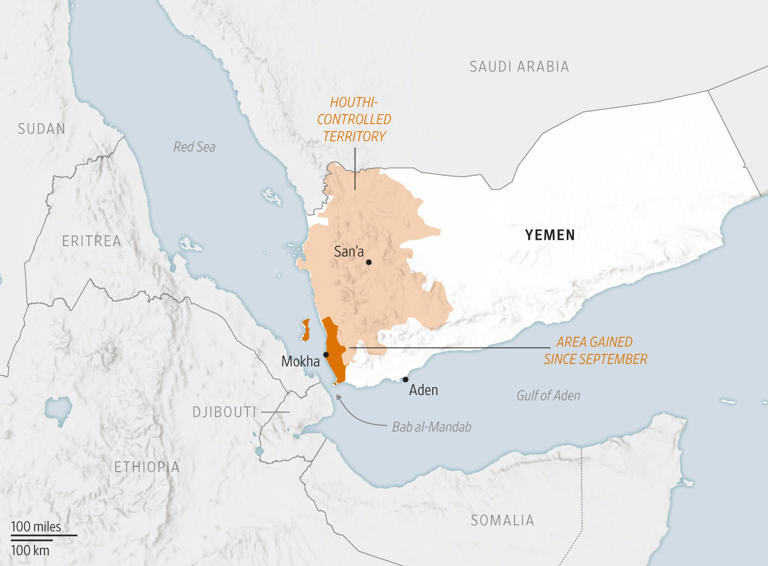
The militant group has stepped up attacks in the Red Sea, expanded its footprint along the Yemeni coast and asserted control over the Bab al-Mandeb Strait, a crucial corridor for global energy.
Here is a look at how the Houthis have enlarged their sphere of influence to become key players in the wider war between the U.S. and Iran—and the weapons and tactics they have used to do so.
The Houthis, with an estimated 350,000 fighters, burst out of the territory the group has held for over a decade in western Yemen. In the lightning offensive, Houthi militants seized islands in the Red Sea and expanded their dominion on the mainland, including the port city of Mokha.
They had been preparing for the assault for months. In mid-August, they moved weapons and thousands of troops to positions around Mokha, threatening their opponents’ supply lines. They used their control of Yemeni telecoms systems to listen in on their enemies’ calls and to sow confusion and intimidate their rivals into giving up.
The Houthis lack a traditional navy, but they operate a disruptive, asymmetric maritime force along Yemen’s coastline, relying on Iranian-designed land-based missiles, explosive drones, sea mines and armed fast-attack boats, as well as drone boats, to assert control.
What is in the Houthis’ arsenal?
The Houthis’ arsenal of ballistic and cruise missiles, antiship weapons and drones draws heavily on Iranian technology and components. The group can produce or modify some weapons in Yemen, while relying on Iran for more sophisticated systems and technical assistance. Many of these weapons are stored in underground facilities, according to the U.S. Defense Department.
Around 2015, the Quds Force, the external operations arm of Tehran’s Islamic Revolutionary Guard Corps, started sending the Houthis components to assemble Iranian-designed missiles and drones. The Iranians also sent trainers to teach the Houthis how to build the weapons themselves—turning the ragtag guerrilla group into a high-tech army able to hit Saudi oil facilities, disrupt Red Sea shipping traffic and even threaten the U.S. military.
The Houthis frequently use Waid suicide drones, local versions of Iran’s Shahed. The group has also launched the more sophisticated Samad drone to attack Saudi Arabia, the United Arab Emirates and Israel.
The Houthis are also the first nonstate actor to deploy antiship ballistic missiles, adapted for operations in the Red Sea. The best known is the Sayyad, which is able to search and lock onto vessels using radar reflections.
The Houthis now have a new source for the supplies they need to launch their attacks: China.
Chinese companies are supplying the group with so-called dual-use goods that can be used for both military and civilian purposes. The goods are particularly critical for its drone technology, according to United Nations reports and data gathered by arms experts.
For a decade, the Revolutionary Guard used small fishing boats, known as dhows, to smuggle small arms, drone components and missiles out of Iran to the Houthis. But many have been intercepted by U.S. authorities and groups in Yemen opposed to the Houthis.
The Houthis have also been using Djibouti, an African coastal state on the other side of the Red Sea, to transfer weapons, and are trading small arms with al-Shabaab, the Somali branch of al Qaeda, U.N. reports show.