The journalist the FSB bugged in Moscow thinks he knows why Trump fears Putin
Luke Harding says his own experience of FSB surveillance in Moscow explains why he believes President Donald Trump is afraid of Vladimir Putin. It is an allegation, not a verified fact.
Author Luke Harding says he knows why President Donald Trump “truly fears” Vladimir Putin: the Russian leader, in Harding’s view, almost certainly holds compromising material on the American president, and Trump knows it too.
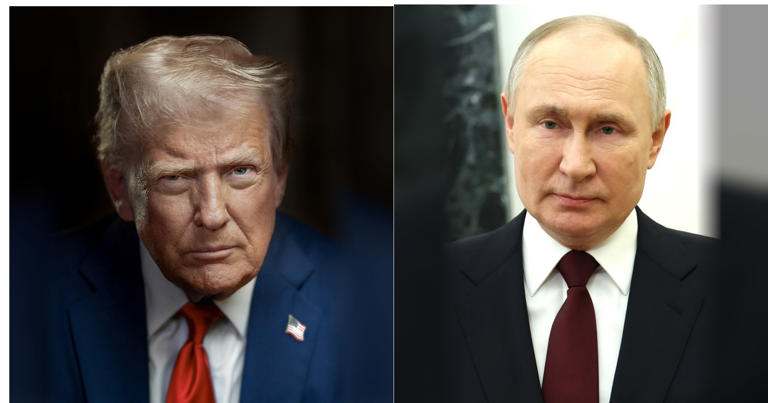
Harding, the veteran Guardian correspondent and author of The Betrayal: Trump, Putin and The New Age of Conquest, made the claim on The Daily Beast Podcast in a conversation with host Joanna Coles. He argues that Trump, 80, “excessively appeases” Putin, 73, out of fear rooted in the Kremlin’s formidable surveillance machine, and he speaks from personal experience of how that machine operates.
What Harding actually claimed
Harding’s argument is straightforward, even if the evidence behind it is not. Trump, he told Coles, is “afraid” of the Russian president because Russia’s intelligence services likely gathered compromising material on him years ago, and Putin can deploy that leverage at any moment.
That would explain, in Harding’s telling, a pattern he finds striking: a president who is combative with allies and rivals alike but consistently gentle with Moscow. Harding frames Trump’s deference not as strategy or ideology but as something more primal, the behavior of a man who knows what the other side has on him.
It is worth being precise about what this is. Harding is offering an interpretation, a seasoned journalist’s read of a relationship that has never been fully explained. He is not presenting a leaked intelligence file or a verified document. The claim is an allegation, and it should be weighed as one.
Inside the FSB’s playbook
Harding’s confidence comes partly from his own biography. In 2007, while working as a correspondent in Moscow, he and his family were surveilled by Russia’s Federal Security Service, the FSB, successor to the KGB. He says agents broke into the family’s apartment and planted listening devices.
The surveillance was designed to be felt, not hidden. Harding recounted returning from a family holiday in Berlin to find a Russian-language sex manual placed beside the marital bed, a message he says left no ambiguity. “They made it clear that they were watching us,” he said, recalling the moment he had to assure his wife the object was not his.
There was a darker detail too. Harding described finding the window next to his six-year-old son’s bed busted open, with a ten-story drop below. He said the “clues” left behind were anything but friendly. His conclusion from that experience: the FSB and its predecessor agencies are, in his words, “adept at surveillance.”
The long shadow of the dossier
Harding is not the first to float the kompromat theory, and the idea has a documented history. In January 2017, just before Trump’s inauguration, an unverified dossier compiled by former British intelligence officer Christopher Steele surfaced, alleging that Russia held compromising material on Trump, including claims of sexual activities, and that his inner circle had met secretly with Russian officials.
The Kremlin’s response was swift denial. Putin’s spokesman Dmitry Peskov told reporters that Steele was “not known to the Kremlin” and reiterated that the allegations were false. The dossier was never verified, and its most explosive claims remain unproven.
The story left a legal trail. Three Russian oligarchs named in the dossier, Mikhail Fridman, Petr Aven and German Khan, sued Steele for defamation in Washington, arguing the file falsely accused them of cooperating with the Kremlin to influence the 2016 election. Steele fought back, calling the suit an attempt to intimidate him, and his lawyers said he feared for his family’s safety if his address were disclosed.
How the relationship began
Journalists who have tracked the Trump-Putin relationship longest point to a starting point that has nothing to do with spying. Michael Isikoff and David Corn, authors of Russian Roulette, trace the connection to Trump’s 2013 trip to Moscow for the Miss Universe pageant, where he signed a letter of intent to build a Trump Tower with the Putin-connected oligarch Aras Agalarov.
That deal collapsed after sanctions over Russia’s annexation of Crimea, but the ties kept surfacing. In 2016, Agalarov became one of the conduits for what was described to Donald Trump Jr. as an offer of Russian help to the campaign. Trump and Putin did not meet in person until 2017, at the G-20 summit in Hamburg.
Why the theory won’t go away
The kompromat explanation persists because it is unfalsifiable in practical terms: no one outside Moscow’s intelligence services knows what, if anything, Russia holds on Trump. Skeptics of the theory note that simpler explanations may exist, while Harding points to what he sees as a pattern of deference toward Putin that demands explanation.
What remains clear is the asymmetry of information. Harding’s own Moscow years show how thoroughly Russian services monitor prominent Westerners, and Isikoff and Corn’s account documents Trump’s 2013 trip to Moscow, where he pursued a business deal with a Putin-connected oligarch.
What happens next
Harding’s comments add to the questions about the true nature of the Trump-Putin relationship that have shadowed American foreign policy since the dossier surfaced in 2017. The Kremlin has previously dismissed such allegations as false, and the most explosive claims remain unproven.
For readers, the takeaway is a familiar one in the Trump-Russia saga: a compelling theory from a credible journalist with firsthand knowledge of Russian surveillance, resting on an evidentiary base that may never be opened. The secret, if there is one, is still in Putin’s keeping.