The Senate has already endorsed Todd Blanche’s abuse of power
President Donald Trump’s threat to withdraw Todd Blanche’s nomination as attorney general permanently and renominate him again after recalcitrant Republican Sens. John Cornyn and Thom Tillis are out of the Senate underscores what this confirmation process is really about.
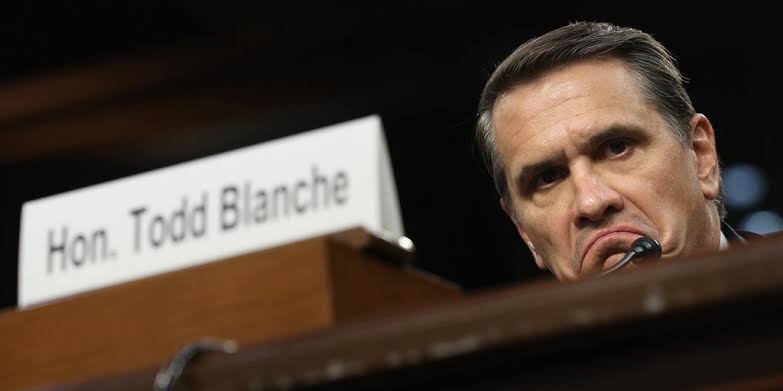
It is not about who will run the Justice Department but whether the Senate will endorse what Blanche has already done there.
Blanche, the acting attorney general since April, was previously the Senate-confirmed deputy attorney general, overseeing the department’s criminal and national security work. If Trump withdraws the nomination, Blanche could remain in control — potentially well into 2027 — under federal statutes governing succession and acting appointments. Rejecting the nomination would not immediately remove Blanche from the department’s leadership.
Set aside, for a moment, that the Republican opposition publicly blocking Blanche’s confirmation currently consists of two senators — both acting only after their political futures were settled. The context leading up to this week’s confirmation standoff is important.
Blanche was Trump’s personal criminal defense lawyer from 2023 through 2024. As a former federal prosecutor, Blanche gave legal vocabulary and professional credibility to Trump’s grievances about investigative “witch hunts” and “corrupt” prosecutors. Blanche helped turn Trump’s belief that prosecution is political warfare into a theory of law enforcement.
Then Trump placed him in charge of law enforcement, and the defense theory became the governing philosophy.
Consider the record: Under Blanche, the DOJ has repeatedly pursued people Trump publicly identified as enemies. Cases against former FBI Director James Comey and New York Attorney General Letitia James were dismissed after a judge concluded that the Trump-picked prosecutor who brought them had been unlawfully appointed. Other efforts directed at Trump’s perceived adversaries have likewise failed: A federal judge rejected a subpoena aimed at the Federal Reserve; the DOJ abandoned its effort to prosecute former Federal Reserve Chairman Jerome Powell; and a grand jury refused to indict Democratic lawmakers for sedition.
Far from reassuring the public that presidents do not choose investigative targets, Blanche has defended Trump’s involvement. At his first news conference as acting attorney general, Blanche tore down the firewall between presidential grievance and federal prosecution, saying Trump had not merely the right but a “duty” to identify people he believed should be investigated.
Now consider what Blanche’s theory means: When prosecutors investigated Trump, their actions “proved” the DOJ was weaponized. When Trump tells Blanche whom the department should investigate, that is the president performing his constitutional duty.
The only consistent principle in this is who controls the machinery.
That same inversion appears in the controversy holding up Blanche’s nomination. The DOJ entered into an extraordinary settlement of Trump’s $10 billion lawsuit against the IRS. The case was sharply criticized by the federal judge overseeing the suit, and Trump signaled Friday he plans to appeal. The agreement included plans for a roughly $1.8 billion “anti-weaponization” fund that could compensate people saying they were victimized by federal law enforcement, potentially including Trump supporters prosecuted in connection with the Jan. 6, 2021, Capitol riot.
Blanche has testified that the fund is dead, though Trump defended it on Friday, and payouts have proceeded to people claiming government persecution. Cornyn and Tillis want that assurance memorialized in binding documents.
They also object to provisions insulating Trump, his family and affiliated businesses from certain tax enforcement. Blanche personally signed an addendum stating that federal agencies are “forever barred and precluded” from pursuing broad categories of claims arising from earlier tax returns — even though DOJ ethics officials reportedly advised him to recuse himself from matters involving Trump personally.
There is something almost surreal about Republican senators demanding documentary corroboration from the nation’s chief law enforcement officer because they do not trust his sworn assurances about the government’s commitments. But Trump has already vacillated over whether the fund should survive, and Blanche has shown repeatedly where his loyalties lie.
Cornyn and Tillis are right to insist that the government cannot create an open-ended fund for favored political constituencies or negotiate special tax protections for the president. But those provisions are not isolated drafting problems. They are manifestations of the DOJ’s deeper transformation.
A department that settles the president’s personal lawsuit, shields him from enforcement, pursues people he denounces and accepts his identification of investigative targets is operating according to a simple worldview: Law enforcement is legitimate when it protects Trump and corrupt when it constrains him.
Sadly, the only two Republicans willing to interfere with Blanche’s confirmation are two senators Trump can no longer meaningfully punish. Tillis is retiring. Cornyn lost his Republican primary after Trump backed his opponent. Apparently, senatorial independence begins where political ambition ends.
Even then, Cornyn and Tillis are bargaining over two grotesque provisions rather than confronting the department’s overall record under Blanche. Eliminating the “anti-weaponization” fund and narrowing the tax agreement are proper demands. But satisfying them would not restore the DOJ’s independence, reverse its pursuit of presidential enemies or repair its damaged safeguards.
The legitimacy of federal prosecutions depends on the understanding that charging decisions begin with evidence and law, not with a president’s list of friends and enemies.
Blanche knows that. He also knows that federal prosecutors possess powers that can destroy reputations, bankrupt families and take away liberty. That makes his conduct all the more disturbing.
The Senate cannot necessarily prevent Trump from keeping Blanche in charge. Trump can withdraw the nomination, leave Blanche in place as acting attorney general and wait for more compliant senators.
But the Senate can withhold its approval. A vote against Blanche would say that senators refuse to confer the legitimacy of Senate confirmation on an acting attorney general who has converted his former client’s criminal-defense theory into the operating philosophy of federal law enforcement.
A vote to confirm him would say the opposite.
That is why confirmation matters even if the title does not. The Senate may be unwilling — or at this point, unable —to stop the Blanche DOJ. Senators can still decide whether to endorse it — and whether to share responsibility for what it has become.