Trump’s wind blown Houston arrival sparks hair jokes before Artemis II honors
A gusty arrival at Ellington Field turned Donald Trump’s hair into an online talking point, but the viral images do not establish that he wears a hairpiece. The more consequential story was a two day Houston trip combining Republican fundraising with recognition of the Artemis II moon crew.
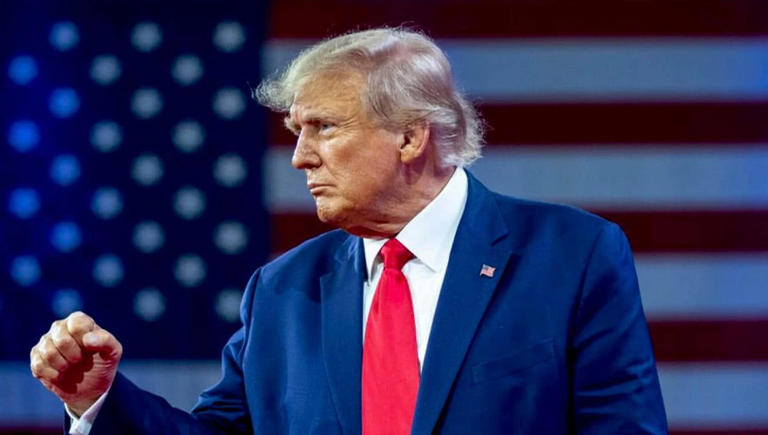
President Donald Trump arrived in Houston on Thursday, Aug. 27, with photographers waiting at Ellington Field Joint Reserve Base. As he stepped off Air Force One and crossed the tarmac, wind lifted and separated parts of his familiar hairstyle, producing images that quickly attracted jokes and renewed speculation about whether his hair is natural.
Some of the online commentary went further than the evidence. Calling the president’s hair a “hairpiece” or toupee is speculation, not something the photographs prove. Trump, who was born June 14, 1946, is 80 years old, not 83 as one circulating account of the moment stated.
What the photos actually show
The clearest verified description is straightforward: Trump was photographed arriving on Air Force One at Ellington Field in Houston on Thursday. Associated Press photographer Mark Schiefelbein was among those documenting the arrival, and local Houston coverage also showed the president descending from the aircraft and greeting people on the ground.
Wind disturbed Trump’s hair during the outdoor sequence. That is visible. What the images cannot establish is how the hairstyle is constructed, whether cosmetic products or extensions were involved, or whether he wears a wig or toupee. Social media users can speculate, but an evidence first account should not convert those guesses into fact.
Interest in Trump’s hair is hardly new. He has long denied wearing a wig, and the subject has repeatedly surfaced during television appearances, campaign rallies and windy airport walks. In 2016, he allowed late night host Jimmy Fallon to touch his hair on camera. In 2018, Trump publicly joked about working to conceal a bald spot.
That history helps explain why a few windblown frames can become instant online material. Trump’s hairstyle is part of a highly recognizable public image, and any disruption to it draws attention. But there is still a difference between a joke about what a photograph resembles and a factual claim about what is on someone’s head.
The travel route got muddled
Another detail in the viral retelling needs correction. Trump did not step off Marine One in Houston. Marine One is the call sign used when the president is aboard a Marine Corps helicopter, and it is used for relatively short transfers rather than a Washington to Texas flight.
The White House schedule showed Trump leaving Washington for Houston on Thursday, while news photographs documented him arriving at Ellington Field aboard Air Force One. Separate Associated Press images showed him using Marine One during the Washington portion of the trip before transferring to the presidential airplane.
That distinction may sound minor, but it matters because photographs can easily be detached from their original sequence. A caption that places the right person on the wrong aircraft or at the wrong point in a trip can create a false scene even when the broader story Trump traveling to Houston is correct.
The Houston arrival itself was well documented. Local reporting said Trump touched down at Ellington Field Thursday afternoon, with supporters gathered nearby. He then moved into the political portion of a visit that would shift the next morning toward NASA and the Artemis program.
The trip began with Republican fundraising
Trump’s first major Houston engagement was political. His public schedule listed an RNC engagement for Thursday evening, closed to the press, and local and national reporting identified it as a Republican National Committee fundraiser ahead of the November midterm elections.
Published invitations and reporting put the basic entry price at $10,000, with much higher amounts tied to greater access. The Houston Chronicle reported that a photo opportunity with Trump was priced above $88,000. Other host level packages reached into six figures, underscoring Texas’ role as a major Republican fundraising market.
The event also came as Republicans focused on an unexpectedly competitive U.S. Senate race in Texas. Trump has backed Republican Ken Paxton, the state attorney general, against Democrat James Talarico. The Texas Tribune described the contest as tight and reported that Trump’s Houston appearance was intended in part to help inject money and attention into Paxton’s campaign.
That political context is more significant than the hair jokes because it explains why Trump was in Houston in the first place. The trip was not built around a public rally. It paired a closed door party fundraising event with a high profile presidential appearance at one of the country’s most important spaceflight centers.
The NASA stop carried bigger stakes
On Friday, Trump was scheduled to present the Congressional Space Medal of Honor to all four members of the Artemis II crew at NASA’s Johnson Space Center. NASA set the ceremony for 11 a.m. EDT, which is 10 a.m. local time in Houston, with NASA Administrator Jared Isaacman also participating.
The recipients are NASA astronauts Reid Wiseman, Victor Glover and Christina Koch, along with Canadian Space Agency astronaut Jeremy Hansen. The medal is among the highest U.S. honors associated with human spaceflight and is awarded by the president in the name of Congress following a recommendation from the NASA administrator.
Only 30 astronauts had previously received the medal, according to NASA and CBS News. Past recipients include Neil Armstrong and John Glenn, as well as astronauts honored posthumously after the Apollo 1 fire and the Challenger and Columbia shuttle disasters.
The ceremony therefore represented more than a photo opportunity. It placed Trump alongside a crew whose April mission marked the return of humans to the vicinity of the Moon after more than half a century, while also tying the president to a program that began during his first term.
Artemis II set a distance record
Artemis II launched April 1, 2026, from Kennedy Space Center in Florida and returned to Earth April 10 after a nearly 10 day mission. It was the first crewed flight of NASA’s Orion spacecraft and the first time astronauts had traveled to the Moon since the Apollo era.
The crew did not land on the lunar surface. Instead, Orion flew a trajectory around the Moon designed to test the spacecraft, life support systems, navigation, communications and other capabilities needed for later Artemis missions. That distinction matters: Artemis II was a crewed lunar flyby and deep space test flight, not a moon landing.
During the mission, Wiseman, Glover, Koch and Hansen reached a maximum distance of 252,756 miles from Earth. NASA said that surpassed the human spaceflight distance record previously associated with Apollo 13. The crew later splashed down in the Pacific Ocean off San Diego before returning to Houston.
The mission also carried a series of historic firsts. Koch became the first woman to travel on a lunar mission, Glover the first Black astronaut to do so, and Hansen the first Canadian. Their flight made the crew an obvious candidate for an honor reserved for unusually significant contributions to the nation and human spaceflight.
Trump has long tied himself to Artemis
Trump’s presence at Johnson Space Center also fit his broader political identification with the U.S. space program. During his first term, his administration directed NASA toward a renewed lunar program that became Artemis, and he signed legislation creating the U.S. Space Force as a separate military service.
Artemis has since continued across administrations, with schedules, budgets and technical plans changing along the way. Artemis I flew without a crew in 2022. Artemis II’s successful 2026 mission was the first crewed step, while later missions are intended to test additional systems and eventually return astronauts to the lunar surface.
The program is also a reminder that ceremonial moments can mask harder policy questions. NASA’s exploration plans depend on large appropriations, complex contracts and hardware from government and commercial partners. A successful crewed flyby is an important milestone, but it does not by itself resolve the cost, schedule and engineering challenges facing later lunar missions.
For Trump, however, the symbolism is powerful. A president associated with the program’s launch could stand beside the crew after a successful mission, linking a current White House event to one of the most visible American technological achievements of the year.
The Lake America reference was real
One social media joke about the wind referred to “Lake America,” and that part of the surrounding political context was not invented. Earlier Thursday, Trump signed an executive order directing the U.S. government to rename Lake Ontario as “Lake America” for federal purposes.
The order directs the Interior secretary, working with the U.S. Board on Geographic Names, to update the Geographic Names Information System within 30 days and to use the new name in federal maps, contracts, documents and communications. The action applies to U.S. federal usage.
It does not give the United States authority to dictate what Canada calls the lake, which forms part of the international boundary. Reuters reported that Canadian Prime Minister Mark Carney and New York officials rejected the change, highlighting the limits of a U.S. executive order over a shared geographic feature.
The renaming came amid worsening U.S. Canada trade tensions and echoed Trump’s earlier move to rename the Gulf of Mexico as the Gulf of America for U.S. federal usage. That made the Lake America joke attached to the Houston hair photos topical, even if it had nothing to do with the weather at Ellington Field.
The viral moment obscured the real story
The windblown images were easy social media material because they were visual, immediate and connected to a public figure whose appearance has been scrutinized for decades. They also arrived during a week in which Trump’s hair had already attracted renewed online speculation after other public appearances.
But the strongest factual version of the story is narrower than the viral framing. Trump’s hair was blown out of its usual shape. People mocked it online. The images do not prove he wears a hairpiece, and labeling one as fact goes beyond what the photographs establish.
The same discipline applies to the rest of the account. Trump is 80. He arrived in Houston aboard Air Force One, not Marine One. The RNC event was a closed door fundraiser with high dollar access. And the Friday NASA stop centered on four astronauts whose Artemis II flight set a human distance record and reopened crewed lunar exploration after more than 50 years.
Those corrections do not make the windblown moment disappear. They put it in proportion. A few dramatic frames may have supplied the viral hook, but the Houston trip itself connected three larger stories: Republican midterm fundraising, Trump’s latest symbolic dispute with Canada, and the recognition of a milestone in NASA’s return to the Moon.