Ukraine’s mass Moscow drone raid cuts power to over 5,000, restricts four airports
More than 5,000 electricity customers lost service during a mass Ukrainian drone raid on the Moscow region, while temporary operating restrictions affected the Russian capital’s four main airports. The overnight attack on August 17-18 showed how a large unmanned-aircraft wave can disrupt several metropolitan systems even when authorities report extensive interceptions.
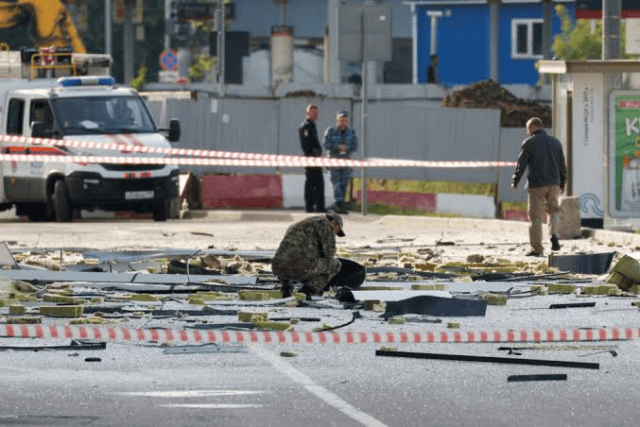
Damage to power-network equipment disconnected 109 transformer substations serving Likino-Dulyovo and Orekhovo-Zuyevo, according to regional authorities. The interruption also affected 46 social facilities. Emergency crews and mobile generating units were deployed to restore electricity. Officials reported three injuries, including those of a 10-year-old girl, a woman and a 27-year-old man, as well as damage to residential buildings.
Russian officials issued different figures for the aerial operation. Moscow Mayor Sergei Sobyanin said 620 drones flew toward the region and that 180 were destroyed there. Moscow regional governor Andrei Vorobyov separately reported more than 150 interceptions by air defenses and electronic-warfare equipment. Those totals have not been independently verified, so they are best understood as official claims rather than a confirmed accounting of the raid.
Interception totals do not measure the entire disruption
The significant figure for infrastructure operators is not simply how many drones were reported destroyed. It is the number of systems that had to react simultaneously: air defenses tracking and engaging aircraft, grid operators isolating damaged equipment, airports restricting traffic and emergency teams deploying backup generation.
That distinction matters because interception is only one layer of metropolitan protection. Even if most aircraft in a wave are stopped, the remaining activity can still impose operating costs. Defensive engagements or falling debris may also produce hazards, although the available information does not establish whether the electrical damage came from direct strikes, interceptions or debris. It likewise does not show that the civilian electricity network was the raid’s principal target.
The loss of 109 substations illustrates how damage to distribution equipment can spread beyond the immediate point of impact. Substations connect sections of the network and transform electricity to usable distribution voltages. Disconnecting many of them can interrupt service across a broader customer base, requiring crews to inspect equipment, isolate unsafe sections and introduce mobile generation where needed. The reported outage does not establish lasting grid degradation, but it does demonstrate an immediate restoration and logistics burden.
Airport restrictions create disruption without an airport strike
Russia’s Federal Air Transport Agency temporarily restricted arrivals and departures at Vnukovo, Domodedovo and Zhukovsky for flight-safety reasons. Sheremetyevo also advised passengers of temporary operational limitations. There is no indication in the available information that a drone reached any of the airports.
That is an important operational boundary. An airport does not need to be struck for drone activity to affect its schedule. Under Russia’s air-defense response procedures, flights can be suspended when a drone is detected in the relevant area. Restrictions protect aircraft from an uncertain airspace environment, but they also reduce runway throughput and can force airlines and controllers to hold, delay, divert or reschedule flights.
Once restrictions are lifted, normal operations do not necessarily return immediately. Aircraft and crews may no longer be positioned for their next assignments, while delayed departures compete for available airport and air-traffic capacity. The evidence for this specific raid establishes temporary restrictions, not how long the resulting schedule disruption lasted.
Large drone waves shift the burden toward system endurance
Mass raids place a different demand on defenses than isolated aircraft. Authorities must sustain detection, identification, engagement and public-safety decisions across a wide area while preserving enough capacity for additional threats. At the same time, utility crews and airport operators must make conservative decisions with incomplete information.
Ukraine’s growing use of domestically produced long-range drones indicates an industrial ability to conduct operations far inside Russia. However, the competing official counts from this raid do not provide a reliable basis for calculating production rates, interception efficiency or the number of aircraft that reached their objectives. The confirmed consequences electricity interruptions, airport restrictions and emergency deployments are more dependable measures of operational pressure than the unverified drone totals.
One outage also does not prove a systematic campaign against Moscow’s civilian power supply. The next meaningful indicator will be recurrence: whether future long-range raids repeatedly disrupt electricity and transportation around the capital, or whether the August event remains an isolated instance. For infrastructure planners, that difference determines whether mobile generators and temporary flight restrictions remain contingency measures or become a recurring operating requirement.