Watch: Florida driver tossed more than $6,000 from a GMC Sierra in a Pearland, Texas chase, then got charged with tampering
Pearland police say a masked man spent the early evening of Sept. 16 at the ATM drive-thru of a bank in the 9900 block of Broadway Street in Pearland, Texas, making one transaction after another with several different cards and withdrawing large amounts of cash. According to the department, the driver of the white GMC Sierra that man climbed into then failed to stop for officers and threw cash out the window during the pursuit.
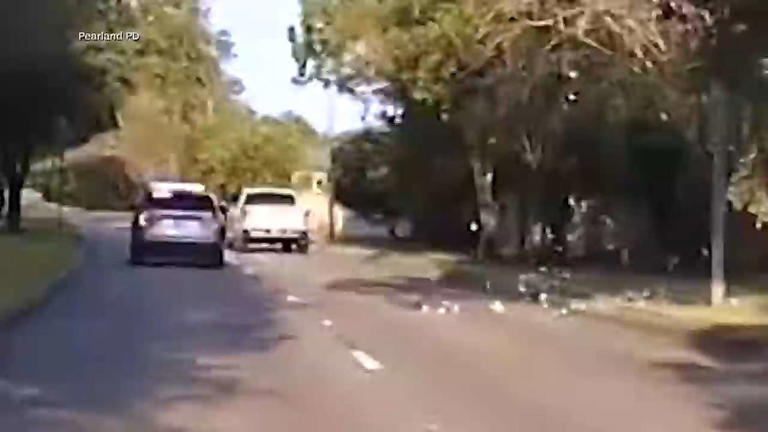
Officers recovered more than $6,000 from along the pursuit route, the Pearland Police Department said in a Facebook post that included dashcam video of the chase. Police identified the driver as Levon Steven Jr., of Florida, and charged him with evading arrest and tampering with evidence. His passenger, Tarvares Givens, also of Florida, was charged with failure to identify. The department said detectives are still investigating for additional fraud-related charges, and that both men were in the Brazoria County Jail at the time of its post.
So far, nobody has been charged with anything involving the ATM or the cards. Every charge police have announced comes from what happened after the Sierra left the bank: the passenger’s dealings with an officer, the drive up Smith Ranch Road and the money leaving the window. The last of those carries the same felony grade as the chase itself, and Texas’ highest criminal court has held that evidence thrown where witnesses can still see it was not actually concealed.
A drone found the Sierra in a Smith Ranch Road parking lot
The department’s account runs like this. Pearland dispatch told officers a masked male was using several cards at the drive-thru. While officers were on the way, he got into the passenger seat of the white Sierra, and the truck left. The department’s Drone First Responder 1 system, known as DFR1, and an officer from its Crime Reduction Unit found the truck in the parking lot of a business in the 2500 block of Smith Ranch Road.
The passenger got out and started walking away, and the Crime Reduction Unit officer detained him. The driver pulled out of the lot. When other officers tried to stop the Sierra, police said, it kept going north on Smith Ranch Road, turned east on McHard Road, then went north into the 1600 block of Max Road, where it stopped. Officers made a high-risk traffic stop and took the driver into custody without further incident.
The dashcam clip the department released runs 25 seconds. It shows the Sierra running alongside a marked patrol SUV on a tree-lined road, with bills scattered across the pavement and the grass shoulder. A license plate reader did similar spotting work for Florida troopers in a Miami-Dade chase that ended with a stolen Honda on its roof. In Pearland it was the drone, and the pursuit that followed stayed on a handful of city streets.
Two felony counts for the driver, both third degree
Running from police on foot in Texas is a Class A misdemeanor. Section 38.04 of the Penal Code makes it a third-degree felony when the person uses a vehicle while in flight. The statute sets no minimum speed or distance. A 156 mph run like the Corvette pursuit The Auto Wire covered earlier this month and a short trip up Smith Ranch Road would land in the same grade under Texas law. A third-degree felony carries two to 10 years in prison and a fine of up to $10,000.
Tampering with evidence, under Section 37.09, is also a third-degree felony. The statute covers a person who, knowing an investigation is pending or in progress, alters, destroys or conceals any record, document or thing with intent to impair its availability as evidence. Pearland police did not say what act the tampering count rests on. The only conduct in the department’s account that fits the statute is the cash going out the window. That leaves the driver facing two felonies with the same sentencing range, before any fraud charge is filed.
Texas’ top criminal court on evidence thrown in plain view
The Texas Court of Criminal Appeals has twice dealt with people who got rid of evidence while someone was watching. In Thornton v. State, decided in April 2014, a man dropped a crack pipe as two plainclothes officers approached him, and one of them saw it the whole time. The court of appeals found the evidence insufficient for tampering, and the Court of Criminal Appeals reformed the conviction to attempted tampering rather than order an acquittal.
The closer match came in April 2020. In Stahmann v. State, a driver threw a bottle of promethazine over a wire fence after a car crash. It landed two to three feet past the fence, in plain view on the grass. Two bystanders watched him throw it, never lost sight of it and pointed a deputy to the spot. The court held that “actual concealment requires a showing that the allegedly concealed item was hidden, removed from sight or notice, or kept from discovery or observation,” and found no actual concealment. His conviction stood only as attempted tampering, which a lower appeals court had already substituted. An attempt drops the offense one grade, and in this case that meant a state jail felony, punishable by 180 days to two years in a state jail instead of two to 10 years in prison.
Pearland’s own description of the chase sits close to the Stahmann facts. The department wrote that officers “observed the driver throwing large amounts of cash from the vehicle,” and its camera recorded bills scattered on an open road in daylight. The department also said it recovered “more than $6,000,” which leaves open whether every bill was found. That detail could matter, because bills that were never recovered would be harder to call “in plain view” than money officers gathered off the shoulder.
The tampering count also depends on what detectives find about the bank visit. The cash counts as evidence only if it connects to an offense. If detectives connect the withdrawals to fraud, the money on Smith Ranch Road becomes the proceeds of a crime. If they don’t, the State would be arguing that a man impaired the availability of evidence in an investigation that has so far produced charges only for fleeing and for a passenger’s response to an officer.
The passenger’s charge and the 2023 change for Texas drivers
Givens’ charge, failure to identify, has narrower limits than many people assume. Under Section 38.02, refusing to give your name, residence address or date of birth is an offense only after a lawful arrest, and it is a Class C misdemeanor, punishable by a fine of up to $500. Giving an officer a false name, address or date of birth after being arrested or merely detained is a Class B misdemeanor, which carries up to 180 days in jail and a $2,000 fine. Pearland police did not say which version Givens is accused of.
Drivers have a narrower cushion than passengers. A subsection that took effect Sept. 1, 2023, under Senate Bill 1551, makes it a Class C offense for the operator of a motor vehicle who is lawfully detained for an alleged violation to fail to show a driver’s license when asked and then refuse to give a name, license number, address or date of birth. Section 38.02 puts no such duty on a passenger who is only detained. Giving false information is a separate offense for both.
What comes next in Brazoria County
Police said the investigation is ongoing and that detectives are working toward additional fraud-related charges. The department has not said whose cards were used at the drive-thru, how many there were or which bank was involved. Brazoria County’s online court records sit behind a human-verification screen, and The Auto Wire could not confirm bond amounts, attorneys for either man or court dates. The charges are accusations, and neither man has been convicted of anything in this case.
For Steven, the tampering count turns on two things the dashcam can’t answer: whether prosecutors can tie the cash to a crime, and whether they can show any of it was hidden rather than scattered in front of a patrol car. If they can’t, Stahmann suggests that count could drop to an attempt, leaving the evading charge as the only full third-degree felony for not pulling over.
When a fleeing driver throws evidence out in plain view of a police camera, should Texas treat it as felony tampering, or is the Court of Criminal Appeals right that evidence nobody lost sight of was never concealed?