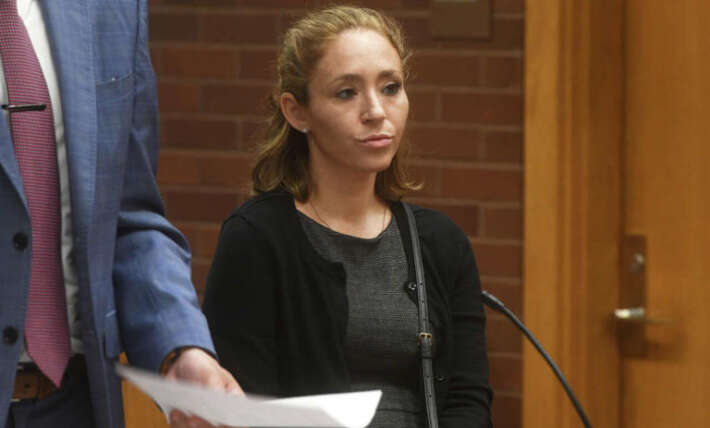
Woman, 25, says she gave husband ‘the choice to leave’ after getting terminal diagnosis (exclusive)
Amanda Tam was diagnosed with juvenile ALS just days before her 21st birthday

NEED TO KNOW
- Amanda Tam was diagnosed with juvenile ALS at 20 but continued her education and graduated on time
- She and her husband, Spencer, married in 2024 and have adapted their life together to her diagnosis
- Tam shares her story online to raise awareness and hopes to travel to Asia next on her bucket list
Amanda Tam began dating her now-husband, Spencer, when they were both 16.
After graduating from high school, the pair went to college together at McGill University in Montreal, Quebec, Canada. However, during their second year, Tam was diagnosed with juvenile amyotrophic lateral sclerosis (ALS) and tells PEOPLE she wasn’t sure if their love story would continue.
“When we first started dating, obviously, none of us thought this would happen, but I was diagnosed at 20, so I guess three and a half years into our relationship,” Tam, now 25, says.
“I gave him the choice to leave. Obviously, this isn’t the life that we planned, and obviously, we’re still young, so I didn’t want to hold him back,” she continues. “So I let him have a choice to either stay or leave, and he decided to stay. So [I’m] very grateful for that.”
Tam first noticed a change in her gait in March 2021 and was officially diagnosed with the rare and terminal motor neuron disease in October of that same year, just five days before her 21st birthday.
Still, in 2023, Tam completed her degree in psychology, and the pair got married in July 2024. Tam lived at home in the years following her diagnosis, but the couple officially moved out together in November 2025.
Although the diagnosis has inevitably been life-changing, Tam says it “wasn’t a really big barrier in our relationship” and emphasizes that Spencer, also 25, is her main support system.
“Obviously, the way I live and everything now and how I’m slowly losing my ability to do things is pretty impactful and is a big impact on our life, but it’s not something that we see as an issue,” she shares. “We just adapt to everything.”
For example, Tam says she is no longer able to get dressed on her own, so Spencer helps when needed.
“I would ask, ‘Oh, can you help me put my arms through?’ ‘Can you help me button my pants?’ And stuff like that,” she shares. “So it’s not an active thing where we’re like, ‘Oh, this is happening. This is bad.’ It’s more like we can kind of just adapt to our situation.”
While the average age of diagnosis for ALS is 55 and the usual life expectancy is two to five years after first showing symptoms, Tam says people with juvenile ALS “normally progress slower” — with life expectancies ranging from several years to over a decade.
Tam admits that what “scares” her the most is the thought of becoming “fully paralyzed,” and having “no autonomy whatsoever,” leaving her “fully reliant on people.”
“I know my support team is there for me and everything, and they want what’s best, but I also don’t want to be a burden to them,” she shares. “Just because I know I wouldn’t be able to do the things that I want to do and I wouldn’t have my life anymore. So at the same time, it’s not just about me — it’s about the people around me as well, and how that affects them.”
Still, as the five-year anniversary of her diagnosis nears, Tam says she can still walk with a walker and uses a wheelchair when she is outside. She is also still able to eat on her own and doesn’t need any breathing machines, making her “somewhat independent enough that I can be left alone, and I’d be fine.”
While some people assume she and Spencer got married young due to her diagnosis, Tam notes that it was always her plan “to be engaged when I was 22 and then be married at 23.”
Well before her diagnosis, Tam says she “had a timeline” of things that she wanted to get done before a certain age, and technically, she says they are right on track.
“I have everything that I wanted to do done,” she says.
Tam shares that, in Quebec, a standard bachelor’s degree takes around three years. Since she was diagnosed nearly halfway through her schooling, she was committed to staying on course.
“I knew when I was diagnosed that I wanted to do it within three years,” she says. “So stress really affects ALS. It can, I guess, move it along quicker, like my symptoms. So, what I really wanted to do was finish my degree within the three years.”
While her doctors suggested she lighten her course load at first, she “really did not want to do that whatsoever.”
“I just wanted to be done with school. So I did my full course load, doing five courses a semester, and I was lucky enough to be able to complete my bachelor’s on time,” she shares.
Now that Tam is married and has her degree, she feels like she did “a pretty good job” sticking to her original plans — even if her diagnosis threw other dreams off course.
“I really did not want the diagnosis to stop me from doing things that I wanted to do,” she shares.
Tam stopped working in May 2025 after struggling to find a job that could accommodate her needs and is now focused on spending time with loved ones, raising awareness online and traveling.
“Right now, I just want to travel as much as I can just because I want to be able to experience the world and see different cultures and everything,” she tells PEOPLE.
“I go by cruise just because it’s way easier,” she adds. “I know the food is there, the accommodations are all there and I’m still able to experience what they have in the cities. But yeah, my bucket list is just to be able to travel.”
While she has been to different cities around Europe and the United States, her next goal is to visit Asia.
“I would love to go to Japan,” she says. “Japan, South Korea, Singapore, Hong Kong, just places like that, because they are more modern. Europe is really hard as a wheelchair user, just because everything is cobblestone.”
Tam shares content about living with a terminal illness online to raise awareness, often with a humorous lens.
“Despite my situation, I’m doing the best I can,” she emphasizes. “I feel like, because of this disease, I’m doing a lot more than I would have without it. So I feel like when I get a new follower, it’s heartwarming to me knowing that I’m doing something for the greater good.”
“If I didn’t have this disease, I’d probably work in corporate jobs day-to-day, but now I feel like I’m fulfilling something,” she adds. “I feel like this was my purpose, or I guess I have a purpose now, where it’s I want to tell people my story, I want people to know about it.”