Woman, 26, reveals 1st sign of rare cancer doctors thought was strep throat: ‘My whole life stopped’
In 2024, Jessica Holmes estimates that she came down with strep throat three or four times. She worked with young kids, so she knew that getting sick frequently was a hazard of the job.
But, when she started feeling sick yet again in January of 2025, even she thought, “This is getting ridiculous,” Holmes, 26, of Weymouth, Massachusetts, tells TODAY.com.
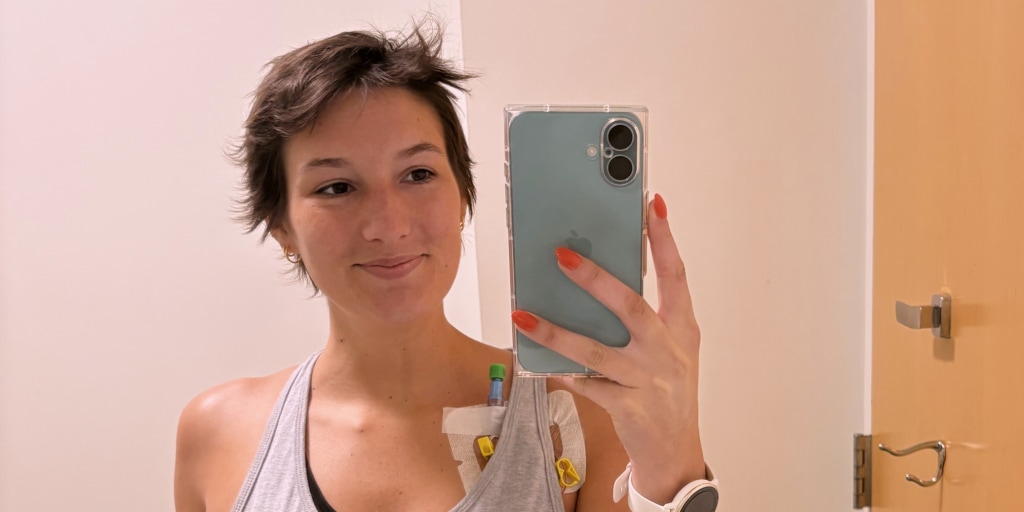
“I would get sick, but then take the medication and be fine,” she recalls. But she would just get sick again. And this time, “the strep started to lead to more pain,” Holmes says. By the second time she got sick that year, she had already made plans to get her tonsils out.
She would soon learn that this wasn’t a normal bout of strep, however, because it led to a lump “like a big egg” in her throat near her esophagus, Holmes recalls. “It was huge,” like the size of a golf ball, she says, and it grew during the day. “By the time the kids ate lunch at 12:30, even they were starting to notice it,” she recalls.
Holmes left work to get the lump checked out at a local clinic, where she was told to go to the emergency room.
“I waited for maybe six or eight hours in the ER just to get told that I’m fine,” Holmes says. “They gave me antibiotics and sent me home.”
At first, the antibiotics did help. But multiple rounds of imaging and, finally, a biopsy revealed something else: Holmes was told she had Hodgkin lymphoma, a rare cancer of the lymphatic system that primarily affects young people, in April 2025.
“My whole life just stopped,” she recalls. After so much reassurance that the problem was her tonsils or strep, Holmes says, “I never in my entire life would have imagined being that young, hearing those words from one of the 20 doctors I worked with at the time.”
A Rare — But Often Treatable — Cancer That Affects Young People
Hodgkin lymphoma is a “pretty rare disease,” Dr. Effi Hochberg, an oncologist at Mass General Brigham Cancer Institute, tells TODAY.com. There are only about 8,000-10,000 cases a year in the U.S., he says, but it tends to hit young people between the ages of 18-30.
That means that “you see people at the beginning of their lives,” Hochberg says, “and the goal in these patients is not just to cure them of the disease now, but to try to use the therapy that’s going to leave them as healthy as possible for the rest of their lives.”
While the repeated strep throat infections that Holmes had didn’t directly cause the cancer, they can make people more conscious of their lymph nodes and, therefore, more likely to notice when there’s a lump.
Another possibility is that “she could have had the lymphoma for some period of time, a couple of months,” he says, “and (with) her immune system being suppressed with the cancer, she was a little more likely to get these strep throat infections.”
Or, the timing could have been totally coincidental, says Hochberg, who is also Holmes’ doctor.
Along with the lump and frequent infections, Holmes had developed rashes on her stomach, arms and legs that she first assumed was winter dry skin. And, even though she’d been working out and making an effort to eat more protein, she’d been losing weight.
Finding the Right Care
The first oncologist Holmes went to told her that she would need intricate surgeries followed by a regimen of chemotherapy and radiation.
She was told she needed a surgery to remove some lymph nodes in her neck, Holmes recalls, and she would be left with a scar from her earlobe to her collarbone. It would have meant fewer radiation treatments, but she was scared.
“I’m sitting there and my jaw was to the floor,” she says. Feeling a little “like a lab rat,” Holmes decided to get another opinion — and met Hochberg.
After about three weeks of navigating unknowns, “I met Effi and was like, I can finally breathe. I’m hearing answers,” Holmes recalls.
In addition to describing the treatment plan, he showed her images of her actual cancer, told her how the treatments would make her feel and look, and, crucially, asked how she was doing.
Surrounded by supportive family, Holmes says she felt shy in that first meeting. “But he could see it on my face that I was scared as s–t,” she says. “So when it was one-to-one, I just broke down to him.”
She’d been questioning how this could have happened to her, and “he couldn’t have reassured me more,” Holmes recalls. “He was like, ‘You’re in my care. I will take care of you, and I will cure you.’”
Even today, Holmes gets emotional thinking about that meeting because “he did save my life,” she says. “There’s no other way to put it.”
Hochberg took a different approach to treatment. Knowing that Holmes has decades of life ahead of her, his plan was “a little bit less intensive,” he explains. “We have to think about what is the treatment that gives her the best chance of doing well long-term, not just right now.”
Their plan ultimately involved more chemotherapy but no surgery or radiation.
Fertility Treatment First, Followed by Chemotherapy
From there, Holmes first underwent a round of egg retrieval to preserve her fertility, which she describes as “worse than treatment.”
The rollercoaster of hormones, frequent blood draws and ultrasounds, waking up early for an injection and precisely timing the next one became “so exhausting that I couldn’t wait for it to be over,” she says. As rough as the experience was, she ended up with 36 eggs and felt amazed that her body could do something like that.
Then she started 12 rounds of chemotherapy with infusions given every two weeks over a period of about six months. While the drugs made her feel weak and nauseous, she was also genuinely excited to reunite with the medical staff for each of her infusions.
“But I always cried when I got home,” she says. “I slept. I cried. I would feel nauseous. I would go in a depressive episode for two or three days, but then I jumped right back into being better.”
As she noticed that her sadness followed each round of chemo, anxiety about the soon-to-come depression started to creep in as well. “I just expected it after every treatment,” she says. “I was like, you’re going to go home and you’re going to be sad. And I didn’t want that.”
That, combined with an ever-growing list of medications she had to take, led to her developing panic attacks. “I was just like sick in my stomach at the thought of how much my body was taking, of how weak I was actually becoming,” she says.
The lowest point came about halfway through her treatment, right after her seventh round of chemotherapy, when her grandfather died. Holmes describes him as her “favorite person,” and after his memorial services the following week, she went right into her next grueling round of chemo.
That’s when Holmes started seeing a therapist through Mass General, who helped her navigate everything she was going through.
‘Cancer Made Me Stronger’
Holmes finished her last round of chemo in December. Today, she’s cancer-free, and after getting her master’s degree in psychology, she now works as a primary therapist for adolescents.
She’s working on regaining her strength in small group classes because chemotherapy left her weak. “I couldn’t even walk up a hill without feeling like I was going to pass out,” Holmes says.
Putting on weight has been another challenge both physically and mentally. “I didn’t enjoy looking in the mirror, being unrecognizable as a pale, bald, no-eyebrows cancer patient trying to get my life back. I was very insecure,” Holmes says, adding that she’s been working on positive self-talk with her therapist.
With the support of her personal trainer, therapist and doctors, Holmes has realized that she can take it slow. “I was just so eager to get my life back,” Holmes says, but she’s accepted that “it’s not going to happen overnight.”
While Holmes has more than a 90% chance of being cured, Hochberg says, she stills need to be monitored for at least 10 years after chemo to make sure the cancer doesn’t return and that she doesn’t develop rare complications from the chemotherapy.
Something unique about treating this type of cancer is that “people are beginning to live their lives independently, and then suddenly that’s all shattered around them,” Hochberg says. “How they navigate becoming ill as a young adult is just really a mark of who they are as a person.”
What’s striking about Holmes, he says, is that she’s so human, personable and open about what she’s feeling — and the remarkable way her family was able to surround and support her.
Looking back on all she’s been through, Holmes says, “I want to show (people) that cancer made me stronger. It did break me down, but it also rebuilt me to be someone I never thought I’d become in such a short period of my life.”