Europe resorts to drastic measures as rivers dry up, bringing energy and economic pain
Sweltering heat waves. Deadly, unprecedented wildfires. And now Europe’s key rivers are drying up, threatening to wreak new havoc across the continent in this summer of climate extremes.
Authorities have blown up riverbeds, ordered energy-saving measures and shut down nuclear reactors in an effort to stave off the crisis. But it’s already fueling disruption and economic costs.
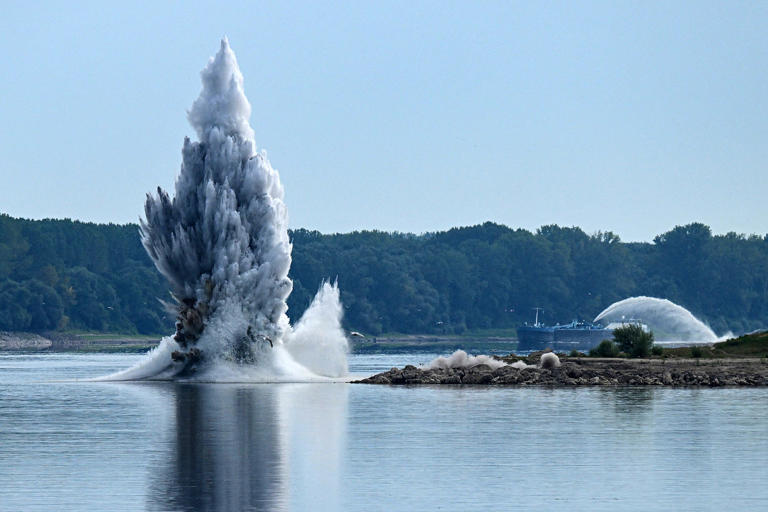
The record low water levels could be seen this week from the Danube to the Rhine, waterways at the heart of Europe’s identity and industry. Sunken World War II ships have even emerged from beneath the rivers, as the crisis exposes relics of Europe’s war-defined past, as well as the dangers of heat and drought that may define its future.
Riverbed dries up
The Danube, Europe’s second-longest river, flows through 10 countries and is used to cool nuclear reactors that Hungary, Romania and other central European nations rely on for energy supplies.
Its water levels have dropped to never-before-seen lows across some sections of its course, which runs from the Black Forest mountains of western Germany to the eastern Black Sea.
“I’ve walked along this river my whole life, so I know what it’s supposed to look like — and seeing it this low is a bit unsettling,” Agnes Molnar, who guides free walking tours in the Hungarian capital, Budapest, told NBC News in an email.
“You start noticing things you never used to see: rocks, sandbanks, parts of the riverbed that are usually underwater,” Molnar, 53, said. “It makes the drought feel real in a way that numbers or headlines don’t.”
Tourists and locals have embarked on walks along the bed of the Danube, bearing witness to the mighty river now laid so low. Documenting this particular emblem of the European climate crisis, their photos and videos show World War II-era motorcycles and ordinance among the historical artifacts revealed by the receding waters.
The European Union has the ambition of a climate-neutral economy by 2050, but the continent’s leaders have had to balance climate action with energy security, as the Russian invasion of Ukraine and the U.S.-Israeli war with Iran complicate the debate around reliance on fossil fuels and nuclear power.
It’s impossible, though, to escape the immediacy of the rolling crises and record-breaking heat now facing the world’s fastest-warming continent.
Scientists link the increasing extremity and frequency of events such as heat waves and periods of low river levels to climate change.
“These events are part of a broader, well-documented pattern,” said Swenja Surminski, a professor at the Grantham Research Institute on Climate Change and the Environment at the London School of Economics.
“Europe is experiencing hotter and, in many regions, drier summers, making low river flows more frequent and severe,” she added.
Compared with a decade ago, periods of exceptionally low river levels are becoming less unusual, Surminski said, placing more frequent pressure on transport, energy systems and other water-dependent infrastructure.
The alarming trend is visible not just by day on the rocks of the Hungarian capital but in its pitch-black nights: The city has turned off the lights at major landmarks, while authorities urged Hungarians to curb their power use just as millions were seeking to cool their homes amid scorching temperatures that reached as high as 42 degrees Celsius (107 Fahrenheit) on Thursday.
It comes after prime minister Péter Magyar warned that the Paks nuclear power plant, which generates about half of the country’s electricity and uses water from the Danube to cool its reactors, was on the verge of shutting down for the first time in its history because of the low water levels.
The plant has been running at a fraction of its capacity, though the country has so far managed to avoid a complete shutdown. There was relief Friday as rain in neighboring Austria promised a rise of 8 to 12 inches in the Danube’s water levels.
Hungarians could cease their voluntary restrictions, Magyar announced.
Molnar said she could not turn off her air conditioning in the searing afternoon heat, but had been conserving water and postponing household chores. She said she blamed the previous government of Trump ally Viktor Orbán for ignoring the climate crisis. “Climate change is real, and most people who take it seriously already understand that,” she said.
It’s not just Hungary.
In neighboring Romania, authorities blew up a rock outcrop earlier this week to help redirect water from the Danube to cool the sole working reactor at a major nuclear power plant in the country’s southeast. They are also planning to sink rock-filled barges into the Danube to aid in the water diversion efforts, a last-ditch move to prevent that country’s own energy crisis.
Romania has declared a nationwide state of emergency throughout August and the Energy Ministry also asked consumers to reduce electricity consumption, warning of “no prospects for improvement in the short term.”
Authorities in the capital, Bucharest, have dimmed street lights and switched off lights on major landmarks at night.
The low water levels have also forced Serbia’s key hydroelectric plant to operate with only 20% of its capacity, and exposed the hulking wreckage of Nazi battleships that were scuttled near the Serbian port of Prahovo in WWII as German forces retreated in the face of the Soviet advance.
“These events highlight how physical climate risks can affect critical infrastructure across countries and underscore the need to strengthen resilience through measures such as alternative cooling technologies, greater operational flexibility and more diversified energy systems,” Surminski, the climate researcher, said.
Cargo concerns
In Germany, water levels on the Rhine have fallen to new lows this week, raising fears of deeper fallout for a fragile economy so reliant on the cargo that usually passes down the river.
The navigable water depth at a key chokepoint, Kaub in western Germany, was at 7.5 inches Thursday, the country’s inland navigation agency said. That’s below the previous low on record of nearly 10 inches in 2018, the Federal Waterways and Shipping Administration told NBC News.
The Rhine, which starts in the Swiss Alps and empties into the North Sea, is an important shipping route for European commodities. Its dropping water levels mean extra costs for the freight industry, with vessels having to sail partly loaded, increasing costs for cargo owners who are forced to seek alternative ground transportation options.
That has raised fears about the long-awaited recovery of Europe’s biggest economy.
Economist Stefan Kooths of the Kiel Institute for the World Economy told Reuters the effects of water levels alone could dampen the country’s gross domestic product in the third quarter by between 0.1% and 0.2%.
The tourism industry is also taking a hit.
River cruise operator Viking has said some of its itineraries on the Danube and Rhine may be modified due to “exceptionally low water levels.” Last week, 186 passengers had to be evacuated from a Viking cruise ship that got stranded on the Danube in Bulgaria. The company told NBC News the ship “came into contact with a sandbank” in the river.
David Berendi with Duna Cruises, which operates sightseeing boat tours in Budapest, told NBC News that the Danube was still passable for the company’s vessels, but that the narrowing river made it trickier to navigate. The dimming of lights on Budapest’s landmarks has affected demand, he added, since many visitors choose evening cruises specifically to experience the illuminated city.
For Agi Noszek, a Budapest-based photographer who goes down to the river regularly to take photos and record videos, the current state of the Danube is “powerful, shocking and beautiful at the same time.”
The energy crisis, she said, was “something that you can feel immediately on your skin.”
“I am also concerned about the long-term effect,” Noszek said in a phone interview. “The tendency for the future is not looking very good.”