AI’s real threat to jobs could be lower pay
The AI job apocalypse may need a rebrand — a new white paper finds that rather than triggering full-scale job losses, the new technology is slowing wage growth, especially among lower-paying occupations.
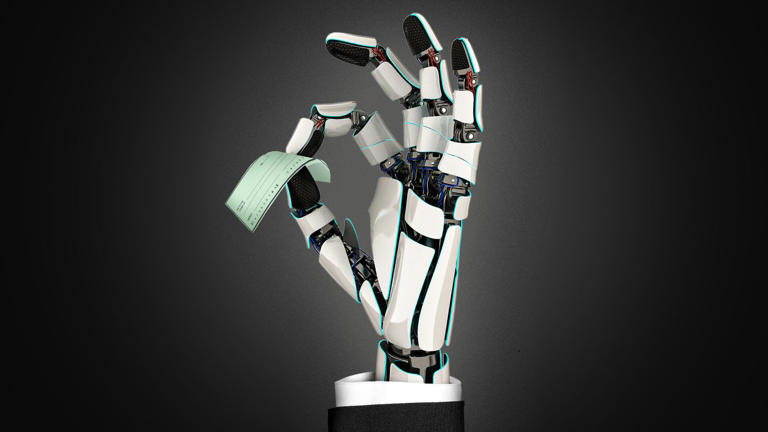
Why it matters: In other words, you get to keep your job, but you’ll make less money doing it.
Where it stands: Workers in occupations with high AI exposure had real wage growth that was 6.7 percentage points lower than that of those in low-exposure fields after 2023, the first full year after the rollout of ChatGPT.
- That’s according to the report from economists Sania Edlich and Torsten Slok at the investing giant Apollo Global Management.
- Affected workers lost out on $28 billion annually as a result.
Follow the money: Workers at the bottom of the income ladder saw wage growth decline more than those at the top, they found.
- The research didn’t find a significant AI-driven effect on employment.
How it works: Apollo used Labor Department wage data to compare pay in 11 occupations with high AI exposure, as measured by Anthropic’s Economic Index, to those with less exposure.
- Those occupations include computer programmers, customer service reps and financial analysts.
- Apollo says around 5.8 million U.S. workers, or about 3.7% of the labor force, are currently in high-exposure occupations — a low estimate.
What to watch: “As AI adoption deepens across corporate America, the true number of workers feeling these effects could grow substantially beyond what current exposure measures capture,” the paper’s authors wrote.
- The findings have “potentially profound implications for income inequality and living standards, particularly for lower-wage workers who have the fewest resources to weather the transition.”
Reality check: The number of AI-affected jobs may understate the trend and is based on just Anthropic’s analysis.
- A confounding issue: Some of the gap might reflect how the AI buildout is lifting wages in low-exposure trades. Electricians and construction workers, for example, are in high demand to build data centers.
- Data and research on AI’s impact on the job market are evolving quickly and will take years to unfold — this is just the latest contribution.
The big picture: It’s not a good time for slowing wage growth — higher costs are eating into Americans’ paychecks and savings.
- Spending rose faster than income last month and savings declined, according to data out Thursday from the Bureau of Economic Analysis.
Between the lines: Intuitively, the findings make sense. Over the past year, executives at many companies have talked endlessly about AI’s potential to replace human workers.
- That kind of talk could scare workers away from demanding higher pay or taking the risk of job-hopping.
- Gone are the days of the Great Resignation, when droves of workers were quitting their jobs to take better gigs. The quits rate, a measure of workers voluntarily leaving their jobs, is now comparable to the mid-2010s levels.
- And after a few years when wage growth outpaced inflation, it’s now at zero.
JPMorgan has also done work on high AI-exposed occupations — software, publishing, graphic design and call centers were among those most vulnerable, says Phil Camporeale, chief investment strategist for JPMorgan Wealth Management.
- “Workers in those sectors are more desperate in a way to keep their jobs and aren’t demanding wages that they saw before,” he says.
Friction point: Slower wage growth is exactly the kind of trend line that Wall Street and some economists paint as positive. It means slower inflation more broadly and eases pressure on the Federal Reserve to raise rates.
- Camporeale says it means companies have less ability to pass on higher prices to consumers.
- Still, for those who like pay raises and are struggling with higher prices at the supermarket and gas station, this is all less than heartening.