Peng Liyuan, China’s soft power figure embraced by Melania Trump at the Washington summit
On the red carpet at Joint Base Andrews, just outside Washington, while the two men who largely determine the global geopolitical landscape moved among soldiers, flags, and interpreters, there was another scene, less noisy but equally calculated.
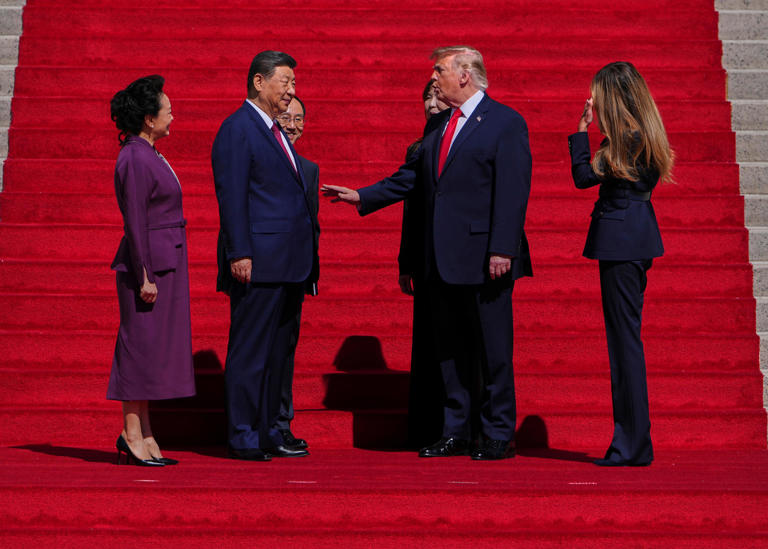
The First Ladies of the United States and China, Melania Trump (56 years old) and Peng Liyuan (63 years old), greeted each other with measured, almost intimate smiles, like two old acquaintances picking up a conversation interrupted years ago.
Left behind were the headlines about tariffs, Taiwan, chips, sanctions, and wars. Ahead, an image that Beijing also desired: that of a confident China, sophisticated and capable of projecting closeness even in Washington.
On Wednesday, Peng descended from the plane alongside Xi Jinping wearing a blue-gray dress, fitted at the waist, with a Mao collar and small qipao-inspired openings on the skirt. She paired it with a pale pink scarf. There were no visible logos, no flashy jewelry, no nods to major Western fashion houses. For over a decade, the Chinese First Lady has become one of the most refined pieces of Beijing’s soft power: a silent ambassador of the “cultural confidence” that Xi emphasizes in his speeches.
Melania, in a dark two-piece suit and white shirt, played the role of a sober hostess. Trump, in a coat and gloves, and Xi, in a dark suit with a purple tie, stole the cameras’ attention. But Peng and Melania offered another snapshot of the summit: a diplomacy of smiles, dresses, and small gestures. At one point, Peng seemed to comment with Melania on the height of the honor guard soldiers. Later, after the ceremony, she murmured a “wonderful” during another brief exchange.
Peng is not a decorative First Lady. Before becoming the wife of China’s most powerful man, she was already a national celebrity. A soprano linked for decades to patriotic galas of the People’s Liberation Army, she was more well-known than Xi for many Chinese for years. Her voice accompanied official campaigns, national celebrations, and Chinese New Year television nights. When Xi rose to the top of the Communist Party, the regime found in her something it had not had for a long time: a First Lady with her own charisma, stage discipline, and carefully exportable international image.
Her role broke with a tradition of almost invisible wives in the Chinese communist elite. The Party’s imagination was burdened by the precedent of Jiang Qing, Mao’s widow, associated with the radicalism of the Cultural Revolution. Peng embodies the opposite: presence without threat, elegance without explicit political protagonism, modernity without Westernization.
In China, her outfits have been interpreted as a statement of principles. Peng has favored local designers for years and silhouettes that blend official sobriety with traditional references.
The name most associated with her wardrobe is Ma Ke, a Chinese designer who explained in 2014 that when dressing Peng, she was not seeking to highlight anything ostentatious, but to express “the inner confidence” of the wearer. “There is no need to please others or be flashy,” she said at the time. “It’s a kind of discreet elegance.”
No Chinese brand dares to openly exploit her name in commercial campaigns. But local stylists point out that her dressing preferences anticipated a trend that now thrives among the country’s Generation Z: young people who wear reinvented hanfu, Mao collar jackets, updated silks, and accessories inspired by ancient dynasties to proclaim that Chinese style can also be modern and desirable.
On Thursday, while Trump and Xi sat down to negotiate at the White House, Melania and Peng toured the Smithsonian’s National Museum of Asian Art together. They spent about 45 minutes among porcelain and paintings. Much of the visit focused on the Peacock Room, a space decorated in blues, greens, and golds, inspired by Chinese porcelain and 19th-century Japanese taste.
It was not the first time they shared a diplomatic choreography. In 2017, they coincided at Mar-a-Lago during Trump’s first term. Months later, in Beijing, they visited a primary school together, attended classes, and witnessed a cultural performance by students. Melania then referred to Xi and Peng as “kind hosts.” That personal relationship, now resumed in Washington, helped soften for a few hours the harshness of a summit marked by structural rivalries.
In the evening, the stage moved to the State Dinner, the most solemn ritual of American diplomacy. There, Peng once again occupied that calculated place between discretion and message. Seated among the hosts, amidst toasts and measured speeches, the Chinese First Lady completed the day as she does best: without overshadowing Xi, but helping to dress the visit with a layer of normality, cordiality, and sophistication. For Chinese propaganda, that image holds its own value.In a summit where all the focus was on commercial, technological, and military tensions, Peng offered a more amiable counterpoint: a China that not only competes for power but also for prestige, style, and seductive capacity.