Ukraine’s air defenses have no answer for Russia’s new jet drones
Since the discovery of the first remnants of a jet-powered Shahed drone near Kyiv in June 2025, these upgraded kamikaze UAVs have become a nightmare for Ukrainian civilians. Described by some analysts as the most significant Russian drone innovation since the beginning of the war, they are outrunning the beleaguered nation’s innovative interceptor systems, forcing a pivot in technology development and air-defense strategies.
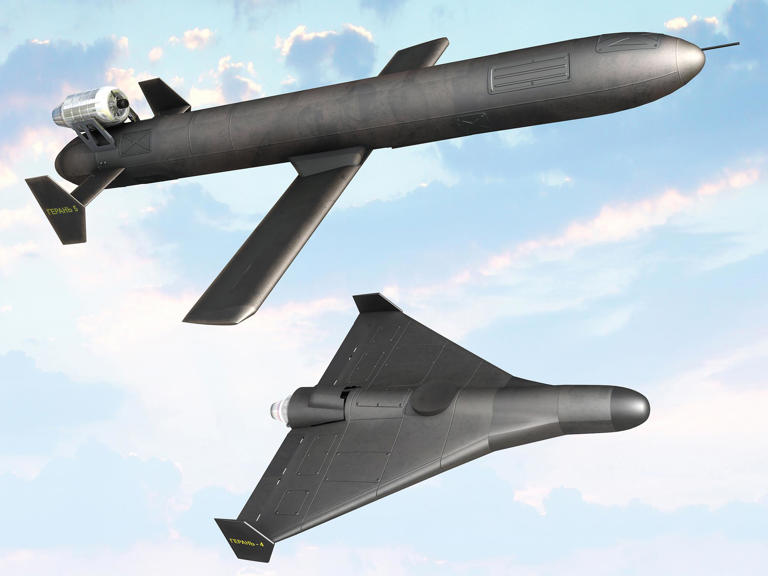
Russia manufactures the Iran-designed long-range Shahed drones under the name Geran at its Yelabuga factory in Tatarstan, some 800 kilometers east of Moscow. In a little over a year, Russian engineers have developed three iterations of the jet-powered killer drone—Geran-3, 4 and 5.
Geran-3, although fitted with a Chinese-made Telefly JT80 turbojet engine that enabled it to reach speeds of up to 370 kilometers per hour, was not very maneuverable and for that reason not much more effective than the propeller-powered Geran-2. Geran-4, first used in January this year, however, ushered in what some analysts are describing as a new era of long-range drone warfare—one that could be a first step toward the destructive power of larger military jets.
“With Geran-4, the Russians greatly improved the airframe,“ Berlin-based defense advisor Marc C. Lange told IEEE Spectrum. “They made it much more sturdy, much more rigid, they added internal struts and changed the internal geometry so that it can make actual evasive maneuvers. It’s a jet-powered drone that feels a lot more like an actual jet.“
Geran-4 also features the more powerful Telefly LX-WP-160 and TF-TJ2000A turbojet engines, which provide peak speeds of around 500 km/h. Geran-5, rolled out at about the same time, is shaped like a cruise missile and can hit targets farther away than Geran-4, at distances of up to 1,000 km. Both drones, in addition to being faster than their propeller-based predecessors, also fly at higher altitudes of up to 6 or 7 kilometers, which makes not just interception but also detection more complicated.
“The basic condition for effective interception is that the interceptor has to be faster than the target,“ says a source at drone company BlueBird Tech, who didn’t want to be identified for security reasons. “That was achievable against earlier Shaheds that flew at roughly 180 to 200 km/h, while an interceptor drone could reach around 300 km/h. But the practical limit of propeller-powered interceptors is around 450 km/h.”
The defenders can make up for the interceptors’ slower speeds by hitting the incoming threats head on. But the agile Geran-4 in particular can easily dodge the intercept attempts, says Lange.
“The Gerans are coming at an extremely high speed and at that speed, even a very slight pitch or yaw ensures that the interceptor misses the target,” Lange says. “The interceptors usually don’t have much flight time, usually only a few minutes, so one brief movement of the incoming drone and the intercept attempt is lost.”
Jet-Powered Gerans Cost Twice As Much As Prop-Driven Gerans
Civilians in Ukraine have been facing the harsh reality of Russia’s improved attack capabilities particularly hard since August, according to Anastasiia Mishkina, the executive director of Tech Force, the association of Ukrainian defense tech manufacturers.
At around $80,000 per unit, jet-powered Gerans cost about twice as much as the earlier, prop-driven models. Nevertheless, Russia has significantly scaled up their deployment in recent months.
The number of jet-powered Gerans fired at Ukraine rose from 350 per month in June to 2,800 in August, and Ukraine’s struggle to stop them is now evident in every major city.
“It feels like there are no countermeasures, no air defense,” says Mishkina, who is based in Kyiv. “If there is an air raid alert, you hear the blast immediately because the jet Shaheds are fast and hitting the targets all the time.”
Where in the past Russia concentrated on night-time attacks, the air raids are now coming thick and fast, spanning all hours of the day. And life in some Ukrainian cities is grinding to a halt.
“Everybody is really working on countering the new type of Shaheds because basically our everyday living is affected super heavily,” Mishkina says.
Ukrainian defenders are already testing prototype interceptors. But the technologists admit that Ukraine is now forced to catch up while Russia is further scaling up production of the jet-powered Gerans and hence the attacks.
“The problem is that low-cost systems designed specifically to intercept these kinds of targets were not developed in advance,” says the BlueBird Tech source. “There simply had not been a war for which such systems were designed.”
Ukraine’s Next Move: Jet-Powered Interceptors
Mishkina adds that Ukraine needs domestic jet engines to power interceptors that could match the speeds of Geran-4 and -5. But that’s not the only challenge. Most intercepts today are performed by skilled drone operators. And at the speeds at which these jet-propelled machines would chase each other, human reaction time begins to hit its limits.
Advanced AI-powered terminal guidance systems that could accurately guide targets at such high speeds are an obvious solution, but the cost of such systems might be prohibitive. For a drone-intercepting drone, a successful mission is a one-way mission, because the interceptor gets destroyed along with its target.
“Blowing up NVIDIA Jetson ORIN boards by the hundreds and thousands is not a viable path economically,” notes Lange. “We are currently at a moment where we need to reassess how much computing power is necessary to fly such things at such speeds and think about a possible change of paradigm.”
Optimized, leaner neural networks that do more with less could be one path forward, Lange believes. And so could a switch from guidance based on imagery to navigation using thermal, RF, or acoustic signatures, which is less compute-intensive.
“If the Ukrainians don’t find the right path, the cost-exchange ratio could significantly shift in favor of the attacker,” warns Lange.