Woman told baby boy needs X-ray, then comes shock three-word diagnosis
From the moment her son arrived in the world, mom of three Michelle Reyes could see that he was different.
Reyes, who is from Buena Park, California, remembers her third pregnancy as being the hardest.
“My pregnancy with Tommy was really hard on my body,” she told Newsweek. “I asked for a chair at work because I was struggling to stand for long periods.”
However, no scan or doctor ever identified anything during that time to give them cause for concern.
“All of my tests came back looking good,” Reyes said. “As far as I knew, I was going to have a healthy baby boy.”
As soon as Reyes gave birth to her son Tommy, however, she became concerned.
“The first thing I noticed was his feet. They were both severely turned inward,” she said. “The nurses reassured me and said he had probably just gotten comfortable in the womb and that it shouldn’t be anything to worry about.”
A few days later, while she was still in the hospital recovering, Reyes was visited by a specialist who wanted to take X-rays of Tommy’s feet.
“That’s when we were told for the first time that Tommy had been born with severe bilateral clubfoot,” Reyes said.
This is a birth defect that causes both feet to turn inward and downward. According to the CDC, it affects roughly one in every 1,000 babies born in the United States, with both feet involved in around half all cases.
Hearing those two words was a shock to the system for Reyes.
“It was definitely a lot to take in because we had gone through the entire pregnancy thinking everything was completely fine,” Reyes said.
One of the strangest parts about what happened was that, just weeks earlier, Reyes had randomly watched a video on social media about a baby with clubfoot.
“I had never heard of clubfoot before, so I just scrolled past it and didn’t really think anything of it,” she said.
Now it was becoming a reality for her and her family. Reyes remembers her first thought being: “What did I do wrong?”
“I started blaming myself,” she said. “I wondered if maybe it was because I wasn’t moving around enough during my pregnancy or if there was something I could have done differently.”
However, her doctor explained it wasn’t anything she had done. Sometimes, babies are simply born with clubfoot. There is rarely a specific reason why.
While Reyes was still processing what had happened, her doctor scheduled an appointment for Tommy to see a specialist.
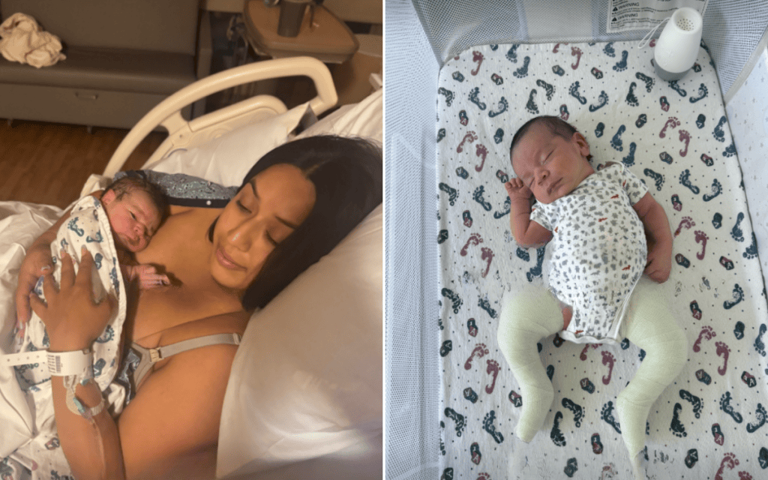
Tommy was just 6 days old when casts were put on both his legs.
“The casts went from his thighs all the way down to his toes,” Reyes said. “We had appointments every two weeks, and, at each appointment, they would remove the casts and put on new ones, gradually straightening his feet little by little.”
After five casts, Tommy had an Achilles tenotomy, a minor surgical procedure in which the Achilles tendon at the back of the ankle is released to improve the foot’s position and range of motion. He was then fitted with one final cast.
Once that final cast came off, Tommy was given a special pair of boots connected by metal bar between them that he had to wear 23 hours a day for the first six months of his life.
“After that, he was able to go down to 14 hours a day, which we usually do overnight while he sleeps and during his nap,” Reyes said.
The plan is to gradually reduce the amount of time he has to wear the boots, depending on how his feet progress.
The American Academy of Pediatrics reports the Ponseti method has initial correction rates of 90 to 100 percent. A clinical study, published in the Journal of Pediatric Orthopaedics, reported success rates around 93 percent when the full treatment and bracing protocol is followed. The study followed 137 idiopathic clubfeet for at least two years.
“The whole process has honestly been amazing to watch. I’ve seen such a huge improvement in his feet since he was born,” Reyes said. “He’s still able to do everything a baby his age should be doing. He crawls normally, he’s starting to learn how to walk, he swims, and he can pretty much do everything any other baby can do.”
After a challenging start to life, Reyes is hopeful that Tommy can have a future in which being born with clubfoot is not something that ever holds him back.
“I want him to know his story and remember everything he went through as a baby. He was so brave through all of his casts, his procedure, and everything else he had to go through at such a young age,” she said.
Reyes wants her family’s story to serve as a source of hope for others who may be going through similar experiences.
“I want other parents to know that it’s OK to be overwhelmed at first, but there is so much hope, and their baby can still grow up doing all the things they imagined for them,” she said.