‘I would get fired’: The admission exposing Mamdani’s antisemitism office as a muzzle, not a shield
An office charged with combating antisemitism cannot fulfill its mission if its officials fear losing their jobs for challenging the mayor who appointed them.
That is the troubling question now facing New York City Mayor Zohran Mamdani’s administration following an alleged admission by one of his Jewish outreach officials: “I can’t speak out against my boss, or I would get fired.”
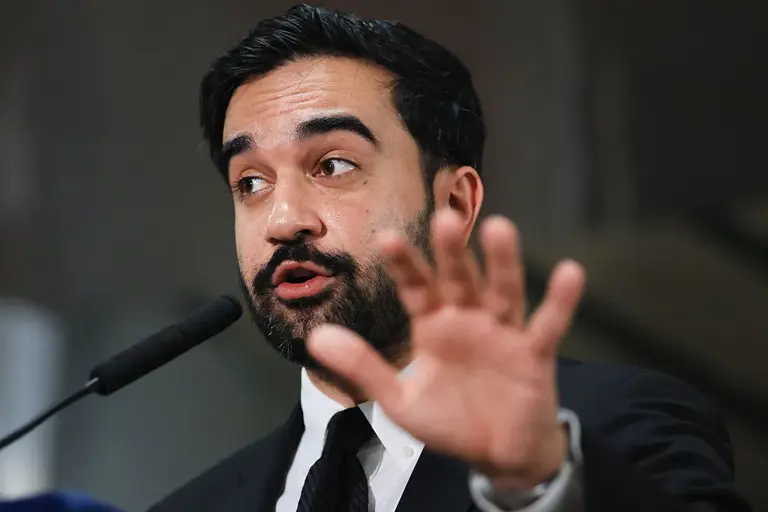
The statement was allegedly made during a July 9 meeting between Abraham Hamra, an attorney, Jewish advocate, and Syrian Jewish refugee, and Josh Binderman, deputy director of the Mayor’s Office to Combat Antisemitism. The mayor’s office has called Hamra’s account a “complete and utter distortion,” but notably, it did not specifically deny that Binderman made the statement or explain what he said instead.
MAYOR MAMDANI, YOU CAN HATE THE JEWS — BUT YOU MUST PROTECT THEM
That distinction matters.
This is not merely a dispute over the recollection of a private meeting. It raises a far more consequential question: Can an antisemitism office housed within the mayor’s administration independently confront rhetoric coming from the mayor himself?
Recent events have made that question impossible to dismiss.
Mamdani met privately with a group of rabbis this week and afterward touted his administration’s plans to combat antisemitism across the five boroughs. Rabbis who attended reportedly urged him to change his rhetoric toward Israel, warning that his language was harming Jewish New Yorkers. Yet Mamdani apparently made no commitment to do so.
“I had a candid and productive conversation with rabbis representing a wide swath of New York’s Jewish communities and affiliations, and I appreciated hearing from them,” Mamdani said following the meeting.
Listening is important. But when antisemitic hate crimes are rising, Jewish New Yorkers need more than listening sessions and carefully worded statements. They need to know whether the office created to protect them is empowered to tell the mayor when his own words are contributing to a hostile climate.
The numbers make this an urgent matter. Antisemitic incidents accounted for 60.3% of New York City’s confirmed hate crimes in May, according to the New York Police Department, even though Jewish New Yorkers represent roughly 10% of the city’s population.
Jews were targeted in 41 of the city’s 68 confirmed hate crimes that month, a 71% increase from the 24 recorded in May 2025. During the first six months of 2026, 178 of the city’s 322 confirmed hate crimes were antisemitic.
It was against this backdrop that Hamra attended a listening session organized by the Mayor’s Office to Combat Antisemitism. Phylisa Wisdom, the office’s executive director, had also been scheduled to participate but was unable to attend because of a medical emergency, according to Hamra.
Hamra told me he entered the meeting with an open mind and hoped to address genuine concerns affecting the Jewish community. One of those concerns involved Mamdani’s rhetoric about the American Israel Public Affairs Committee.
During a June 18 get-out-the-vote rally at Kings Theatre in Brooklyn, Mamdani referred to the forces confronting progressive candidates as “monsters” before pointing to AIPAC and accusing the pro-Israel organization of using “dark money” to influence elections.
Mamdani and his supporters argue that criticism of AIPAC and Israeli policy should not be conflated with antisemitism. That is true as a general principle. Criticism of any political organization or foreign government is not inherently antisemitic.
But criticism does not occur in a vacuum, and political leaders have a responsibility to understand the effect of their words. Referring to a major vehicle for pro-Israel political participation as a “monster” does not sound like a narrow policy disagreement to many Jewish New Yorkers. It sounds dehumanizing, particularly at a moment when Jews are being disproportionately targeted by hate crimes.
Hundreds of rabbis subsequently signed an open letter demanding an apology.
Hamra said he raised the controversy directly with Binderman and asked how the administration’s antisemitism office could confront troubling language when it came from the mayor himself.
“I asked him, ‘What are you going to do about the troubling language coming out of the mayor’s office?’” Hamra recalled. “How does your office plan to combat antisemitism when the concern is coming from the mayor himself?”
According to Hamra, Binderman responded, “I can’t speak out against my boss, or I would get fired.”
“I was in shock,” Hamra said. “That answer left me deeply disheartened.”
If that statement was made, it confirms precisely what many Jewish New Yorkers fear: The office responsible for combating antisemitism may be structurally incapable of confronting it when doing so would require challenging Mamdani.
The mayor’s office strongly disputed Hamra’s characterization, calling it “a complete and utter distortion, spun up by a right-wing activist.” It defended the meeting as one of several listening sessions intended to inform what it described as the country’s first municipal plan to combat antisemitism.
“That plan, informed by these conversations and the diverse perspectives of Jewish New Yorkers across our city, will be released in the coming weeks,” the office said.
But labeling Hamra a “right-wing activist” does not answer the underlying allegation. Nor does it address whether Binderman or any official in the office can publicly challenge the mayor without fearing professional consequences.
Hamra’s personal history also deserves more than a political label.
“I’m a Syrian refugee who works to make immigrants’ lives better and who is speaking out against the hate that displaced me and 1 million Jews from Arabized countries,” he said in response.
That history informed another concern he raised during the meeting: Mamdani’s public recognition of the Palestinian Nakba without comparable acknowledgment of Jewish refugees displaced from Arab- and Muslim-majority countries.
“Why did the story of more than 100,000 of your constituents not matter as much as telling the Palestinian story?” Hamra said he asked.
Hamra said Binderman described a video recognizing displaced Jewish communities as a good idea, but suggested that it would not happen on Hamra’s preferred timeline. According to Hamra, he was told that Mamdani had the remaining three years of his term, and potentially four more if reelected, to make such a video.
For Jewish refugees and their descendants, this is not a competition between tragedies. Recognizing Palestinian history does not require erasing Jewish history. A mayor representing one of the world’s largest and most diverse Jewish populations should be capable of acknowledging both.
Hamra followed up by email with Binderman and Wisdom on July 10, documenting his recollection and asking for direct answers. The correspondence, which he provided to me, shows that Wisdom thanked him for participating in the listening tour and offered to discuss the office’s goals in a future call. But Hamra said his questions about Binderman’s alleged statement and the office’s independence were not directly addressed. Binderman did not respond to that email.
The problem here is larger than one meeting or one alleged remark. No municipal office can credibly police the conduct of the administration to which it is politically subordinate unless its leaders have meaningful independence and protection from retaliation.
New York City needs an antisemitism office whose definition of antisemitism does not change depending on the politics of the person accused of contributing to it. Its leaders must be able to challenge the mayor, his allies, institutions on the Left or the Right, and anyone else whose words or conduct endanger Jewish New Yorkers.
Binderman referred my request for comment to the mayor’s press office, which responded on behalf of the administration. The office called Hamra’s account a “complete and utter distortion” and characterized him as a “right-wing activist.” However, its statement did not specifically deny that Binderman made the remark attributed to him or explain what he said instead.
Hamra also documented the exchange in an email sent to Binderman and Wisdom the following day. While Wisdom thanked him for participating in the listening session and offered to discuss the office’s goals further, Hamra’s account of Binderman’s statement was not directly addressed. Binderman did not respond to that email.
MAMDANI PICKING LINA KHAN TO SAVE NYC’S ECONOMY IS LIKE HIRING AN ARSONIST TO FIREPROOF IT
The administration therefore issued a response, but it left the central question unanswered: How can an office credibly combat antisemitism if its officials believe that challenging the mayor could cost them their jobs?
Jewish New Yorkers deserve an office empowered to protect them, even when doing so requires confronting the mayor. They should not be asked to trust one whose first obligation appears to be protecting him.
Ariella Noveck is a journalist specializing in antisemitism and Middle East affairs, with extensive experience covering Jewish communities worldwide.