Israel’s Arabs are now kingmakers and they’re ready to oust Netanyahu
Israel’s Arab parties will tell Isaac Herzog, the Israeli president, that they will support the Zionist opposition bloc in forming a new Israeli government, according to a leading figure in the movement.
Jafar Farah told The Telegraph he expected both the Joint List and Ra’am to recommend that Gadi Eisenkot, the former IDF chief of staff, become prime minister, ousting Benjamin Netanyahu.
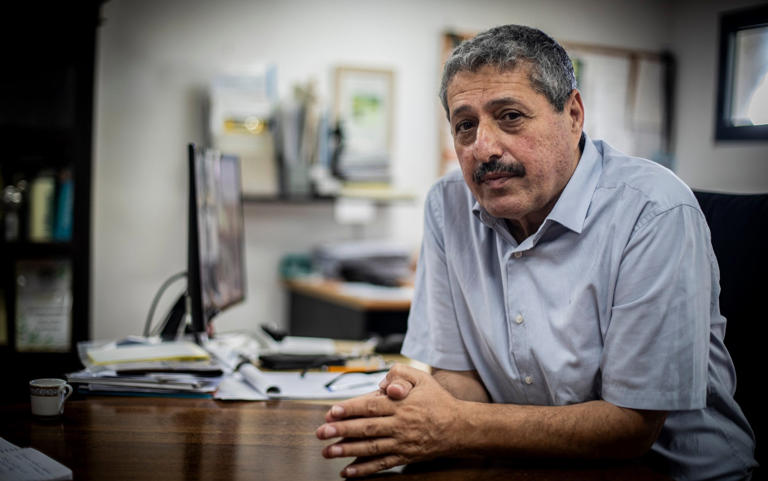
Mr Farah is director of the Mossawa Centre, an advocacy group for Arab citizens of Israel. He stood as a Joint List candidate until he withdrew during the campaign.
The Israeli election produced a stalemate on Tuesday, with neither of the two main Jewish blocs large enough to form a government.
Mr Netanyahu’s bloc won 53 seats. Mr Eisenkot’s main opposition bloc won 48.
In contrast, the two Arab parties – the Joint List and Ra’am – saw support surge and won 19 seats in the parliament, according to the count on Friday, making them potential kingmakers between the pro-Netanyahu and anti-Netanyahu blocs.
Now parties must meet, bargain and seek a way to team up for at least 61 seats in the 120-member Knesset.
“The Joint List will recommend Eisenkot to become the candidate for prime minister,” Mr Farah told The Telegraph. “Maybe the three seats of [the nationalist Arab party] Balad will refuse, but the others will probably recommend.”
He added that he thought the Joint List would also “sit and negotiate” with the Jewish opposition bloc over the four principles Mr Eisenkot has set out for any party to formally join with it in government, which include commitment to Israel as a Jewish and democratic state and recognition of Hamas as a terrorist organisation.
“There will be negotiation … secretly maybe in the near future, he will send his representatives to sit and talk … Publicly, maybe it will happen only after the recommendations,” he said.
Mr Farah is director of the Mossawa Center, the advocacy hub for Arab citizens of Israel and an important player in Arab-Israeli politics.
In the run-up to the election, he was a senior candidate on the Joint List, led by his colleague Yousef Jabareen, but withdrew after reheated allegations over his treatment of women dating back 15 years resurfaced.
In the wake of the vote on Tuesday, Mr Jabareen said: “We are ready and willing to pave the way for the Netanyahu government’s removal.”
Ra’am, the more socially conservative and religious of the two Arab-Israeli parties, has already indicated it would join the Jewish opposition bloc.
However, the position of the larger Joint List has been more ambiguous, its leftist leaders prone to put principle ahead of pragmatism.
In the hours before final results were announced, Mr Netanyahu and his Likud party amplified unsubstantiated allegations that Arab-led parties had “stolen” the election, potentially with foreign assistance.
Joint List under pressure
Now, with its voter base facing open racism from the country’s hard right, the Joint List is under mounting pressure to deliver real change.
The Telegraph talked to more than a dozen Arab-Israeli voters in the mixed cities of Haifa and Acre towards the north of Israel on Friday.
All said they wanted the Arab Parties to join the Jewish opposition to form a majority government. And all said they saw themselves as Arab-Israeli citizens first, rather than Palestinians – “just like a second or third generation Indian does in England”, said one.
Khaled, 40, a manager for an international shipping company, said he had voted for Ra’am having grown tired of Ahmad Tibi, the Joint List’s most prominent parliamentarian.
“Tibi has done nothing. Just shouting, ‘occupation! occupation!’”, he said. “Occupation does not take care of us. It’s a ship that sailed a long time ago”.
Most of those The Telegraph talked to said they faced “daily discrimination” but thought political cooperation was the best way to improve their lives.
The issues of violent crime in Arab-Israeli communities, improved civil infrastructure in Arab towns and the ability for Arab-Israeli citizens to get building rights were their priorities.
Not all voted for Arab parties. Rami, 38, a Christian Arab-Israeli medical engineer from Haifa, said he had voted for Naftali Bennett, the former Israeli prime minister who is part of the opposition change bloc.
“I voted for Bennett and my friend voted for Eisenkot. We are a minority of the Arabs here, but most of the Arabs here want the Arab parties to sit with the Zionists”, he said.
Like others, he added: “The best way forward is for everyone to work together. Just as I criticise some in the Arab parties for not giving support to the Israeli left, I blame the Israeli right for not dealing with the Arab parties. If you don’t want the Arabs in government, how do you think things will change?”
Ibrahim, 71, a former professional football player who was sitting with friends in a shisha bar in the historic old town of Acre, said the scale of the Arab turnout at the election had made “the whole Arab-Israeli population feel good” and predicted “even more will come to vote” if there was another election.
He, too, urged cooperation. “We hope they will join together. The Jews are good people. The problem is the current government and the religious extremists”.
Only one Arab-Israeli The Telegraph talked to said he had not voted.
“We are a minority under discrimination; elections can change nothing”, said Mohammed, 42, a boat skipper from Acre.
“What do Arabs here want? We want to live like humans. In the last weeks Channel 14 made voting for us feel like a crime. If you vote you are a terrorist”.
His friend Khaled agreed that if an Israeli-Arab voiced their opinion “too loudly”, they could “go to jail”, but believed it was safe to vote.
“I think to vote is the right thing and the best thing to make change,” he said.
Eisenkot’s four conditions for cooperation
Mr Eisenkot has said he intends to “represent all Israelis” if he is able to form a government.
And while several of the members of his opposition bloc have said they will not sit with the Arab parties, Mr Eisenkot has laid out a formula for a possible deal.
He says he will sit with any party that commits itself to supporting four key principles: “recognition of Israel as a Jewish, democratic and liberal state committed to equality; commitment to the values of Israel’s Declaration of Independence; mandatory service for all Israeli citizens – military, national or civilian; and recognition of Hamas as a terrorist organisation and of the obligation to destroy its military capabilities and governing power in the Gaza Strip”.
Mr Farah of the Mossawa Center, like others associated with the Joint List, instinctively prickles at these “very smart preconditions”.
This is not because they are necessarily hard to agree with but because they are framed as a precondition intended to “embarrass” the Arab parties, he said.
All members of the Knesset are already required to recognise Israel as a Jewish state and support the Declaration of Independence, and support for Hamas in any form is illegal, he noted.
He added that the requirements also masked a lot of detail that was important to Arab-Israeli voters, most notably in the areas of “equality in law” and the “practicalities” of enabling universal service for Arab-Israelis.
“In the kibbutzim they have their institutions to do civil service. Also the Ultra Orthodox… We want our children to go to service, in the communities, in hospitals but we don’t have the institutions… only 2 per cent of the subsidies is given to Arab civil society organisations,” he said.
Nevertheless, the Arab parties would “negotiate” if invited to do so by Mr Eisenkot and the opposition bloc, Mr Farah added.
“We will be engaged, of course. Preconditions for negotiations are preconditions for negotiation. [But] there will be negotiation”.
Ultimately, Mr Farah said he was not optimistic a joint Arab-Israeli government could be formed, noting resistance from the right was extreme.
“I am not sure that Eisenkot will be brave … I think he will know he could be killed … killed in the way that Rabin was killed in ’92 [sic]”.
Demonstrations expected
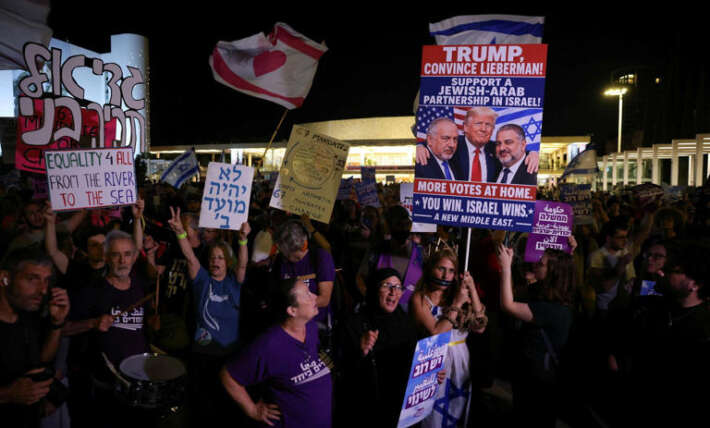
Several demonstrations were expected across the country on Saturday night in support of the formation of a Jewish-Arab government.
Leaders from the Standing Together group, a Jewish-Arab grassroots movement, said rallies would be held in Tel Aviv and Jerusalem, as well as in Beersheba, Haifa and Tayibe.
“Protesters are demanding that the bloc’s leaders recognise their victory and form a government based on Jewish-Arab partnership,” the organisers said.
“The Jewish-Arab majority that voted for change must also be reflected in the next government,” they added.
“Arab votes are worth exactly as much as Jewish votes, and Arab citizens must be full partners in shaping the country’s future”.
An Arab-Israeli coalition is not the only possibility for forming a new Israel government. A Zionist government of “national unity” is also a possibility should the centre-right parties agree to cooperate.
The biggest obstacle here is Mr Netanyahu himself, as the four parties of the Jewish opposition bloc constructed their entire campaign around removing him from power. To agree a deal with him now would be difficult in the extreme.
Mr Netanyahu also has options. He will try to convince the right wing of the opposition bloc to join him or – more likely – attempt to block the formation of a new government and force another election.
He and his Likud party have continued its campaign to delegitimise the Arab parties by portraying them as anti-Israeli radicals, even “terrorists”.
They have also alleged widespread voter fraud by the Arab parties – something the Central Elections Committee has so far rejected.
Asked for his best bet, Mr Farah said it was possible that a minority opposition bloc would be formed with informal support from the Arab parties until Mr Netanyahu’s ongoing trial for corruption ended, perhaps in the spring.
“If there will be conviction of Bibi in ’27, then they will create a national [Jewish] government,” he said.