
Humanity may reach singularity within just 4 years, trend shows
In the world of artificial intelligence, the idea of “singularity” looms large. This slippery concept describes the moment AI exceeds beyond human control and rapidly transforms society. The tricky thing about AI singularity is that it’s enormously difficult to predict where it begins and nearly impossible to know what’s beyond this technological “event horizon.” There’s no light that flips on and says, “here it is”.
This has left AI researchers, companies, and critics looking for signs of reaching singularity measured by AI progress approaching the skills and ability comparable to a human.
One such metric, defined by Translated, a Rome-based translation company, is an AI’s ability to translate speech at the accuracy of a human. Language is one of the most difficult AI challenges, but a computer that could close that gap could theoretically show signs of Artificial General Intelligence (AGI).
“That’s because language is the most natural thing for humans,” Translated CEO Marco Trombetti said at a 2022 conference in Orlando, Florida. “Nonetheless, the data Translated collected clearly shows that machines are not that far from closing the gap.”
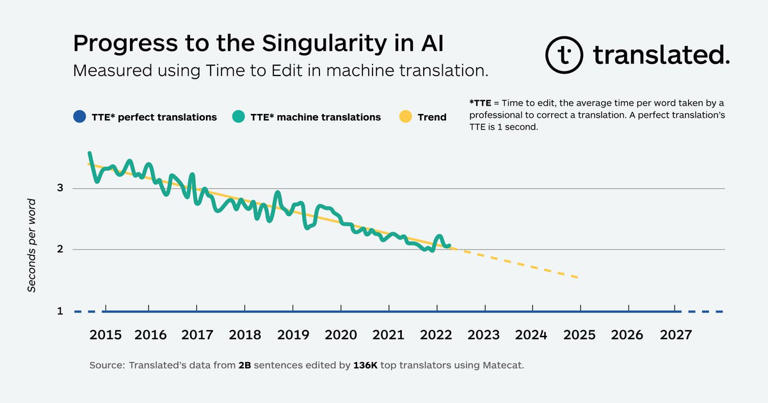
Translated tracked its AI’s performance from 2014 to 2022 using a metric called Time to Edit, or TTE. The idea is simple enough: measure how long professional human editors need to fix AI-generated translations compared with human-generated translations. Over that eight-year period, across more than 2 billion post-edits, the company’s AI showed steady improvement.According to Translated, it takes a human translator roughly one second per word to edit another human translator’s work. In 2015, professional editors needed about 3.5 seconds per word to check a machine-translated suggestion. By the time of Translated’s 2022 analysis, that number had fallen to about 2 seconds. If that curve kept moving, the company argued, machine translation could reach human-level editing effort by the end of the decade, or possibly sooner.
“The change is so small that every single day you don’t perceive it, but when you see progress … across 10 years, that is impressive,” Trombetti said on a podcast. “This is the first time ever that someone in the field of artificial intelligence did a prediction of the speed to singularity.”
That said, we’re moving further away from single-metric AGI forecasts. In March 2026, Google DeepMind published a framework arguing that AGI progress should be measured across a broad set of abilities, including perception, learning, memory, reasoning, executive function, problem solving, and social cognition.
In Nature, researchers also introduced Humanity’s Last Exam, a 2,500-question benchmark built because older tests had become too easy for frontier models. The official leaderboard cited in the update report still shows a large gap: Gemini 3 Pro at 38.3 percent, GPT-5 at 25.3 percent, o1 at 8.0 percent, and GPT-4o at 2.7 percent.
Then came ARC-AGI-3, introduced in March 2026 by the ARC Prize Foundation. That benchmark was built to test interactive, experience-based reasoning: can an agent explore, infer goals, build a world model, and keep learning over time? Humans solve 100 percent of their environments. Frontier AI systems, as of March 2026, score below 1 percent.
Finally, the 2026 International AI Safety Report, led by Yoshua Bengio with input from more than 100 experts, says general-purpose AI has continued to improve, especially in math, coding, and autonomous operation. But it also says models can look like geniuses on difficult tasks, then stumble on simpler ones. Progress could slow, continue, or accelerate.
Still, AI translation is still highly important. In the European Language Industry Survey 2026, based on 1,058 participants across 45 countries, 63 percent of independent translators reported using automated translation in some form. Only 41 percent considered freelancing sustainable, down from 64 percent in 2023. And only 23 percent of independent professionals rated machine translation or AI quality as high to very high, down from 40 percent in 2025.
For its part, Translated, in its 2026 assessment, says machine translation can handle more work but is “not sophisticated enough to remove the need for human judgment” in enterprise localization. It also forecasts “steady improvement rather than sudden transformation.” In a March 24, 2026 announcement for its Imminent report, Translated argued that AI is moving toward systems that learn through real-world interaction, while also saying that scale alone is showing limits without added capabilities such as reasoning and web interaction.
Although this is a novel approach to quantifying how close humanity is to approaching singularity, this definition of singularity runs into similar problems of identifying AGI more broadly. And while perfecting human speech is certainly a frontier in AI research, the impressive skill doesn’t necessarily make a machine intelligent (not to mention how many researchers don’t even agree on what “intelligence” is).
Whether these hyper-accurate translators are harbingers of our technological doom or not, that doesn’t lessen Translated’s AI accomplishment. An AI capable of translating speech as well as a human could very well change society, even if the true “technological singularity” remains ever elusive.